

This page is a simulation made for education. The coin, the 15% a year and every chart here come from a simple model. They are not based on any real stock or index, they are not a forecast, and they are not a promise of any return. Real markets can fall further and stay down longer than this model does, and a real business can get worse.
Nothing on this page is a recommendation, an offer or an invitation to buy, sell or hold any security. Investing in stocks carries high risk. The value of an investment can fall and you can lose capital. Past performance does not indicate future results. Do your own analysis before making a decision.
We have heard this old adage so, so many times. But why do so many people insist on timing the market?
Perhaps because in investment, we have one money and one timeline.
If we make an investment error, we cannot go back to the past and rectify that investment. So instead of committing the investment mistake, we’d rather make an intelligent guess so that we have the best chance to avoid making it in the first place.
And when we pull out from your investments, we feel like we are preventing ourselves from committing these investment mistakes.
Well in today’s article, we will use no math formulas, no proofs, no theory. We’d like to invite you to play a couple of games. Unfortunately (or fortunately) GTA 6 is not one of them. But I think the game that I am asking you to play is fun too 😉
One game is asking you to flip a coin. Another is asking you to beat the market.
You ready? Great and good luck!
Game 1: Coin flipping
Imagine you a have a business, listed in a stock exchange. The business grows steadily and every trading day, the share price either goes up by 1% (heads). Or goes down by 1% (tails).
Now you buy Rp 100juta of that stock. Now, to check how the company price goes on from here, you can flip it and see.
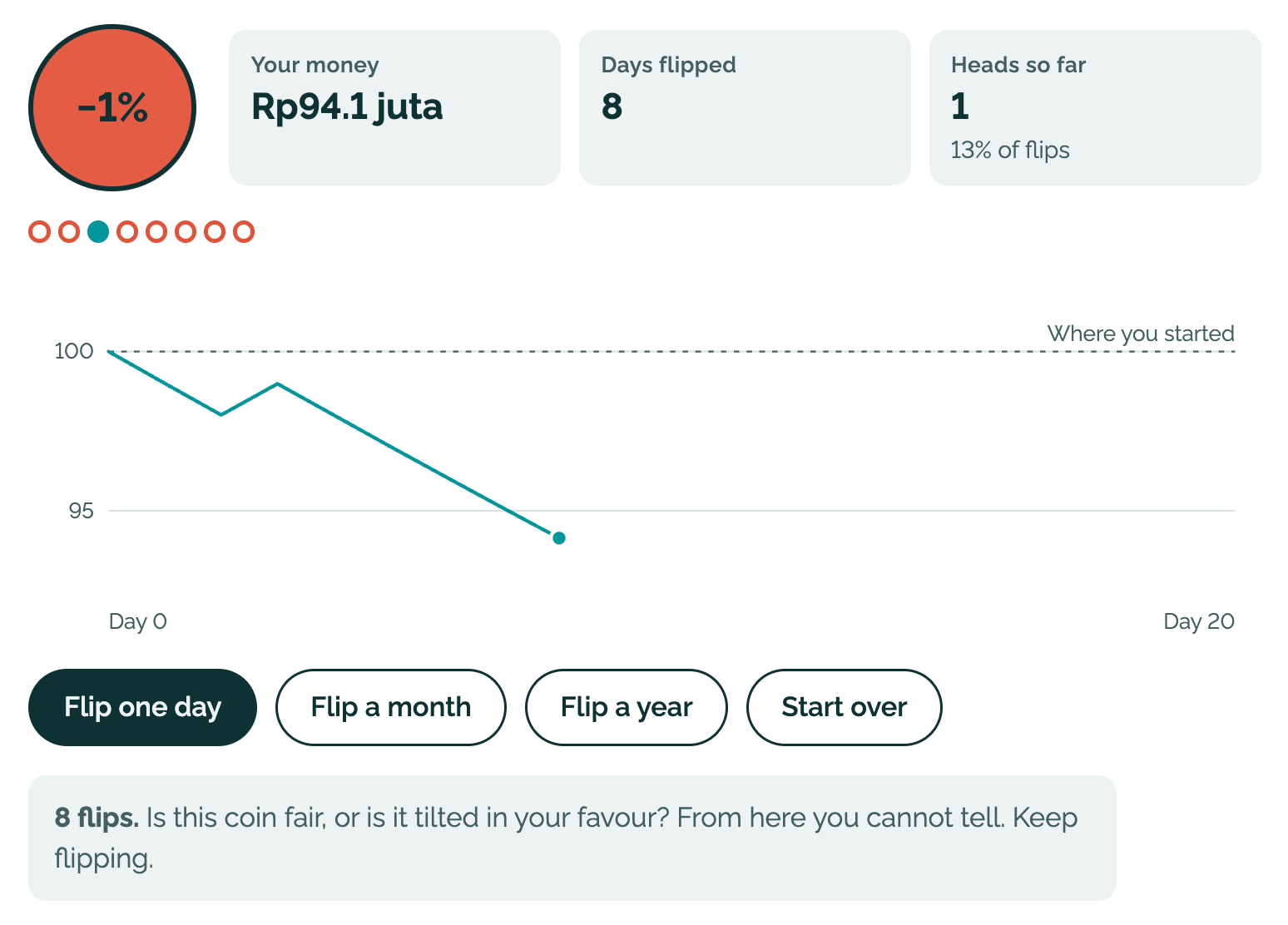
Appetizer is done, and we have a secret. On a given day, the chance of a stock handing head is 53%. And tails is 47%.
It seems like a small edge on one day? Yes the daily edge feels small because the chance of your stock going up and going down is roughly equal. But statistically, this very same edge gives you a 93% chance of having a good year with about 15% per year.
What we want to illustrate is a great year is in reality built out of days that are barely better than a coin toss.
So on any single day you likely cannot feel the edge. It would feel like a coin flip.
Game 2: Now try to beat it by timing
From time to time, we like to believe that we can time the market. That the market is not random and it conforms to our intelligent guesses.
Especially I think that most of us believe the long term is just a pile of short terms. So naturally, the strategy is to win the short terms. When you do that, you win the long term. In essence, sit out the bad days, come back for the good ones.
It is a very natural idea and I do not blame anyone for having it. So try it.
Below are 3 years of the same kind of coin. You have one button. Sell when you think things are about to get worse. Buy back when you think it is safe. While you are out, your money sits in cash and does nothing.
Your only job is to finish with more than the person who bought once and never touched it.
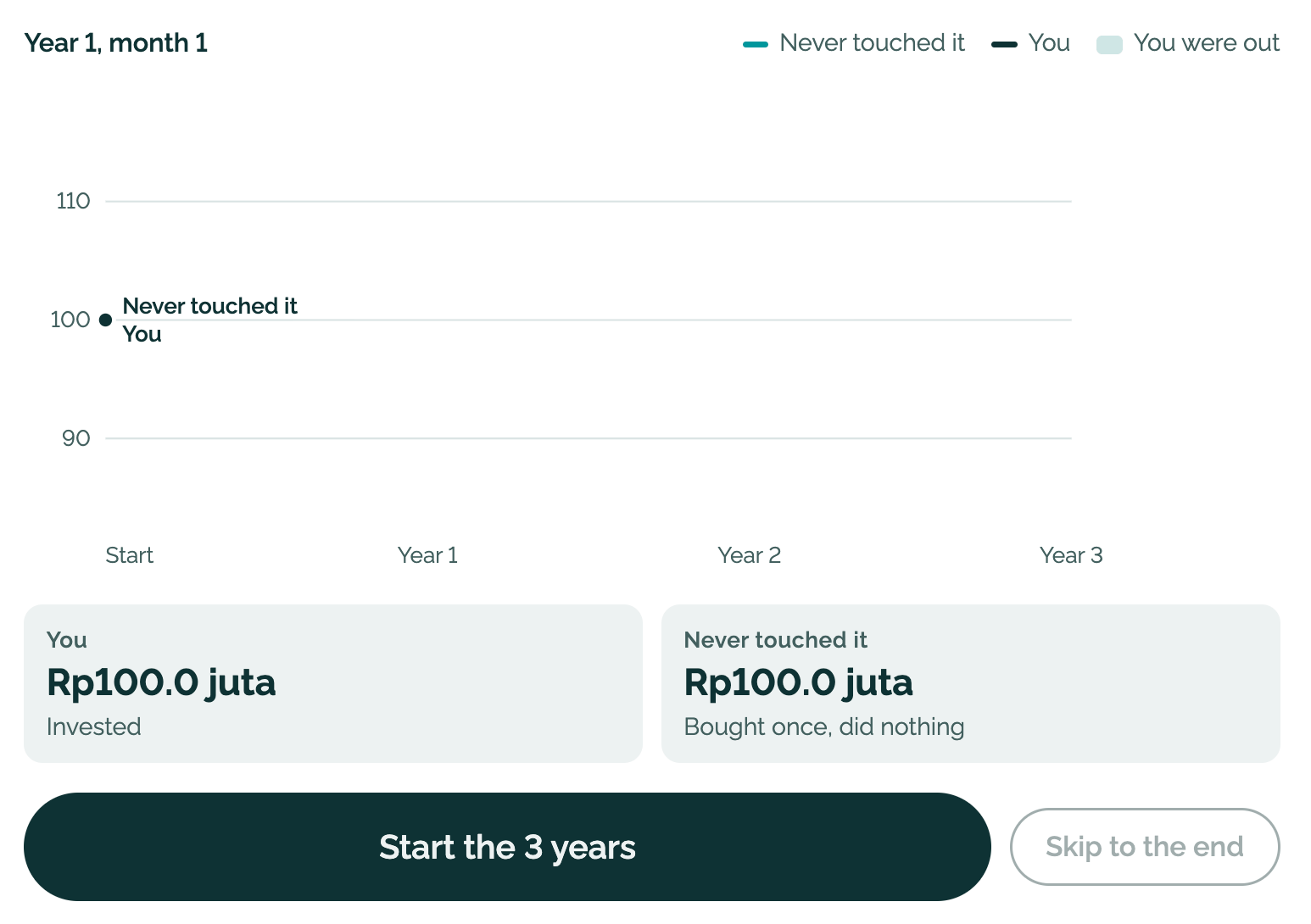
It is a pretty hard game isn’t it?
Here is what I hid from you. This coin has a memory.
The business underneath keeps growing at its own steady pace. The price wanders around it. When the price has fallen well below the business, the coin tilts in your favour, to about 55 heads in 100. When the price has run far ahead, the coin tilts against you.
Does this sound familiar? The days that feel safest to buy actually have the worst of odds. The days that where everybody is screaming “get out” have the best of odds.
Now you might be thinking. Hey that’s not fair! It is a simulation of a bull market. In IHSG, we are in a bear market Toby!
Game 3: Beat the bear market
Of course we have to wait and see in a bear market. Which is fair. So here is another game, in a bear market.
A year ago the market started falling, and it dragged your stock down with it. What you see below is what is left. The business underneath has not changed. It still grows at its steady pace. Only the price was influenced by the market.
Now even though it does not feel like it, but bear market will eventually end. It is just that nobody knows when. It could be tomorrow or it could be 18 months from now. While the bear market lasts, the coin lands heads less often.
Lets go same button. Sell and wait until things look clear. Buy back when you feel it is safe.
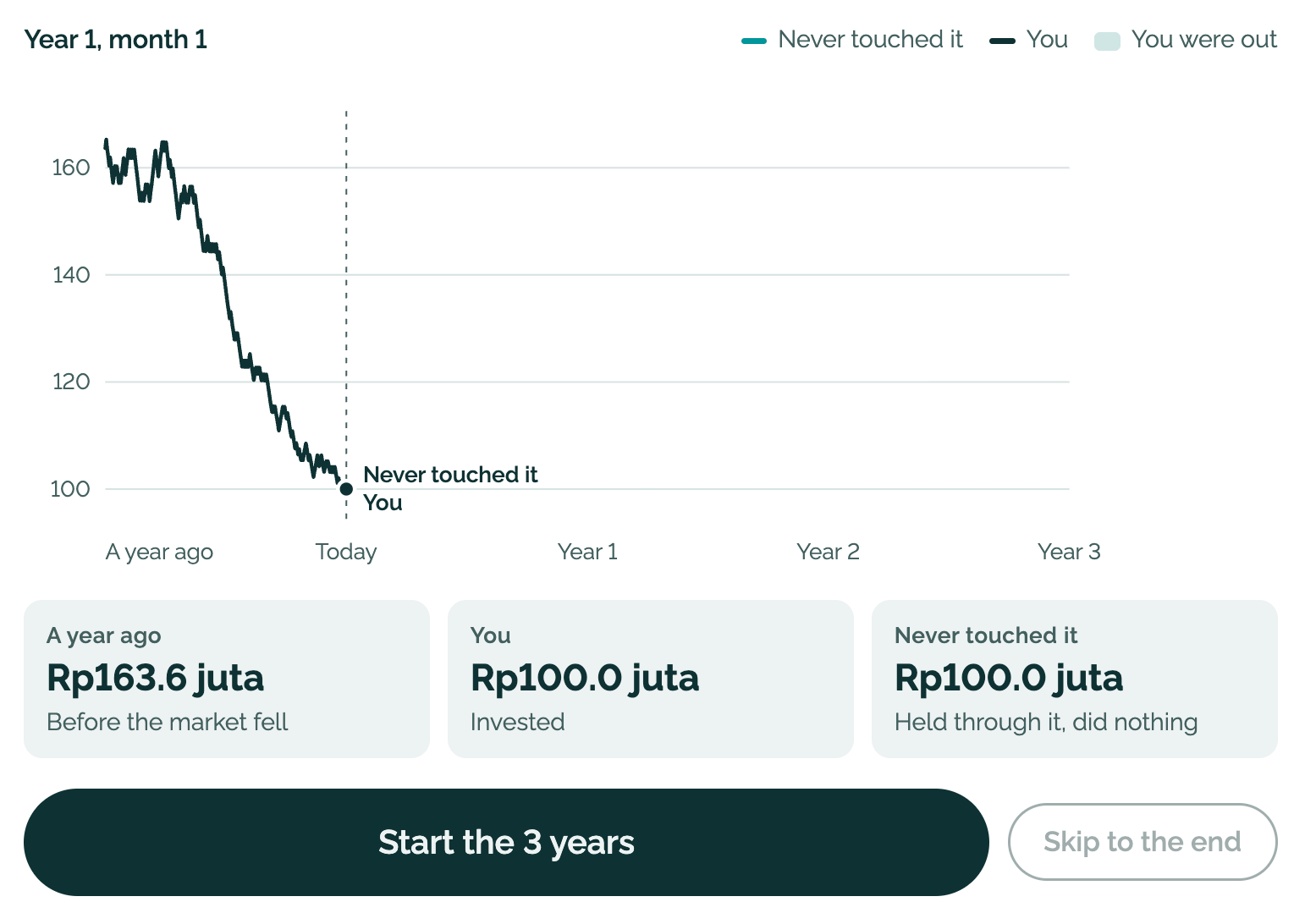
I invite you to look at the odds strip in the illustration of the game. The darkest part, which is the best odds of the whole game starts the exact day the bear market ended. But the price was still on the floor on that day and it is not clear to anyone of us that the bear market has ended.
So that is the trouble with wait and see. By the time it looks safe, the price has already moved. To beat the person who did nothing, you had to buy back while it still felt terrible. And you are essentially making two bets:
First bet when the market is bad, it will continue to be bad
Second bet when you re-enter, you have not missed the best odds of gaining and it will continue be good.
One assumption does a lot of work here. The bear market moved the price. It did not touch the business. If the business itself is broken, that is a different game.
One market is one story. Here are 2,000.
Now you might be thinking. I am just a sample. I am pretty sure if I formulate smart algorithm that is back tested against historical price action, I can time the market well. Well in all honesty you could. Jim Simons did it. I am just trying to say that it is not easy to do so.
You could see each thin line below is one possible future for the same Rp100 juta, left alone. In the illustration, you could drag the slider and see 2,000 different types of future from the same Rp 100juta.
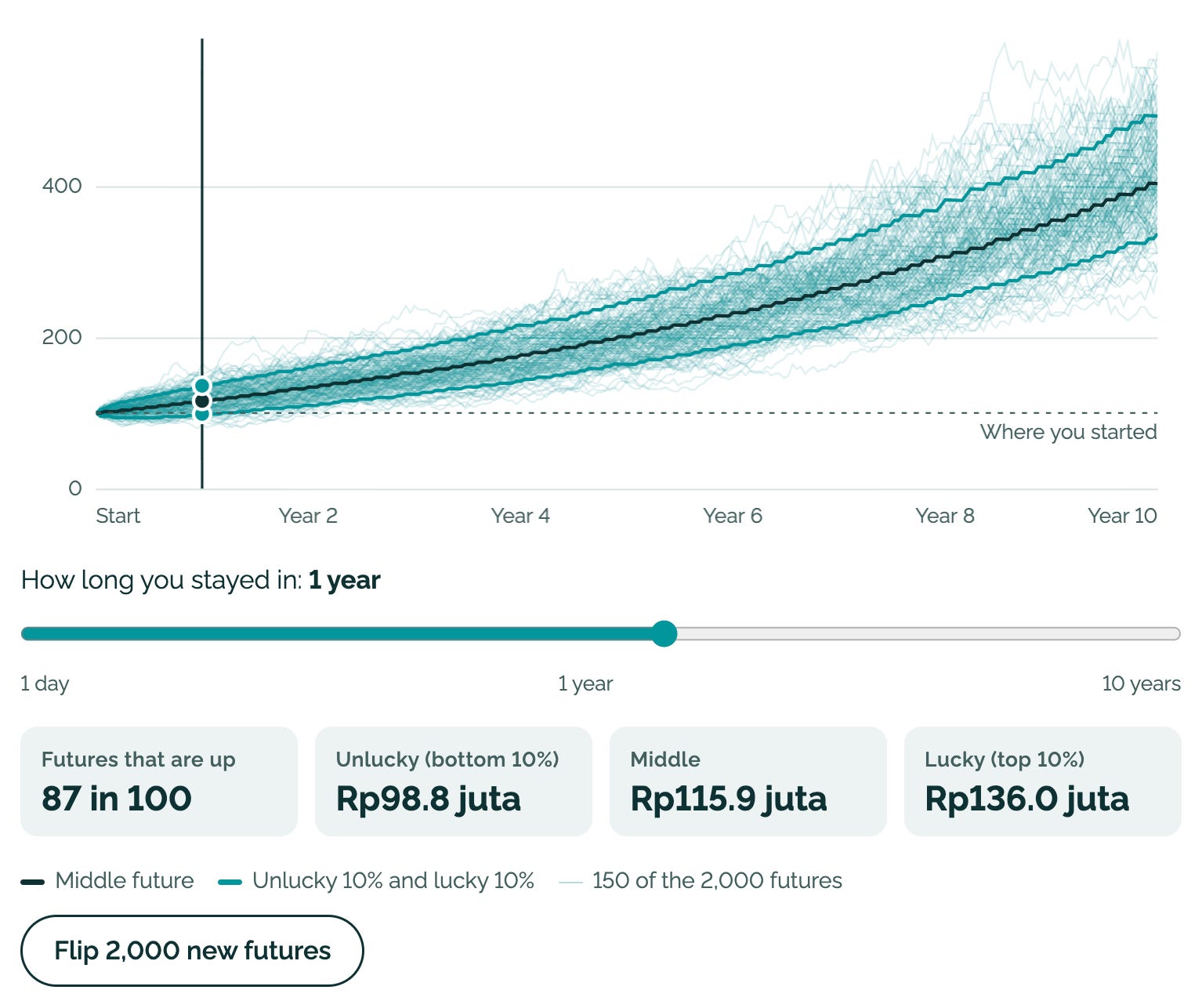
What I hope to illustrate with this is that the future is a range of probabilities. You only get to live in one of this range as time passes. We’d want to be in a space whereby even when we get unlucky, we will likely still be fine and not be thrown out of the game.
So what is the point of playing these games?
Well, the point is not just to illustrate time in the market beats timing the market. But really to have our sharp readers an experience of the cost of looking the price too often.
It describes real life much better than any game above.
The coin does not only move your money. It moves you too.
Psychologists find that a loss hurts about twice as much as the same gain feels good. So let us keep score. Plus 1 for every time you look and you are up since the last look. Minus 2 for every time you are down.
Here is one 10-year stretch of the coin, looked at three ways.
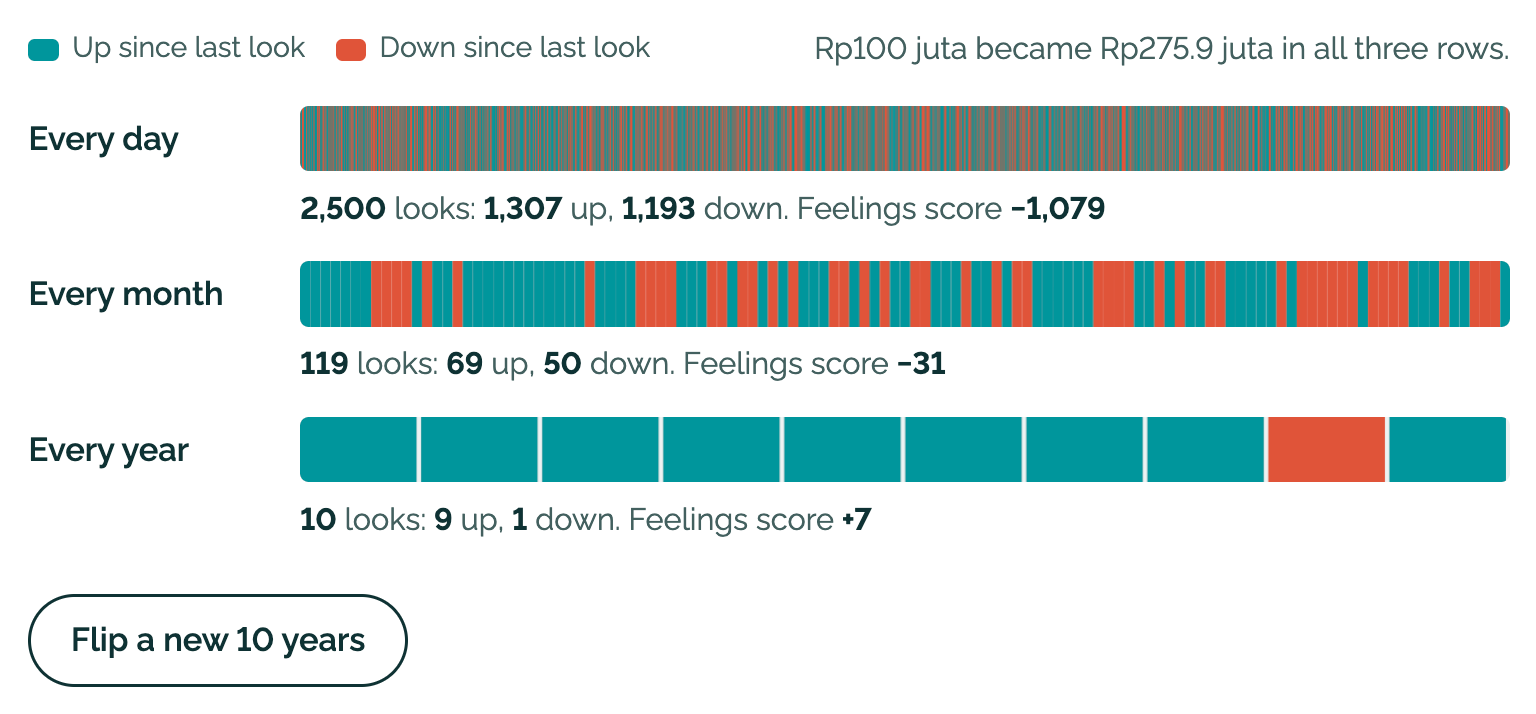
Same money. Same 10 years. Same ending. The person who checked every day paid for it with more than a thousand bad moments. The person who checked once a year had almost none.
You are worse off checking the price every day. The flips play with your feelings, and your feelings have nothing to do with the quality of what you own.
Lessons about uncertainty
Here’s the tricky part and the important lesson. You can’t, Budi can’t, will the coin to land heads. If we can, we will be the richest persons on earth. Also, you can’t, Budi can’t, know tomorrow’s coin flip. The two levers we truly hold are:
the coin that we are holding (is it a good growing business bought at a price under its intrinsic value)
how often do we check the price
And just so that we are clear, looking at the price is not the same as monitoring the business (the coin). And not looking at the price is not the same as not monitoring the business. You still need to monitor the business. In the real world, the coin (business) might change for the worse when new information is unveiled.
The odds of landing a heads could turn into 47 instead of 53. While we still believe that the odds is at 53, we want to keep holding the coin and avoid checking its price.
Who watches the coin?
Let’s say that I delegate the job to watch the coin to a third party. Let’s say to Budi Ryan, who is an OJK-licensed investment advisor.
What do I do then? Well, I have to vet his work to evaluate and check if his work makes sense.
Then I would work in other lines of work, ideally where I am really good at, so that I can have more wealth.
Think for a moment that you are Cristiano Ronaldo. You are really good at football and you have 24 hours.
If you are Cristiano, at any given hour in the day, what should you be doing?
The answer is obvious: practising or playing football. Free kicks, touches, finishes, etc.
If he spends that hour to look at the average selling price of a packet of Indomie to estimate the core earnings of the holding, that does not seem like the best use of his time 🙂
So it is clear when you are Cristiano Ronaldo.
Think of yourself as a version of Cristiano with an expertise. Be it an engineer in oil and gas. Or a family lawyer. Or a psychologist. Your active hour is best spent doing the things that generate the most income for you.
The more people realise that they should be doing what they are really good at (provided it is adding value to others), I believe the better off our society will be.
Cheers folks!
Recompound is a platform operated by PT Solusi Brilian Digital Nusantara. PT Solusi Brilian Digital Nusantara is not a licensed investment advisor. Its role is limited to operational support, and it is in the process of applying to OJK for registration as a Penasihat Investasi.
Investment advice is given by Budi Ryan, an individual Penasihat Investasi licensed and supervised by Otoritas Jasa Keuangan (Keputusan Dewan Komisioner OJK Nomor Kep-1/PM.021/PI/2025). Every Recompound client is a client of Budi Ryan in that capacity. Recompound does not hold or receive client funds, and it does not place orders. Each client’s funds stay in a securities account at the client’s own broker, in the client’s own name. The service is not suitable for every investor.