


Disclaimer: This post is for informational and educational purposes only. It is not financial, investment, or legal advice, and it is not a recommendation to buy, sell, or hold any security or to act on any market view — including anything about Indonesian equities, the IHSG, or the rupiah.
References to Bloomberg, S&P Dow Jones Indices, and other organisations are commentary on publicly available reporting, not claims about their intentions. Quotes and ideas from Simon Evan-Cook and Howard Marks are cited as inspiration; any misreading of their views is mine.
A few weeks ago I caught myself doing something embarrassing.
I was reading yet another Bloomberg headline about Indonesia. This one was about S&P Dow Jones threatening to cut us to frontier-market status. And I thought to myself, I’ve read so much of this negativity that it must be the case: Bloomberg has an agenda against Indonesia.
Think about it. The viral “Sell Indonesia” piece? Bloomberg. The sceptical Danantara interview with Pandu Sjahrir? Bloomberg. The frontier-market warning? Bloomberg. Every negative story about this country that reached my screen in the past month seemed to come from the same source.
So I did what any reasonable person with a suspicion does. I checked who owns them haha.
And I was wrong. Not slightly wrong. But embarrassingly wrong.
I was wrong in a way that teaches me something about my brain works, which is the kind of wrong worth writing about.
The facts first
Bloomberg LP is a private company, roughly 88% owned by Michael Bloomberg. Bloomberg makes money from overwhelmingly from Bloomberg Terminal subscriptions that is sold to traders and fund managers.
And when I actually looked at their Indonesia coverage in full, I also see the positive stories being covered.
The rebound coverage when the rupiah posted its biggest gain in over a year.
The pushback from Pak Purbaya on the “Sell Indonesia” narrative got a write-up.
Honestly when I read the headlines above, it felt kinda weird. Because I was drowning in so much negativity that even a slightly positive headline would immediately prompt me to think rebuttals that were besides the point:
but RKAB (quotas for miners)?
but MBG (free nutritious meals)?
but Kopdes (co-operatives funds channeled from state owned enterprises)?
but Indonesia being non-investment grade?
but the speeches made by the President?
And it is a strange feeling of veering off into non-related topics just to assure my belief that Indonesia is a mess. I am basically desperate to look for write ups that match my beliefs. Until I realised that it was really just the IHSG price chart that causes me to be so negative.
Intellectual honesty is also proven to be a hard thing because…
I have to come to terms that there is no evidence that the negativity was Bloomberg’s agenda.
Bullshit laundering
A few weeks ago I read a Substack Article by Simon Evan-Cook called “Financial News and the Art of Bullshit Laundering,”
Simon describes his early job writing a daily market round-up. The “what happened” part was easy — just numbers. The “why it happened” part was a nightmare, because most days nobody knows why. So he’d browse the news for anything that might explain the move. Market up, inflation down? Great, that’s the story.
Market up despite bad news? Deploy the trusty “despite” manoeuvre and hope nobody asks questions.
IHSG is down -1.19% today despite strong corporate earnings.
IHSG is up (+2.31%) today despite loosening fiscal discipline.
The despite there sounds legit doesn’t it? Despite it not explaining anything.
His conclusion is brutal:
A journalist calls an expert, the expert doesn’t know either but makes something up so as not to sound clueless, the guess gets printed, and then hundreds of smaller publications repeat the guess as established fact. Dirty nonsense goes in that somehow produces clean facts as output. Bullshit laundering, what a name.
Of course there are caveats because I believe that Simon has no intention of offending people who work in news agency. At the end of the day, we are only humans doing our jobs.
So I tested it
Here’s a hypothesis that I attempted to check:
If news drove prices, negative coverage should spike before the market falls.
If narrative follows price, negative coverage should spike after.
I pulled two datasets for the first half of 2026.
Daily average tone of global news coverage mentioning Indonesia’s market and economy (from GDELT, which scores the sentiment of millions of articles).
Daily closes of the IHSG.
Then I asked one question: does news tone correlate more with what the market just did, or with what it’s about to do?
And the result??
Correlation between news tone and the past five days of returns: +0.30.
Correlation between news tone and the next five days: −0.07.
Now, +0.30 is a weak correlation, and with six months of data neither number is statistically significant on its own. But the hypothesis wasn’t “news predicts the past strongly” — it was “news tracks the past more than the future.”
That asymmetry holds up: when I bootstrapped the difference between the two correlations, 99% of resamples showed the backward correlation beating the forward one. The news isn’t necessarily a strong mirror of the past. But it is a mirror of the past far more than it is a window into the future.
And the story tells this data clearly: “Sell Indonesia” went viral on June 5th. The market bottomed three days later. If you sold when the headline told you to, you sold within 5% of the low — and watched the index climb 17% off the bottom over the following week.
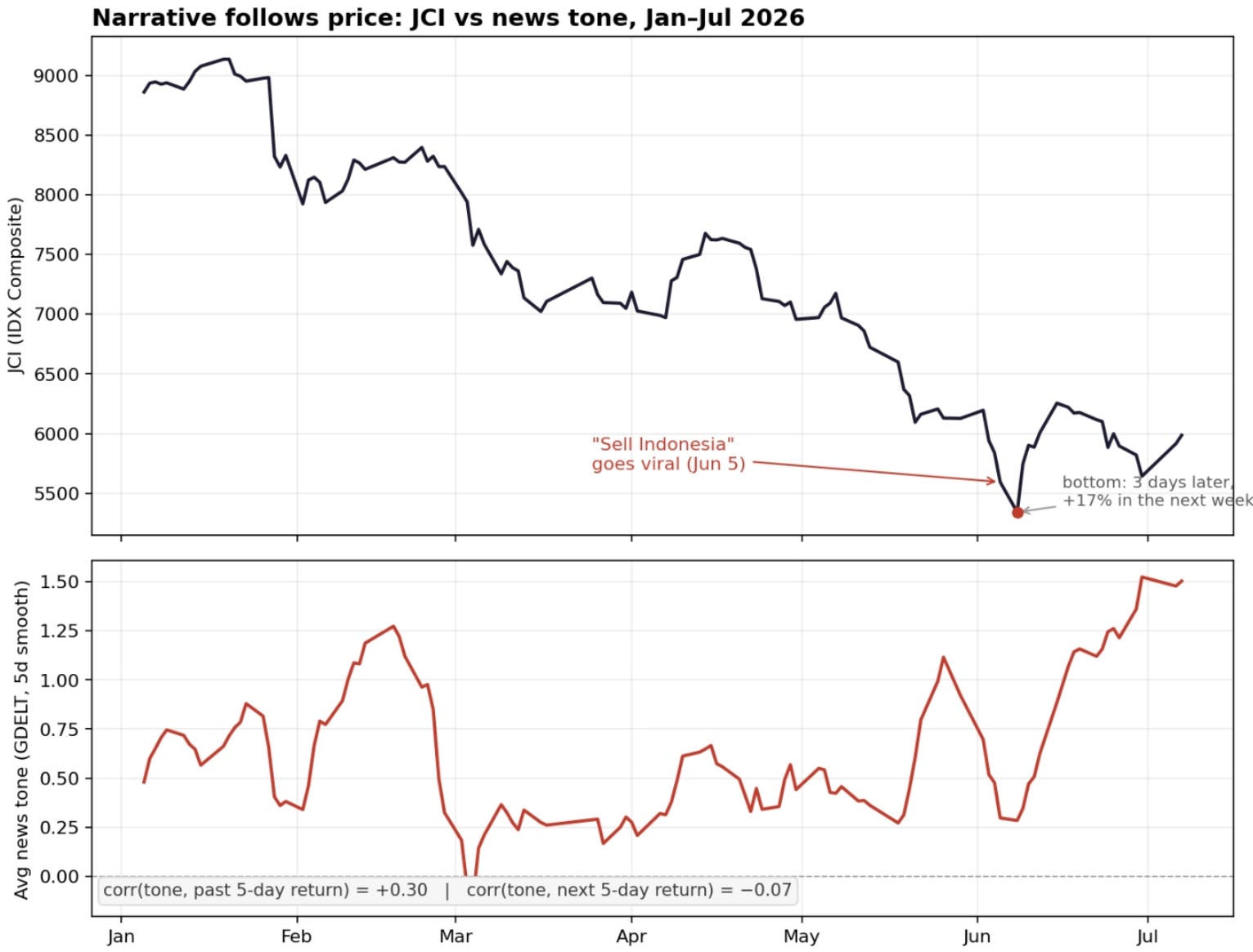
The moment the negative narrative was loudest was, almost precisely, the moment selling was most wrong.
(Honest disclaimer to be made: this is one market, six months, and a sentiment proxy — not a peer-reviewed study. If I ran this on ten markets over twenty years, the numbers would differ. But the direction matches what other researchers have found in bigger datasets, and more importantly, it matched what happened to me, live, in June.)
The unintended by-product
Here’s the part I find unsettling.
Why do we share negative news after a crash? I don’t think it’s malice, and it’s clearly not analysis. I think we naturally crave for an explanation for what we’re observing. For example, our portfolio is down 30% and our brain demands a story.
So if a speaker appears in a podcast saying “Prices went down and I don’t fully know why”, that feels like just another normal person talking.
But when an analyst with suits shows up in your feed saying “Governance concerns is driving foreign investors out from the market”, that feels like knowledge.
But sharing the explanation has a by-product nobody intends: it constructs a reality. A thousand people forwarding “Sell Indonesia” aren’t explaining the drop to themselves, they’re building pessimism that another experiences as evidence that the country is messed up.
That’s really how I ended up accusing a newsroom of running an agenda. Nobody at Bloomberg targeted me. The algorithm simply learns that fear travels further than optimism. “Sell Indonesia Sweeps Trading Desks” gets forwarded to every WhatsApp group in Jakarta. “Nomura Upgrades Indonesia Stocks” gets read by approximately nine people, and I’d bet most of them were at Nomura.
What to do with this
I propose one question.
The question, for every market article that reaches you after a big move:
Would this article exist if the price hadn’t moved?
If the answer is no, you are not reading information. You are reading a commentary.
Narrative follows price and you’ve heard it before. The trick is remembering this in the moment every headline on your screen is begging you to believe the opposite.
If you find this article helpful, go ahead and share it 🙂