

Disclaimer: this post is for educational purposes only. It does not constitute investment advice. It is the author’s opinion regarding new export policy that is recently announced and it attempts to consult recent data that is not usually covered otherwise. We hope that our readers could learn a thing or two from the data that we are seeing and we continue to welcome level headed and constructive discussions. Lastly, if you are a client, check your investment thesis in the client dashboard. This write up has been incorporated there also.
This week, per this post is published, President Prabowo announced a PP (Government Regulation) mandating that all exports of palm oil, coal, and ferro alloys must be routed through a designated BUMN (”single-gate” system).
There are very differing opinions regarding this ambitious new export policy amongst pundits on social media. So we’d like to offer our thoughts being investors in the Indonesian capital market ourselves.
First things first
We refrain from making sensationalist comparisons between this current policy vs other failed government policies in the past like BPPC where clove farmers had to sell cloves at a fixed price to a single government entity during the Soeharto era. Just like how we refrain from rushing to extrapolate that a weakening Rupiah necessarily means that a Rupiah is going to fall in the fashion we see in 1998.
We believe that conditions of the present economy, technology, regulation, information and even governments are not the same. Therefore, just because there had been a precedent, it does not mean that it is definitely likely that we will see a repeat of history. For example, it goes without saying that just because we saw COVID in 2020, does not necessarily mean that Hantavirus will cause economies around the globe to see lockdowns again. It might go on a lockdown for real (I am not a public health expert here), but it does not have to be.
And of course this is not an investment recommendation or financial advice. We are first to disclose that we are not a macroeconomics policy expert too.
Why choose to not make sensationalist claims?
Well to be frank because we are not a media company. We don’t get anything from making sensationalist claims. If you like our Substack post or put a comment, we don’t get paid. And getting famous on social media is not our business model. So there’s almost 0 point for us to make such sensationalist alarmist/euphoric claims.
What helps is for us to analyse and reflect on the data that allows us to make an informed decision as a long term investor. Knowing fully our limitations about what the outcome will be in the future.
Don’t get me wrong, it is possible that the policy could be a huge failure. But I stress that it is not wise to dismiss the likelihood of it being successful as well. And we ought to look at both the negatives and the positives as it is so as to stay well informed of what is going on.
Now with that out of the way, let’s get into it.
Key Pointers and Questions
What does the policy actually do?
All exports of three commodities (palm oil US$23B, coal US$26B, ferro alloys US$16B — total US$65B/year, ~23% of national exports) must go through a designated state owned enterprise (BUMN). Implementation is phased: Phase I (June–August 2026) is documentation only — transactions still go directly between company and buyer, while Danantara Sumber Daya Alam (DSI) validates volume, pricing, and delivery. No margin taken. Phase II (September 2026+) is full implementation where DSI takes over all contracts, shipments, and payments. This is the phase the market fears — and the one that may involve a margin.
How massive is the underinvoicing problem?
Based on UN COMTRADE data, cumulative export underinvoicing from Indonesia over the past 34 years (1991–2024) totals US$908 billion (~Rp 15,400 trillion).
For reference, BCA’s profits is about Rp 50 trillion per year. So that 34 years of under invoicing is about 300 years of BCA’s net profits 🤯. Indonesia hasn’t even been around that long. We are in the less than 100 years club (1945 independence).
This is the gap between what Indonesia reported as exports versus what trade partners reported as imports. This isn’t an estimate — its recorded international trade data. From this, I think that the government’s motivation is clear: make more money (increase state revenue) by plugging a leak that is worth hundreds of billions of dollars that has been flowing offshore (primarily to Singapore).
If underinvoicing is successfully curtailed, more USD stays in Indonesia — which is also a positive for the rupiah.
The mechanism is textbook transfer pricing: an Indonesian producer sells to a Singapore affiliate at $100 (below benchmark), the affiliate re-sells to the real buyer at $150 (market price), and the $50 margin stays in Singapore. Finance Minister Purbaya himself stated that he randomly checked 10 CPO companies and selected 3 ships at random — all showed prices to Singapore at half the price to the US. That’s how widespread the practice is.
Who is being targeted?
Not “clean” mining companies — the target is companies that have been invoicing below benchmark. A documented example: Global Witness reported that Adaro used Coaltrade Services International (Singapore) to sell coal below benchmark prices from 2009–2017, avoiding an estimated ~US$125 million in Indonesian taxes. Profits were booked in Singapore (tax rate ~10%) instead of Indonesia (~50%). This policy forces all invoices to be verified against published benchmarks by the BUMN. If a company has always been invoicing at benchmark, the impact is minimal — it’s just a compliance layer.
Who benefits from the practice of under invoicing?
It follows that the ultimate beneficial owners (UBO) who owns the trading companies will benefit. The spread between the sales to the trading company and the sales to the importer gets to stay in the private trading companies (likely owned by majority shareholders).
Are there overseas precedents?
There are many, among others:
China: Operates a “designated exporter whitelist” for strategic minerals (tungsten, antimony, rare earths). Only government-approved companies can export. Effective for revenue control, but China’s rare earth export quota was struck down by the WTO in 2014 after Japan/US/EU challenged it.
Malaysia (PETRONAS): Full state control of oil & gas since 1974. Private companies (Shell, Exxon) still operated profitably via Production Sharing Contracts, but long-term investment declined ~40% from peak.
Chile (CODELCO): Copper was nationalized in 1971, but later opened to a dual-track model — state-owned CODELCO alongside private miners (BHP, Freeport). Private companies remained profitable, just paying higher royalties (up to 46.5%).
Zambia: The cautionary tale — full nationalization of copper in 1969 ended in disaster. Copper prices fell, the state entity couldn’t respond quickly, mining’s GDP contribution collapsed from 33% to 7.7%. Zambia eventually re-privatized.
Are there more recent local precedents?
PT Timah (TINS) — the most directly relevant domestic precedent: PT Timah formed an internal task force to crack down on illegal tin miners in Bangka Belitung who had been paying zero royalties and zero taxes. The result? Q1 2026 net profit surged
+1,184% YoY
(from Rp 117B to Rp 1.5T), revenue +160%, GPM expanded from 18% to 39%. When the playing field was levelled and illegal competitors were removed, the legitimate company’s profitability transformed overnight. This is the same mechanism as the export rules — when underinvoicing is eliminated, clean companies actually benefit.
There’s another one, Indonesia’s own Berdikari (single-gate importer for SBM / soybean meal): caused short-term price spikes during the transition period, but poultry and feed company GPMs actually improved once stabilized. Although we don’t see this positively (more neutral) because the GPM could also be pushed by increasing poultry prices and volume because of free meal for children policy.
Why is market dominance the key to this policy working?
The logic is straightforward: if buyers (foreigners) have sufficient alternative suppliers, they switch — the added bureaucracy from the BUMN gate becomes a reason to buy from another country. But if the country is dominant and buyers don’t have adequate substitutes, they have to comply.
Indonesia has this leverage in all three targeted commodities: — Thermal coal: #1 exporter globally, 40%+ of global seaborne supply — Palm oil: #1 exporter globally, 55%+ of global supply — Ferronickel: #1 exporter globally
India, China, Bangladesh, and Vietnam cannot replace their entire Indonesian coal supply with Australian or South African alternatives overnight — the volume gap is too large. So as long as the BUMN fee and bureaucratic friction remain reasonable, buyers will continue purchasing from Indonesia. This is fundamentally different from Zambia’s failure — Zambia held only ~7% of global copper supply, so buyers immediately shifted to Chile and Congo when ZCCM’s bureaucracy became burdensome.
Who is the designated BUMN intermediary?
While this can change from time to time, but the one that is identified now is PT Danantara Sumberdaya Indonesia (DSI) — a brand new entity incorporated on 18–19 May 2026 (one day before the announcement), under the Danantara sovereign wealth fund.
Luke Thomas Mahony has been appointed as Direktur Utama (CEO) of DSI. He’s an Australian national based in Jakarta, previously SEVP Business Performance & Optimization at Danantara Indonesia since September 2025. Before that, he was Chief Strategy and Technical Officer at PT Vale Indonesia (INCO) from July 2024 to September 2025, and held senior roles at Vale Base Metals (CTO, then Director-Technical). His earlier career includes stints at BHP Billiton and Xstrata Coal.
The bull case on Mahony: he’s a technical mining person with hands-on operational experience across multiple countries. He understands how multinational mining companies structure their export sales — which is exactly what DSI needs to police. Being a foreigner may also make him more neutral from domestic political pressure.
The skeptic’s case: you’re appointing a former Vale executive to oversee an entity that will audit companies like Vale. Vale Indonesia (INCO) sells ~80% of its output to Vale Canada Limited — this is exactly the kind of related-party export structure that DSI is supposed to scrutinize. There’s probably a potential conflict of interest.
To us, the appointment of a legitimate mining professional rather than a bureaucrat is a net positive signal for execution quality. It partially de-risks the “Zambia scenario” where incompetent state management destroys the industry. But the conflict of interest angle is worth monitoring — especially how DSI handles ferro alloy exports from IMIP/IWIP smelters and nickel shipments.
How will DSI make money?
Danantara CEO Rosan Perkasa Roeslani has confirmed that DSI will operate as a trading company — taking a margin from every export transaction. This is not a flat administrative fee; DSI will function as a commercial intermediary that buys from producers and sells to international buyers, capturing the spread. The stated purpose: to eliminate both
underinvoicing
(selling below benchmark to affiliates offshore) and
overpricing
(inflating import costs to shift profits out).
Where do we see the risk?
How could this hurt miner’s profitability? There are two main risks that we are thinking through:
Risk 1 — DSI’s spread margin is too large. Rosan has confirmed DSI will take a margin — so this is no longer hypothetical. If DSI’s spread exceeds whatever average selling price (ASP) improvement comes from eliminating underinvoicing, the net effect to the exporter is negative. Concrete example: if a miner’s operating profit margin is ~20% and DSI charges a 4% fee on revenue, that’s a ~20% drawdown in operating profit. That’s not trivial.
Risk 2 — DSI becomes a monopsonist and sets buy prices too low. As the sole intermediary, DSI has the power to dictate purchase prices from producers. Exporters lose bargaining power, and profit gets squeezed from the revenue side. This is a bad precedent for foreign investment too — the UNTR’s Martabe gold mine saga shows how this can backfire.
Two scenarios — Scenario 1 (Base case): Nothing changes materially. DSI takes a minimal fee during Phase I, Phase II implementation is gradual, and earnings are broadly unaffected. This is more likely for Phase I (June–August) which is just documentation. — Scenario 2 (Downside): DSI charges a meaningful margin. At a 4% fee on a 20% OPM business, you’re looking at ~20% profit drawdown. This needs to be watched closely once Phase II terms are announced.
The positive case — what if this actually works?
Finance Minister Purbaya’s view during his recent Konferensi Pers is bold: “Profitability must double. It’s time to buy.” Here’s the logic:
Win-win if executed well. Underinvoicing is eliminated → ASP rises to true benchmark levels → the government collects more tax and royalties, and minority shareholders get the earnings that were previously leaking to Singapore trading affiliates. More USD stays onshore in Indonesia, supporting the rupiah.
Single seller = higher negotiated prices. If DSI successfully consolidates Indonesia’s negotiating position as the world’s #1 exporter of these commodities, it could push global prices higher. Companies with good GCG (corporate governance) benefit directly — they weren’t underinvoicing anyway, so the ASP uplift is pure upside.
Non-GCG companies are definitely hurt — and that’s a good thing for the market. Companies that were playing the underinvoicing game lose their edge. The playing field levels. This is structurally positive for investors who pick well-governed companies (which is exactly what we do).
On balance, we believe the positive outcome outweighs the negative
But we are still cautious because there is execution risk. Although Danantara’s recent success in cleaning up PT Timah (TINS) delivered a +1,184% YoY net profit surge is a data point, more successes that lead to better profitability would prove crucial.
Insider signal: does the owner already know before the information was released?
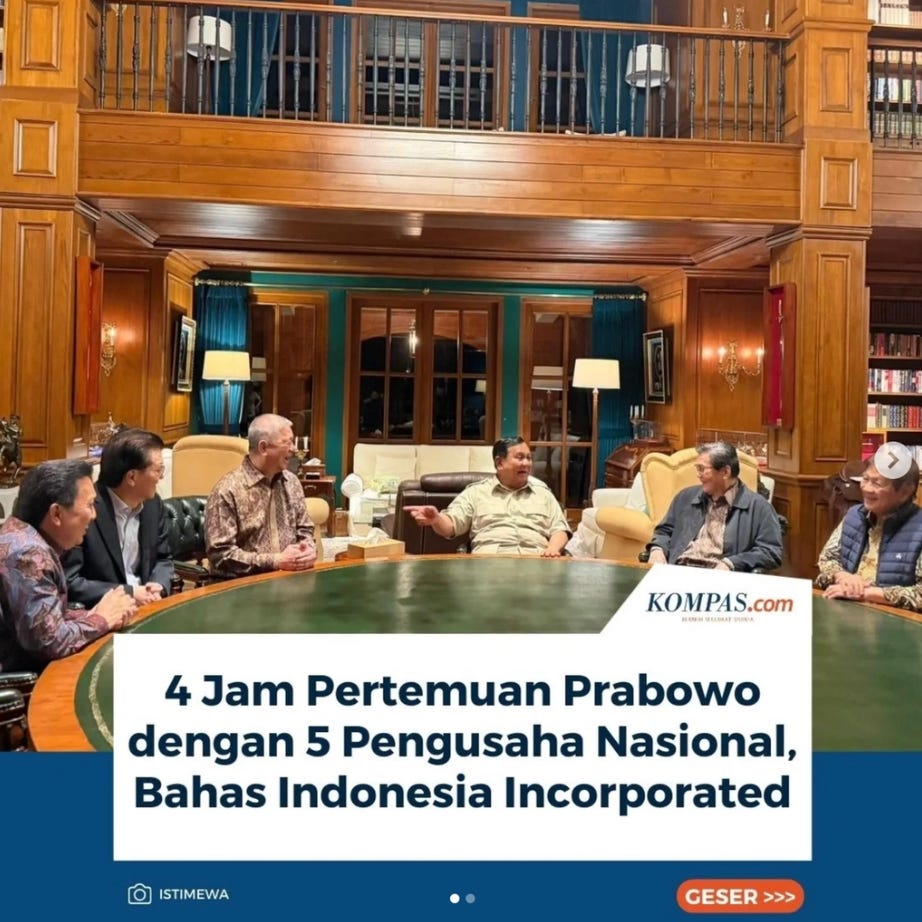
Well we don’t know for sure and I sure wish I could give Mr Anthony Salim a quick call, but a couple months back, our president Prabowo did have a meeting with the conglomerates who own large mining sites. It wouldn’t be far fetched to assume that the bosses have also be briefed regarding the government initiative. Especially the topic of discussion as reported by Kompas: “Indonesia Incorporated”.
And another data point was around this time — when the market was fearful — TP Rachmat increased his personal stake in ADRO from 3.02% to 3.46%. That’s +125.4 million shares added.
Think about that. We acknowledge that this is pure speculation, but the conglomerate owners (TP Rachmat, Boy Thohir, Anthony Salim) likely had early visibility on this policy direction before the public announcement. These are individuals who attend the highest-level government briefings. If TP Rachmat — who would have understood the implications better than anyone — chose to buy more shares rather than sell, that’s not a signal to ignore.
Call it what it is, but to us, insider buying is a bullish signal especially in the middle of widespread market fear. And to be fair, we will check again in the coming months if there are more insider buying or less of insider buying.
But let’s remain level headed and not get carried away. We are investors with limited information anyways. Here are key questions that still need answers:
What will DSI’s margin be? Rosan mentioned DSI will take a trading margin, but the rate hasn’t been disclosed. Below 2% = manageable. Above 3% = needs re-evaluation. Worst case: At 4%+ on a 20% OPM business, we’re looking at a ~20% profit drawdown.
How will settlement payments work? If DSI adds 30+ days to the payment cycle, working capital can get squeezed.
How will DSI handle potential conflicts of interest given its leadership’s prior roles in the mining companies it’s meant to oversee?
Closing Remarks
We will continue monitoring every development that affects the profitability of companies in our portfolio. We think that it is helpful to have every investment decision made based on the best available information at the time — like assembling a puzzle, one piece at a time.
Being right or wrong on any single call is part of the investment business. What matters is that the process is disciplined, the logic is clear, and we keep learning from every outcome. Do our best and never get attached to the outcome. Especially when the outcome is really beyond our control.
Great post, as always