
AI, Commodities, and Why We’re (Still) Betting on Indonesia
2025 rewarded narrative stocks. We think 2026 and beyond will reward real earnings, real assets, and investors who are okay looking wrong for a while in order to be right for a decade.
Disclaimer: This is not investment advice. It’s a reflection of how we at Recompound currently think about the world. We can be wrong. Please do your own research or consult your advisor before making decisions.

2025: the year of narratives
If you only look at index levels, 2025 looks simple: “markets are at all-time highs.”
On the ground, it didn’t feel simple at all.
Early 2025 was full of pessimism, currency worries, and gloomy headlines.
By the second half of the year, the mood had flipped. Social media was full of green screenshots and questions from potential clients: “Should we be more aggressive? If not now, when?”
Under the surface, one type of stock dominated: narrative stocks.
By “narrative stocks” we mean businesses where:
the story and share price have already taken off,
but earnings (actual net profit) are still far behind.
We saw a similar movie in 2021 with digital banks. Prices went up 10–100x, the story was everywhere, earnings did not follow at the same pace, and eventually prices had to come back down.
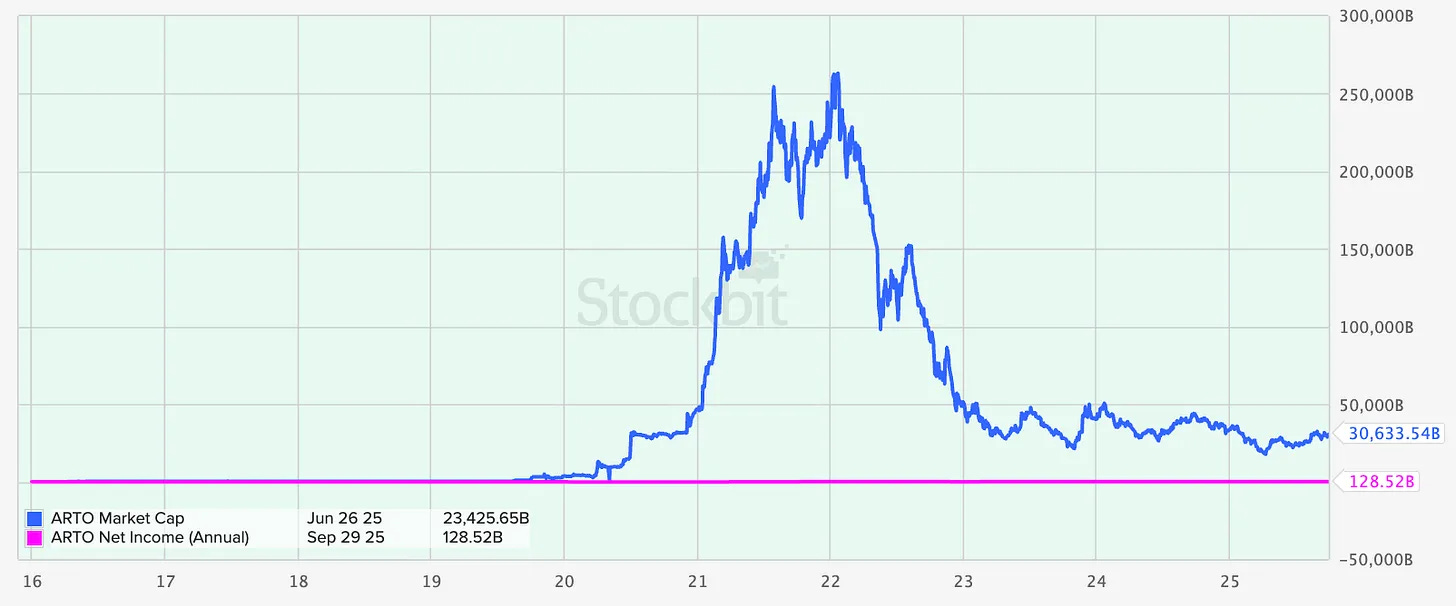
2025 was generous to people who timed these waves perfectly.
We don’t think 2026 will be the same game.
We think the next phase will be kinder to something less glamorous but far more durable:
Earnings-based stocks – businesses where price still mostly follows profits, not just a narrative.
Especially in markets where the real economy is slowly recovering underneath the noise.
The AI revolution is real (and uneven)
Before we go deeper into AI, a quick bit of context on where we’re coming from.
Toby used to work as a software engineer at Goldman Sachs in Singapore, developing and maintaining mission-critical trading systems for the bank’s markets business. When your code breaks there, real money is at risk.
Budi used to work as a data scientist at GoTo Financial, building credit scoring models for their “Paylater” product. Machine learning models were literally his day job long before the current AI hype cycle.
So when we talk about AI, we’re coming at it as people who have actually shipped and maintained production systems—not just as AI tourists reading news headlines & watching podcasts.
And the simple reality is: the AI boom is no longer just a buzzword phase. You can already see it in the data.
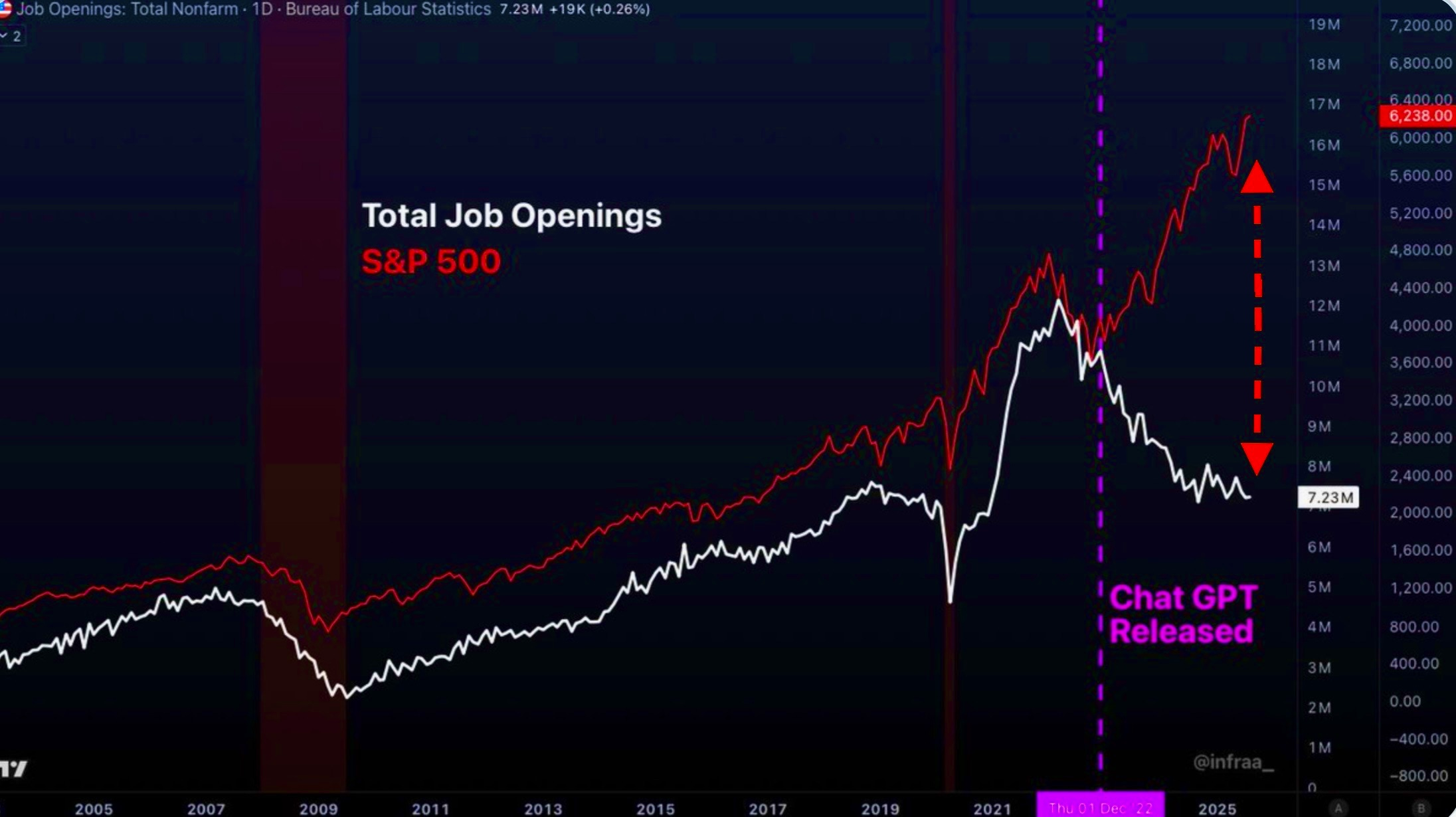
In the chart above:
The red line is the S&P 500, steadily grinding to new highs.
The white line is total US job openings, which have rolled over and trended down since the launch of ChatGPT.
We’re not saying AI is the only driver of this divergence, but the pattern fits the story: corporate profits and index levels keep rising, while the demand for additional workers is flattening or falling.
That’s exactly what you’d expect if AI lets companies:
do more with the same number of people, or
do the same amount of work with fewer people.
In other words, AI is already showing up as a productivity boost for capital, not as a jobs boom for knowledge workers.
Who feels that pressure most? White collars !
Consultants and other professional services
Junior lawyers and paralegals
Auditors, analysts, and back-office knowledge workers
Software engineers whose work is mostly maintenance rather than system design
A lot of what used to require 100 knowledge workers can now be done by 10 very good people plus AI.
Who is less threatened in the next few years? Blue collars !
Construction workers
Miners
Technicians, field engineers and operators
Logistics, warehouse, and field staff
AI (LLMs) today mostly live in laptops, phones, and data centers — not in excavators and brick-laying robots.
And here is the twist that matters for us as investors:
AI is a great leveller for emerging markets.
A capable analyst or operator in Jakarta with access to AI tools can process information like a small team in New York and produce “global-tier” output—without Silicon Valley payroll.
So while AI is a direct threat to some white-collar jobs in rich countries, it is a productivity amplifier for capable people and companies in emerging markets.
Why we are cautious on application-layer AI, AI SaaS, and (most of) the Magnificent 7
If AI is so powerful, why aren’t we simply putting all our money into AI software, LLM platforms, and the Magnificent 7?
Because where you stand in the value chain matters.
Most of what people call “AI investing” today lives in the application layer: the LLMs, chatbots, AI tools, and AI-branded SaaS products that sit closest to the end user.
We have three big concerns with that part of the stack.
Enormous capital expenditure upstream
Training and serving frontier models at scale requires:
huge data centers,
extremely expensive chips,
massive power and cooling,
top-tier research and engineering talent.
Capex has exploded. But AI-specific revenue is still a relatively small share of total profits for the big platforms. In many cases it is subsidized by older, proven businesses.
In plain English:
Companies are investing & spending like crazy on a business whose long-term economics are still unproven.
Intense competition
Big Tech versus Big Tech
Heavily funded startups versus Big Tech
Open-source models that anyone can fine-tune
When many smart teams chase similar problems with similar technology, a lot of economic value tends to be competed away. Great for users; not always great for shareholders.
Unclear unit economics
Key questions still don’t have solid answers:
How much will customers actually pay per token or per AI call over time?
How much of the productivity gain stays with the AI provider versus being given back as lower prices?
What happens if models commoditize faster than the data centers depreciate?
Even some pure-play AI firms admit they are years away from stable, positive cash flow. The gap between “this is powerful” and “this is a high-return business” can be very wide.
A note on AI SaaS
A lot of what the market calls AI SaaS sits right in this risky application layer.
Many AI SaaS products are:
thin wrappers around someone else’s model and infrastructure,
tools with very low switching costs (you can move to the next AI tool in an afternoon),
one feature update away from being copied or bundled by larger platforms.
That means:
your gross margin depends on another company’s API pricing,
your pricing power depends on customers not churning to the next tool,
your moat depends on big incumbents deciding not to copy you.
There will be winners in AI SaaS. But at current hype-driven valuations, we view this segment as one of the riskiest parts of the AI stack for public-market investors.
The Magnificent 7: cash cows, CapEx – and one big pick-and-shovel
For the Magnificent 7 (Apple, Microsoft, Alphabet, Amazon, Meta, Nvidia, Tesla), most current profits still come from “pre-AI boom” segments:
cloud services (Amazon Web Services, Google Cloud Platform, etc.),
devices and hardware,
Windows, Office, and non-AI cloud workloads,
search and video advertising,
e-commerce,
social media advertising,
electric vehicles and energy.
One important exception is Nvidia.
Nvidia is not an application-layer AI play. It is one of the clearest pick-and-shovel winners of the AI boom: selling the GPUs and hardware everyone else needs to train and run models. They have benefited massively from this role.
We are not saying Nvidia is a bad business. It is a phenomenal business. Our concern is different:
At current prices, a lot of that success is already reflected in the valuation.
Being the best shovel-maker in a gold rush is wonderful. Being the investor who buys that shovel-maker when everyone already agrees it is wonderful is a different proposition.
Nvidia is squarely in the “plumbing” of AI, which we like in principle.
But the market already prices it as if years of strong growth are guaranteed.
We’d rather look for less crowded picks-and-shovels with much higher margin of safety—especially in areas like miners and resource producers that feed into the same AI CapEx cycle, but are still priced as if they barely matter.
For the rest of the Magnificent 7, the picture looks more like this:
legacy businesses generate huge cash flows;
a growing share of that cash is being poured into AI infrastructure and R&D;
the long-term return on that incremental capital is uncertain.
There is a real risk that:
Most of the Magnificent 7 gradually evolve from capital-light cash-flow machines into CapEx-heavy gamblers, with slower earnings growth & lower ROIC (Return on Invested Capital) as the returns on those investments fail to justify the total capital invested !
As public-market investors, we don’t get paid for simply being right about technology. We get rewarded if:
the price we pay is materially lower than the cash flows a business can realistically deliver.
On that basis, we’re happy to admire Nvidia as a fantastic business from the sidelines, and focus our capital on cheaper picks-and-shovels—like quality miners—with more room for error.
The less glamorous play: picks and shovels
Whenever there is a gold rush, the safest winners are often not the miners.
They are the people who supply the miners.
Levi’s: a classic pick-and-shovel story
During the California Gold Rush, Levi Strauss did not make his fortune by digging for gold.
He moved to San Francisco, opened a dry-goods business supplying mining camps and general stores, and eventually created tough denim work pants for labourers and miners.
From that practical “let me sell useful stuff to gold diggers” idea came Levi’s jeans.
Levi’s made money by supplying the gold rush, not by finding gold.
That is the essence of the pick-and-shovel strategy.
AI’s picks and shovels (and why we lean upstream)
We see AI in very similar terms. AI needs four big categories of picks and shovels:
Data-centre infrastructure
Buildings, racks, cooling systems, substations, high-voltage connections.
Semiconductors and hardware
GPUs, specialized accelerators, networking chips, storage, power systems.
Energy
Stable, large-scale electricity. Large language models don’t run on optimism; they run on megawatts.
Commodities
Copper, aluminium, steel, and the fuel sources behind the grid.
Nvidia is the obvious “Levi’s” of AI hardware and has been rewarded accordingly.
We prefer to look one step further upstream:
the miners and resource owners that supply the copper, aluminium, coal, and other inputs required to build and power all of this infrastructure;
businesses that still trade at valuations which assume very modest futures, despite sitting on assets the AI boom quietly depends on.
Our bias is simple:
We would rather own the plumbing of the AI world where it is still mis-priced than chase the parts everyone already agrees are great.
If AI truly becomes a multi-year investment cycle, demand for these picks and shovels will not disappear in a quarter. Data centers, transmission lines, and mines take years to build.
This is not a one-summer trend.
Emerging markets: sitting on the resource pile
Who owns a big chunk of the raw material and energy that these data centers need?
A large portion sits in emerging markets:
copper in Latin America and parts of Asia and Africa,
bauxite (for aluminium) in tropical countries,
coal and gas powering grids across Asia,
land and labour for new infrastructure.
When the world wants:
more cables,
more chips,
more cooling,
more reliable electricity,
it quietly needs:
more mines,
more smelters,
more power plants,
often located in countries global investors have largely ignored for the last decade.
That is where we think a meaningful share of the incremental cash flow will show up.
Indonesia: accidentally in the sweet spot
Indonesia is not perfect. We have nepotism, corruption, and political noise (duh!).
But from a resource perspective, we are extremely fortunate.
Three easy examples that connect directly to the AI build-out:
Copper
Essential for almost all electrical and electronic systems:
power cables,
data-center wiring,
circuit boards.
Growing electricity and electronics demand usually means growing copper demand.
Indonesia in terms of global copper reserves / production: 10th in reserve, 7th in production (out of hundreds of countries).
Aluminium (via bauxite → alumina → aluminium)
Light, relatively cheap, and excellent at conducting heat. Critical for:
heat sinks and cold plates that prevent GPUs from overheating,
frames, racks, and structural components of data-centre hardware.
Indonesia in terms of global bauxite reserves / production: 6th in reserve, 6th in production
Thermal coal and conventional energy
Data centers want stable baseload power.
Renewable energy is growing, but not yet enough to carry entire grids.
Many emerging-market grids still depend heavily on coal and gas.
Indonesia in terms of global thermal coal reserves / production: 7th in reserve, 3rd in production
Indonesia is a major player in all three.
We are not saying, “just buy any Indonesian commodity stock and forget about it.”
We are saying:
When the world embarks on a huge, long investment spree, resource owners with decent governance tend to end up on the right side of the cheques.
Indonesia is one of those owners.
A kind reminder that markets move in cycles
Now zoom out and look at how emerging markets have moved versus US stocks over the last three decades.
This chart shows:
the ratio of MSCI Emerging Markets Index to the S&P 500 Index,
when the line rises, EM stocks outperform US stocks,
when the line falls, US stocks outperform EM.
You can see three big regimes:
Late 1990s
The term “emerging markets” and the MSCI EM index only really took off in the late ’80s/early ’90s, giving global investors a neat new bucket to pour money into.
Many countries were liberalizing markets, privatizing state firms and opening to foreign capital. For a while, EMs were marketed as the most exciting, high-growth corner of the world, and money flooded in.
That wave of capital inflows and optimism bid EM equities up to rich valuations
The US was coming off the 1987 crash, the savings-and-loan crisis, and the 1990–91 recession.
People worried about “America in decline” versus Japan and the Asian Tigers, so the narrative favored faster-growing EM over the “old” US market.
US valuations were not crazy at that point; S&P 500 P/Es in the late ’80s/early ’90s were in the mid-teens to low-20s, much lower than the 30+ levels reached at the dot-com peak later in the decade.
Put those together and you get periods, where investors were paying up for EM growth stories while the US looked comparatively cheap—hence “US equities undervalued relative to EM.”
2000–2013: what the last CapEx wave did
To understand why we care so much about infrastructure and commodities, it helps to look at the last big tech-driven CapEx cycle.
After the dot-com bubble burst in 2000, the US went through what many call a “lost decade”:
from 2000 to 2013, the US market delivered only about 2.6% annualized returns;
over the same period, Indonesia compounded at roughly 23% per year in USD terms – a completely different universe of outcomes.
What was happening in the background?
The world was pouring money into building the plumbing of the internet:
fibre-optic cables,
mobile networks and cell towers,
data centers and server farms.
That CapEx wave massively boosted demand for steel, copper, energy, and shipping.
In other words, the early internet era was fantastic for commodities and resource-rich emerging markets, even while many US tech stocks were still digesting the dot-com hangover.
Today’s AI build-out has a similar feel:
We are once again in a heavy infrastructure phase, where most of the money is going into data centers, chips and power – not yet into fat, proven profits for most application-layer companies.
Historically, regimes like that have been very kind to commodity producers and resource-rich emerging markets.
2013 – Now: Indonesia’s own “lost decade”
Now flip the lens.
From January 2013 to mid-2025, Indonesia’s large-cap index LQ-45, measured in USD, actually delivered about -4.7% CAGR.
So while the US was enjoying one of the greatest bull markets in its history—driven by tech and the Magnificent 7 (previously FAANG) — Indonesian large caps in dollar terms effectively went backwards.
That’s the other side of the cycle.
One decade-ish:
US is cheap and hated, EM is loved and ripping higher.
Next decade-ish:
US is the hero, EM is the afterthought people regret owning.
Which brings us to where we are today…
2026 and beyond:
Now look at the far right of the chart.
We are back at levels where:
EM equities are deeply undervalued relative to US equities,
EM equities (especially Indonesia) are extremely under-owned by global funds
the line has started to curl up again.
That is often how regime changes begin—not with a perfect V-shaped bottom, but with a slow, doubted turn.
So when we say:
“For the past 15 years the US has dominated, but we are already seeing signs that the tide is about to turn,”
we are not just telling a nice story.
The relative performance data between EM and the S&P 500 is whispering the same thing.
Markets move in cycles; leadership rotates. No asset class gets to win forever.
As Mark Twain famously said:
How a commodity cycle trickles down
Commodity super-cycles do not only reward miners.
When a resource-rich country enters a strong cycle, you usually see:
faster GDP growth,
stronger government revenues,
higher incomes in producing regions.
This tends to flow into two big areas.
Banks
higher loan growth,
better asset quality (as long as leverage stays sensible),
stronger earnings and dividend capacity.
Consumer companies
as incomes improve, spending on staples and then discretionary goods rises,
companies with strong brands and distribution benefit.
So even though our starting point is “AI → data centers → commodities,” some of the most attractive opportunities we see today are:
large, well-run Indonesian banks,
selected consumer businesses,
plus commodity and infrastructure names where:
management is sensible,
balance sheets are healthy enough,
capital allocation is not reckless.
Margin of safety: how we sleep at night
All of this could be wrong.
AI CapEx could slow earlier than we expect.
US markets could outperform emerging markets for another decade.
Indonesia could mismanage its advantages.
Global investors might stay underweight EM forever.
We are not in the business of perfect prediction. We are in the business of risk versus reward.
Right now, in many Indonesian companies we follow:
valuations imply that the businesses are permanently mediocre or worse,
dividend yields are often higher than local “risk-free” rates,
expectations from foreign investors are already quite pessimistic.
So we ask ourselves:
“If our big-picture thesis is wrong, what happens?”
Our answer looks like this:
Heads, we win
AI CapEx continues, commodities and emerging markets re-rate,
Indonesian businesses tied to this trend enjoy a multi-year tailwind,
we participate from low starting valuations.
Tails, we do not lose much
We still collect solid dividends, many well-established Indonesian companies are net-cash, now easily offer dividend yield far above government bond yield & fixed time deposits
We still own cash-generating businesses bought at pessimistic prices,
Our downside is cushioned by margin of safety.
Or in one sentence:
Heads I win, tails I don’t lose much.
That is the kind of asymmetry that lets us stay invested, stay calm, and still sleep at night.
What this might mean for you
You do not have to agree with all of this. But if you are a busy professional or entrepreneur thinking about your portfolio, a few reflections might help:
Don’t confuse narrative with earnings.
2025 rewarded narrative (story) stocks. 2026 and beyond may ask, “Where is the money (profit) ?”
Be deliberate about where you stand in the AI value chain.
Owning the plumbing can be safer than trying to guess the next viral AI app or AI SaaS tool.
Even within picks-and-shovels, there is a difference between “already discovered champions” like Nvidia and under-appreciated resource owners and miners.
Remember that markets move in cycles.
The last 15 years of US dominance are a cycle, not a law of nature.
Pay attention to starting valuations.
Expensive assets with high expectations are fragile.
Cheap assets with low expectations and real cash flows give you room for error.
Prioritize margin of safety over hero predictions.
You don’t need to call the exact top or bottom. You just need to avoid situations where one bad macro headline destroys your capital.
If you are already a Recompound client: we have published this report exclusively to you beforehand. If you want to talk more about this, we are just one WhatsApp away.
If you are not a client yet, that is fine too. Our job is to keep thinking, writing, and investing our own capital alongside our clients—so that when the tide really does turn, we are already standing in the right place.


