


This article is for education only. It is not a recommendation to buy or sell any stock, fund or ETF mentioned, including BCA, LSIP, EIDO or MSCI itself. Past performance does not tell you what will happen next.
MSCI’s proposal is still a consultation. Its final decision is due by 30 June 2027 and may differ from what is described here. Figures come from public filings and news reports as of October 2026. The two enforcement charts are illustrations, not measured data.
In Indonesia, we’ve all heard about the shocker that was released by MSCI to our capital market. They issued an announcement, opening a consultation to reclassify Indonesia from emerging market into the standalone market. This announcement took everyone by surprise because for the most of 2026, market participants are somewhat downplaying the possibility of Indonesia to be downgraded to frontier market. Now, there is a real possibility that Indonesia is going to move below even frontier, into standalone market.
Before we get into the meat of today’s article, I’d like to express my humble opinion that what MSCI is doing to our capital market is very good to accelerate the reformation process of our capital market. Our regulators have had a bad reputation in policing financial market just from the slew of financial scandals that materialise in our country recently. Not only in the stock market, but other money related markets too. High profile cases are:
Various shadow banks blowups like Indosurya
Pension funds that are grossly mismanaged like Asabri
P2p agri startups that blew up like Tanifund
And of course the age old coordinated trading or colloquially known as “goreng-menggoreng saham”
I cannot imagine myself being in the position of a regulator, having to deal with the mess that they are up against. But I am sure at the very least, with the threat of a global player like MSCI, regulators would have more leverage to clean up this ecosystem, fast.
Because we all know that law enforcement is not an easy feat. We also know that enforcement in emerging market, like Jakarta, is definitely not as a good as one that we see in London or New York.
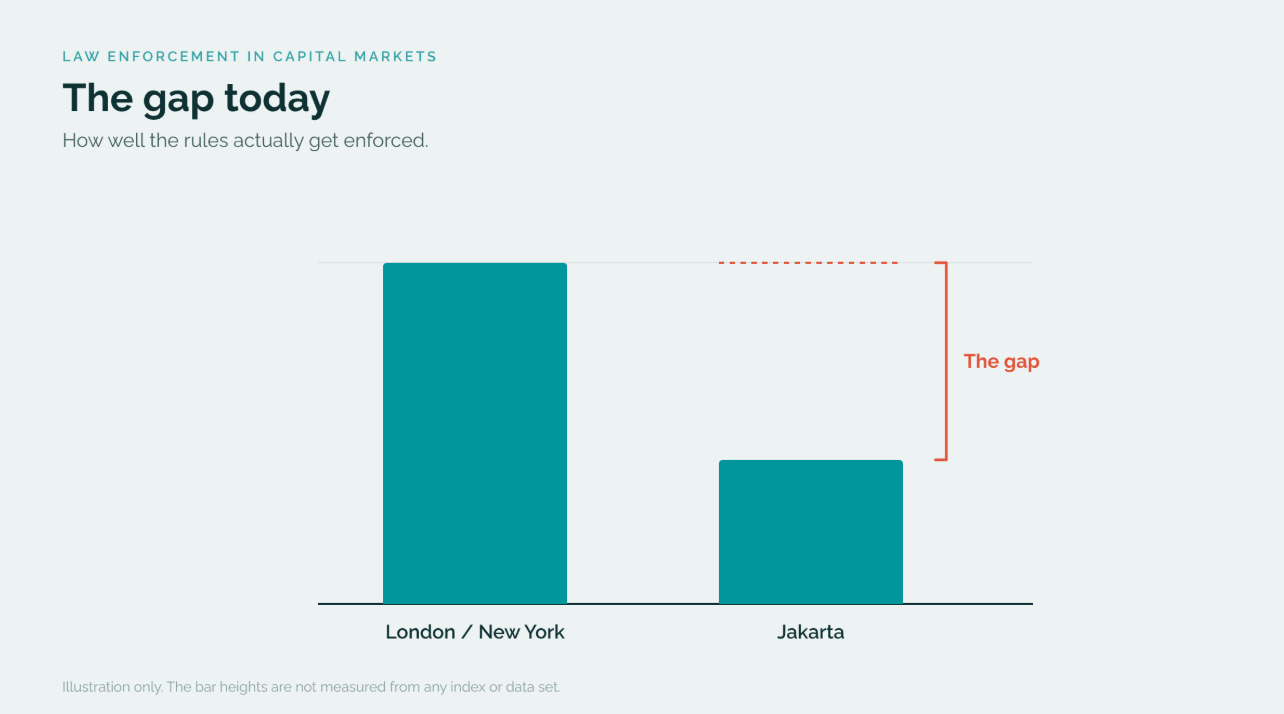
So perhaps this event might reduce the gap to the level what illustration is showing below
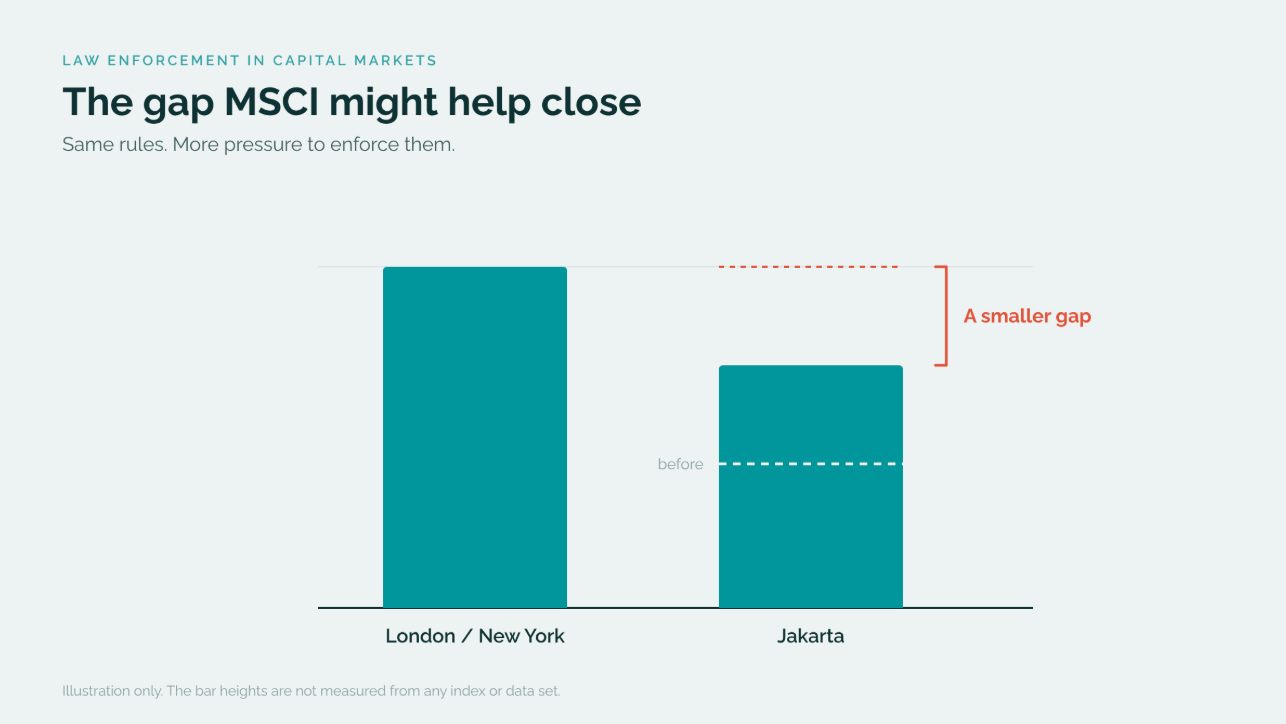
So yeah, I sit on the more cautiously optimistic camp that regulators would be able to get their act together, considering that banking reforms was a huge success in the turn of the 21st century. We now have very strong banks with largest net interest margins in the region. And these banks are very very well regulated too, with strict standards in place surrounding capital adequacy ratio, net open position, etc.
But today’s article is not going to be about our regulators
Social media, the news, and plenty other highly respected individuals have provided their opinions about areas of improvement for our regulators. This article is going to focus on MSCI itself. What is their business like and the assumptions that they make when raking in profits. Fortunately they are a public company so their filings and annual reports are free for us to see.
By having a greater appreciation of what their business model and underlying assumption is, we will be able to make better sense of their decisions. We would also have a better view about the ongoing active vs passive investing debate that is happening in the Western world. It is essentially a tug of war of investing paradigm. From asset managers (who run index funds vs those who run active funds) all the way to startups like Wealthfront (who’s more passive) and Titan (who’s more active in advising wealth).
This MSCI Indonesia downgrade episode certainly adds more data point to the whole debate. Especially about the implementation of passive investing strategies in the market.
But first how does MSCI make money?
You can think of it as MSCI as a Premier League in investing. Yes although it is not completely analogous, it helps think football for a minute and think of them as the Premier League.
Assume MSCI as an entity that defines rulebook of who gets relegated and who gets promoted.
The countries are the clubs inside who’s trying to win or get promoted up in the league. They care about winning and not getting relegated.
The passive funds are entities like SkySports. They don’t play. They just earn from covering the football matches. They don’t really care who wins. All they care about is that more and more people watching the game of football over the years.
And just like SkySports pays the Premier League for the rights to broadcast, index funds pay MSCI a licence fee to use its list.
So what problem does MSCI solve? Why a Premier League in investing is needed? Because if it does not solve any problem and it is not needed, then you wouldn’t have MSCI in the first place.
The rise of passive investing.
Passive investing back in the day was a brilliant financial innovation in the wake of mutual funds with massive fees and overzealous fund managers, at the expense of investor returns. The idea was to invest the market so that investors are guaranteed to get average market returns. Assuming market returns are satisfactory, it follows that investors are “guaranteed” to get a satisfactory returns.
This innovation was pioneered by John Bogle, who launched the first index fund for everyday investors at Vanguard in 1976. Funny enough, Bogle himself was never a fan of investing abroad. He famously said that you don’t need to own international stocks.
But the rest of the industry disagreed. And to take passive investing outside the US, you need a ruler for markets you know very little about. That ruler already existed. Back in 1969, Capital International (the “CI” in MSCI) started publishing global stock market indexes as a yardstick for investors comparing markets around the world. In the mid-1990s, Morgan Stanley launched some of the first ETFs that simply tracked those country indexes. They later became iShares, the family EIDO belongs to today.
So MSCI became the neutral standard setter that determines two broad things:
The country risk
The selected securities in a given country
The riskier the country, the less allocation it gets. And the risk is also defined very clearly from capital controls, information flow, liquidity, and so on. Therefore, we have the classifications that are in place.
Now the second one is a little bit tricky. Because the goal is to invest in the market in order to get market returns. But as I will explain, it is not that straightforward.
Let’s start with the ideal scenario.
A quick note before the maths: what follows is a simplified version of how MSCI builds its indexes. The real rulebook runs to hundreds of pages, with extra screens, buffers and caps. But the core idea is the same, and the core idea is what matters for this story. If you want to geek out and read the entire thing, I have included it at the end of this article.
In a perfect world, if you want to invest in the market, you should be able to buy all stocks in the stock market, weighted by their respective market caps. To put this concretely, if BCA is 20% of the stock market, you would want to allocate 20% to BCA.
And if LSIP is 0.5% of the market, you would want to allocate 0.5% of LSIP in your portfolio. If you can execute this investment to all 900+ companies in JCI, then your mission is accomplished as a passive investor. This is elegant because in this ideal scenario, you do not have to do any rebalancing irrespective of market movement. Because lets say that BCA goes up and occupy 22% of the market weight, your portfolio will also have 22% of BCA and the rest of the weights are automatically adjusted without you having to do anything.
To put it in mathematical terms, you can compute the weight of the stock you want to put in your porfolio by following the formula below:
wᵢ = Pᵢ × Nᵢ / Σⱼ (Pⱼ × Nⱼ)
where
w = the stock’s weight in the index
P = share price
N = number of shares
Σ = add up across every company in the index
Note: share price multiplied by number of shares gets you the market cap. So the formula above reads market cap of an individual company divided by the market cap of all listed companies.
So if MSCI lets their clients invest in the “market” why are there so few companies in the MSCI list?
I’ve just shown that it is very easy in theory for you to determine the weight of each individual stock in your passive investment portfolio. But why MSCI have to come up with the algorithm to include stocks?
So the problem is not the price movement but the problem is number of stocks. Out of 900 stocks we have in JCI, a big fraction of them (couple hundred stocks) barely trade. So imagine if you are an index fund, you will have to facilitate money movement into and out from your funds. Every time an investor puts in money or take money out from your fund, the fund has to buy or sell a little of every stock to keep matching the market.
For the big stocks with a lot of liquidity (high transaction value), that is easy.
But for the small stocks with much less liquidity, that gets expensive and impractical.
Here’s a quick example with made up numbers and lets use BCA again for familiarity:
The fund gets US$100 million of new money and has to spread it across the market.
BCA is about 20% of the market, so the fund buys US$20 million of BCA. BCA trades far more than that every day.
A small company is 0.01% of the market, so the fund buys US$10,000 of it. But that stock might only trade US$5,000 a day. The fund needs two days, and its own buying pushes the price up.
Maybe you are ok with dealing with one small company with 0.01% of the market. But there are hundreds of small companies that you have to deal with every time money comes in or goes out. So you see how nightmarish it is to track the market this way?
So the theoretical solution here is also very elegant. You have to create a proxy of the market by selecting a basket of stocks that make up most of the weight of the market. And the good news is that the market value is lopsided. Only a handful of companies often make up most of the market. So the algorithm becomes as simple:
Sort companies based on market capitalisation in descending order based of its free float value
Go down the list and stop when the companies in the basket is 85% of the market value
So it is not exactly top 10 or top 20 companies. But whatever number the companies really is that make up 85% of the market value.
Why 85% is good enough?
Because market return is the value weighted average of every stock returns in the market. So if you cover 85% of the market in the basket you have constructed. The only way you’d “miss” the market returns is if the remaining 15% of the companies behave extremely differently.
Huh?
To give you concrete numbers, lets say the big names (the one you hold on your basket) gives you 10% returns.
And lets say again that the small names (remaining) performs 40% better with 14% returns. You might think that aw darn it I’ve missed the rally. Well, not really. Because the market returns is:
0.85 * 10% + 0.15 * 14%
which computes to 10.6%.
This means that you only trail 0.6% by owning 85% of the market. Not bad, and over a longer term period, the remaining 15% of the market might lag behind in terms of performance too and you will be able to neatly track the market.
Free float enters the party
This is the cleverest bit, in my opinion, to ensure that the index fund is scalable and implementable for a huge audience of investors. Free float means the actual shares that is for sale, rather than the total shares outstanding of a company. When you list a company, you might only want to part ways with 20% of your company ownership to raise funds from the public. You still keep 80% your company without any intention of selling to any party.
So if you are a passive investor, you do not want to end up buying a share of a company that is not for sale. So the true investable value of a given market is now
Σⱼ (Pⱼ × Nⱼ × Fⱼ)
and determining the weight of a stock in your basket is now
wᵢ = Pᵢ × Nᵢ × Fᵢ / Σⱼ (Pⱼ × Nⱼ × Fⱼ)
where
w = the stock’s weight in the index
P = share price
N = number of shares
F = free float, the share of the company that is actually for sale (between 0 and 1)
Σ = add up across every company in the index
Great, all sounds good
This is where things get exciting. Because bunch of theoretical model and math formulas allow you to implement a real investment product that does not need human intervention. A valid criticism towards active management is fund managers are human which might influence investment decisions. So passive investing takes the humans out of the equation as much as possible.
And MSCI is instrumental in making that happen. The underlying maths that I have just shown you earlier becomes their basis of selecting which securities they want to include. Then investing in the selected stocks is akin to investing in “the market” of a certain country.
Now suppose you are an asset manager, wanting to issue passive index funds to offer to a client. The client wants to invest in the Indonesian market. But you are not going to pick their stocks for them because you might have little clue about Indonesian companies. So what you could do is to use the guideline that is provided by MSCI then buy and sell the shares based on the securities that get included in the basket.
Mind you, MSCI is not doing this for free. If you look at their company earnings, the fund issuer pays MSCI a licence fee, charged in basis points of the fund’s assets. So the more AUM a fund manages, the more licence fee MSCI gets.
This is what the figures look like:
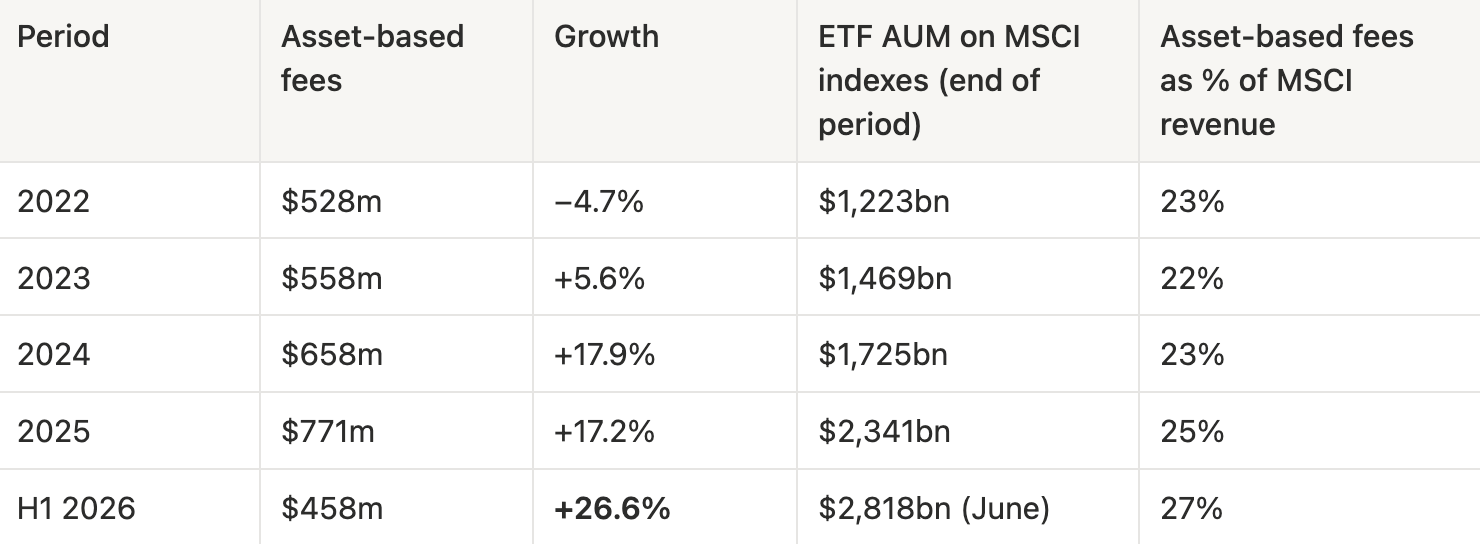
If you look at the period between 2022 and 2025, the ETF AUM nearly doubled.
But there’s a problem
In the nooks and cranny of MSCI small portion of their emerging market segment, Indonesia sits there occupying less than 1% of allocation. The most famous ETF that is issued using MSCI’s guideline is EIDO. Well, their performance does not really capture the performance of the Indonesian market at all. As for the past 10 years, they are down 5% every year on average.
Maybe you might be thinking, boohoo 5% every year is not that bad.
Well, if you are down on average 5% every year for 10 years, assuming you start your investment at $100, you are left with $60.
If you invest that same $100, 10 years ago in the Indonesian market, you will roughly get a flat performance as shown below:

Note: EIDO’s return is in US dollars, includes dividends, and is as of 30 June 2026. The JCI figures are in rupiah and are price only. Dividends would lift the JCI’s number, while the rupiah’s fall against the dollar would lower it for a foreign investor. Treat the gap as a rough picture, not an exact one.
So EIDO has been lagging the JCI every year for the past 10 years. And that is not the problem.
The problem is that it appears now to be a problem
The recent threat to downgrade Indonesia from emerging market to standalone market provides us with a clue.
“persistent opacity in shareholding structures and suspected coordinated trading behavior”
“significant concerns remain around market dysfunction, including continued suspected coordinated trading behavior”
“lack of evidence of meaningful enforcement”
“a reclassification to Frontier Markets would not properly recognize the depth of the market problems”
We definitely understand that high coordinated trading and price manipulation is a problem in every capital market in the world. But we also know that coordinated trading contains a subjective component to it. We will never be so sure about how much price is inflated due to greed vs actual manipulation. Especially in this day and age where spread of information is easy.
Perhaps we can find evidence yes, but getting the complete picture of how bad the manipulation is must contain some element of subjectivity.
Whereas capital controls (which a criteria for standalone market) is much more measurable and objective. Which also happens to be a reason why countries get sent to standalone market.
What does possibility of Indonesia’s downgrade mean
And to us, it is quite clear that Indonesia has regulatory problems.
But I believe that is only half of the picture. Indonesia’s downgrade seems to be suggesting that MSCI is admitting their own inherent limitation in their passive investing strategies. It is sending clear signal to investors that passive investing eventually will require a more subjective, human, and active intervention that of course, could be driven by emotions.
Because how do we differentiate between greed and price manipulation?
How do we draw the line? Is 10 years of price coordination the line I draw to tolerate inflated asset prices? Or 20? Or 5?
Would I be acting the same and upgrade Indonesia to developed market status if price coordination is benefiting my ETFs?
If I were to be MSCI, of course I would rather pinpoint the failure of my investment strategy by pointing out to the loose law enforcement.
But if I were to be intellectually honest, I would also believe that that is the limitation of my passive investment strategy. That eventually, only looking at free float market cap is not an investment practice that will always be a good idea.
And Indonesia is not the only place where this is happening. Four days after MSCI’s announcement, FTSE Russell, another major index provider, opened a consultation on its US style indexes. Its rule says the Growth and Value indexes must split the market 50/50. But a few tech giants have grown so big that the rule started pushing companies like Amazon, Apple and Microsoft into the Value index. So FTSE Russell is now proposing to change the rule.
Different market, same lesson. The rulebook runs on autopilot until reality breaks one of its assumptions. Then humans have to step in.
It is like the Premier League. Imagine the League catches a club inflating their club revenue unfairly to buy expensive players. It will punish the club, maybe even relegate it. What it will not say is that its own rulebook made such financial engineering easy. Because the moment fans believe the whole league can be rigged, fewer people watch. And when fewer people watch, Skysports pays less to the League for the next broadcast deal. Punishing one club protects the product. Admitting a flaw in the rulebook threatens the very same product.
Note: I know that I am a Man Utd fan. But the fact that there’s an ongoing scandal in the Premier League in 2026 with Man City is definitely not the reason why I chose this analogy. It just happens to illustrate the point quite clearly.
Closing Remarks
What do you think? I believe that there should be a fair share of both passive and active management in an equilibrium. If everyone is too passive, it benefits the active managers who really look into it. If everyone is too active, it benefits the passive investment managers.
Right now, the tip of the balance seems to fall into the passive side. Will it turn the other way around in our life time? I don’t know. But interesting to see nonetheless.
Cheers.
Links to materials
MSCI’s decision
MSCI’s method (the 85%, free float, liquidity rules)
MSCI GIMI Methodology book (2016 edition; link the current one from msci.com if you can find it)
MSCI’s fees (your table)
EIDO and the JCI
History (Bogle, MSCI, iShares)
The free-float adjustment you describe creates a subtle compounding problem in markets like Indonesia: when government or founder shareholding is high and free-float is small, the 85% coverage threshold requires including fewer but larger companies, concentrating the investable basket. That concentration amplifies the price impact when those same names are suspected of coordinated trading — the index becomes a larger share of its own problem. The more interesting question your FTSE Russell example raises is whether any passive index methodology can remain truly mechanical when the underlying market structure violates the assumptions that make free-float-weighting theoretically elegant.