


Disclaimer: This article is intended for educational and informational purposes only. Nothing in it constitutes — and it should not be construed as — financial, investment, tax, or legal advice, nor as an offer, solicitation, or recommendation to buy, sell, hold, or convert any security, currency, or financial product. This includes any specific companies named above (and their tickers) and any discussion of the rupiah versus the US dollar; these are used purely to illustrate a point, not as endorsements or recommendations.
The information here is drawn from sources we believe to be reliable as of the date of writing, but we make no warranty as to its accuracy or completeness. Figures such as exchange rates, financial ratios, and fiscal numbers move constantly and may be out of date by the time you read this. Any forward-looking statements are opinions, not predictions.
All investing carries risk, including the possible loss of capital, and past performance is never a guarantee of future results. Please do your own research, and consider speaking with a licensed professional before making any decision. Ultimately, your financial decisions are your own.
Reader’s discretion is advised. Hope it is useful in some way :)
I was sitting down in one of my favorite bank branches while waiting my queue number. You know running errands in a bank like a proper adult ;) When it was my turn and I spoke to the teller about my banking needs, I asked them a number of questions regarding the behaviour of other patrons.
In light of the recent weakening Rupiah against the Dollar, I went straight to ask them
“How do you comfort people who are worried about Rupiah depreciation? People usually associate current levels of depreciation like what happened in the past in 1998 specifically.”
The response was
“ummm.. but it is very different now and then. Nowadays the fundamentals is stronger. and there are more regulation that is in place for the banks now.”
I wasn’t very satisfied with the answer. Because I could tell that people are not going to be comforted with that statement. Also, the teller went on telling me that there they have been busy facilitating transactions of people buying the Dollar lately. They could serve around 6 - 7 people in one branch making big dollar buys. So I could tell that such statement does not comfort people.
The fear is real and contagious
Here is the part I have to be upfront about. I did not remember 1998 (I was only 2 years old). So I am not going to present to people who did and create a debate arguing that their fear is irrational. Especially at that time people watched their savings evaporate and their city burn.
You do not argue someone out of a memory like that.
But the elephant on the room is not about the fear per se. It is about the contagiousness of the fear in the age of social media. A comedian Ronny Chieng has a major rant here summarised in a 90 seconds YouTube shorts:
No matter how ridiculous and funny this video might sound, it is painting a real picture of my experience with many boomers. For the first time in human history, we have a class of individuals who are no longer that productive anymore having access to so much information especially when last time (before the internet was around), information was the biggest edge.
Nowadays, too much information slows you down. It causes people to overthink, be indecisive and be worried about making wrong decisions. But we can’t blame the boomers for this because for most of their lives, information is something that allows them to gain a competitive edge. So it is very counterintuitive to unlearn that and it is very hard to have them be aware of their unhealthy levels of information diet.
Which probably makes the very feeling of fear very contagious
Robert Shiller wrote a whole book about exactly this — Narrative Economics — and his core claim is that economic stories spread like diseases. “Economic narratives,” he writes, “follow the same pattern as the spread of disease.” A story does not have to be true to move an economy. It only has to be infectious. And the 1998 story is beautifully infectious: a frightening number, a remembered trauma to pin it to, and a single simple instruction:
Rupiah is going to collapse so buy dollars, now.
But a story cannot spread that easily if there is no element of truth to it. And it is definitely not my style to make a strawman argument and then attempt to beat it down to say that these people are not rational.
So let me steelman the fear properly
If there are further points that you’d like to add, please add them in for my consideration. It might be an open discussion of some sort as well. The idea is not to dismiss it but it is also not to be consumed by it alive. We want to lean into the fear and see it for what it is. I think that is a much productive use of our time, to make household economic decisions on our daily lives.
Start with the budget (APBN)
In 2025, Indonesia ran a deficit of about 2.92% of GDP. This deficit is seen as the widest outside pandemic years and it is very close to the 3% ceiling. For context, the 3% was written into law after the last crisis in 98.
Plus, tax revenue came in roughly 8% under target in 2025.
So it follows that if government revenue does not hit target, we could expect that budget deficit could grow further surpassing the 3% ceiling. In fact, the government has put that 3% law into review. To me, that’s a clear sign that fiscal anchor is starting to drift.
Danantara
Now we have a new player as well which is designed as a sovereign vehicle to drive economic growth but their reporting is still quite unclear to this date.
What’s their economics like
What’s their balance sheet like
Are they profitable, etc
So it is entirely possible that the liabilities could be accumulating off on the side. But not only that the government is running fiscal deficit, we are also seeing contentious policies that are being passed by the government. Such as free nutritious meals (MBG) that is highly controversial, arguing that this would exacerbate the deficit situation considerably.
I mean how it is not a fiscal monster? The budget in 2025 was Rp71tn and in 2026, it will be up to Rp335tn.
This is still being done despite the 3% ceiling limit. And don’t get me started about the unpredictability that the new export policy started. Yes it sounds great on paper, but it is obvious that investors are jittery about the ability for the entity to execute.
IDX
The situation with the stock market isn’t helping much either. Indonesia received a warning from MSCI in January 2026 that it would be downgraded to the frontier market because there was lack of transparency in the stock ownership which causes price engineering to be more rampant.
In response to that, there has been swift transformation in the ruling such as >1% shareholder disclosure rule, 15% free float minimum requirements and so on. But it remains to be seen if such efforts are sufficient to restore investor confidence.
All in all it seems to be like a perfect storm
Put it all together and it does read like the makings of a perfect storm. Every incentive is now lined up for money to leave Indonesia. And a sizeable chunk of the money in our stock market, by value, is in fact, owned by foreigners: locals now own roughly 61% of the equity market, with foreigners near 39%.
That is not nothing and it is a very serious issue of eroding trust. When you put it together, you get a coherent, sober worry: loosening fiscal discipline, money walking out the door, a central bank defending the rupiah, a currency at all-time lows.
So yes, I take all of this seriously in 2026. Now let’s look at how it started last time in 1998.
How it was back then
My parents’ memory of 1998 is the rupiah number. They said that it weakened from around 2,400 to roughly 16,000 against the dollar, with uglier spikes in the worst of the panic. But just like today in 2026, currency was the symptom, not the disease.
What made 1998 catastrophic rather than merely painful was that four crises stacked on top of one another and fed each other:
a currency that broke from its zone,
a banking system that was rotten with poor oversight,
a corporate sector exposed to dollar debt it could not repay,
and a government that collapsed politically while trying to manage all three at once.
We can dig deep into all four pillars above but I find it amusing that they are very consistent with the core finding of Carmen Reinhart and Kenneth Rogoff in their book: This Time Is Different: studies eight centuries of financial crises (banking, inflation, currency and sovereign debt).
They mention that banking crises tend to come before sovereign defaults, not after. In their research around their book, they put forth:
“banking crises... often precede or accompany sovereign debt crises. Indeed, we find they help predict them.” The hidden debts that sink a government, they note, often include “private debt that become public... as the crisis unfolds.”
So the order of events matters. The currency didn’t bankrupt the country directly. It blew up the banks, and then the banks blew up the state.
Let me repeat that, because it quietly reframes the whole fear. The leading indicator of a sovereign blowup is likely not the exchange rate. It is the banks. More precisely, it is whether the banks are carrying unhealthy levels of foreign-currency exposure that a falling currency can detonate.
So the honest question is not “what is the rupiah number?” It is “is that dollar bomb sitting on the balance sheets again?”
And the wonderful thing about that question is that, unlike the future of the rupiah, it has an answer you can simply look up in their annual reports.
You nervous? It could be a dollar bomb that explodes you know
Ok let’s take a look that one number which is net open position (NOP).
After 1998, Bank Indonesia introduced a hard cap on the exact thing that killed the banks last time. It is called the Net Open Position (Posisi Devisa Neto). The formula is:
(foreign currency assets - foreign currency liabilities) / bank’s capital
currency assets example:
banks’ cash position in foreign currency
banks’ loans given to customers in foreign currency
currency liabilities example:
banks’ customer deposits in foreign currency
banks’ debt in foreign currency
In plain language it means how exposed is this bank to a move in the currency.
But why does that matter so much? Think about what happens when a borrower goes bad. If a bank lends to a company and the company defaults, the bank eats the loss — some borrowers always default, and that part is normal.
That’s why we have provisioning so that writing out that debt will not cause liquidity issues. What made 1998 lethal was that the defaults and the currency crash arrived together. Banks had borrowed in dollars and lent in dollars.
When the rupiah collapsed, their borrowers couldn’t pay. Think about it, if you own a business and you take a USD loan, your loan would shoot up overnight because it is in USD but you earn in Rupiah. As a consequence you will default on your loans because your earnings couldn’t keep up with the ballooning debt.
But the banks? They still have to repay the liabilities they take in USD terms too. So they still owe people (depositors) in dollars but they don’t have the money to repay them back. Which ultimately caused banks to be insolvent.
So now we understand why Bank Indonesia caps the Net Open Position. It limits how far a bank's dollar assets and dollar liabilities are allowed to drift apart relative to its capital.
The dangerous side in a crisis is when a bank ends up owing more dollars than it holds: if the rupiah collapses, the value of what it owes balloons faster (USD) than the value of what it holds (Rupiah), and it has to buy dollars at a punishing exchange rate to settle up. This crystallises the loss on its balance sheet. So banks are to keep the gap small, so that loss stays small.
How much does Bank Indonesia allow?
The cap is 20% of capital. The higher the % is, the more vulnerable a bank is towards currency fluctuations. It is now a figure that is heavily monitored. Today it needs to be reported at the end of a working day by law.
Compare that to 1997, when, in the words of a former senior deputy governor of Bank Indonesia, Anwar Nasution, the rules on foreign borrowing “were generally violated” and corporate dollar debt simply “was not recorded.”
I tried digging the NOP numbers back then in 1998 but couldn’t really find a reliable one. Today the figure is as follows:
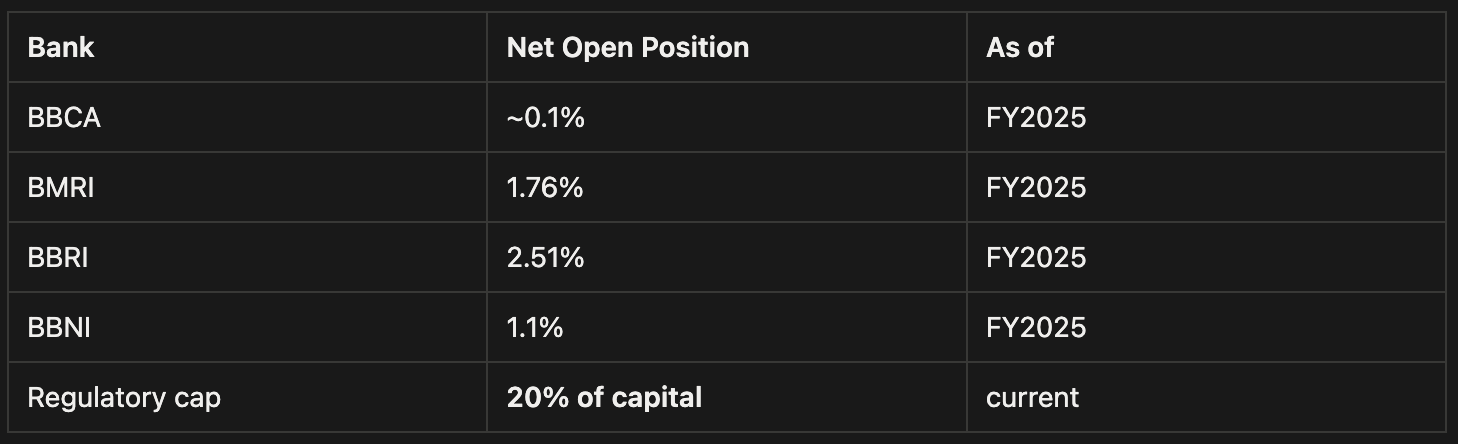
When we read the data, we see that the most dollar-exposed of the big four, BRI, is running currency risk at about 2.5% of its capital. The rest sits lower — from BCA’s rounding-error 0.1% up to Mandiri’s 1.8%. Industry-wide, bad loans sit a little above 2% and the capital adequacy ratio sits around 26% (roughly three times the global minimum).
If we look at it as it is, these are not 1998’s walking-zombie banks papering over bad loans with creative accounting. They are some of the best-capitalised banks in the region, and they are not holding the bomb.
But none of that makes the rupiah’s weakness fake. A weaker rupiah genuinely hurts importers, dollar-cost borrowers, anyone with bills denominated in foreign currency. That is a real cost, and I won’t wave it away. But it is a completely different from a banking collapse that precedes a sovereign default.
So what do you do with this
I am not going to tell you where the rupiah will go. Nobody can, and a confident “Relax bro, it won’t hit 50,000” is not entirely useful as well. The currency could keep weakening for entirely ordinary reasons — a strong dollar, higher oil prices, money chasing higher yields elsewhere. The fiscal drift I steelmanned earlier is genuinely worth watching.
What I am saying is that “the rupiah is at a record low” and “Indonesia is about to repeat 1998” are two completely different claims. The first is a price. The second is commonly preceded by a banking collapse.
Fortunately, for the second one you can check rather than predict, by reading the balance sheets. As of now, they read clean.
And I guess this is exactly why we do what we do. When your feed is screaming negativity and you are probably tempted to “convert everything to dollars” — at the worst possible exchange rate, paying the spread to the banks and then surrendering your rupiah. Our job is to give you the data and make sure that your decisions are driven by things that you could check and verify.
Because if that fear stops spreading for whatever reason, at the very least you know that you have made your decision without regret.
References
In case you’re interested in reading the materials consulted in writing this article, below are the entry points:
Bank Indonesia (2015). Peraturan Bank Indonesia No. 17/5/PBI/2015 — Perubahan Keempat atas PBI No. 5/13/PBI/2003 tentang Posisi Devisa Neto Bank Umum. https://peraturan.bpk.go.id/Details/135521/peraturan-bi-no-175pbi2015-tahun-2015 [The Net Open Position cap of 20% of capital, and the relaxation from 30-minute to end-of-working-day reporting.]
Reinhart, C. M. & Rogoff, K. S. (2009). This Time Is Different: Eight Centuries of Financial Folly. Princeton University Press. [The book-length thesis that banking crises and sovereign defaults travel together across history.]
Reinhart, C. M. & Rogoff, K. S. (2011). “From Financial Crash to Debt Crisis.” American Economic Review, 101(5), pp. 1676–1706 (NBER Working Paper No. 15795, 2010). https://www.nber.org/system/files/working_papers/w15795/w15795.pdf [Source of the exact quoted lines: “banking crises… often precede or accompany sovereign debt crises. Indeed, we find they help predict them,” and “private debt that become public… as the crisis unfolds.”]
Shiller, R. J. (2019). Narrative Economics: How Stories Go Viral and Drive Major Economic Events. Princeton University Press (NBER Working Paper No. 23075). https://www.nber.org/system/files/working_papers/w23075/w23075.pdf [“Economic narratives follow the same pattern as the spread of disease.”]
Nasution, A. (2015). “How Indonesia reformed its risky financial sector.” East Asia Forum, 24 April 2015. https://eastasiaforum.org/2015/04/24/how-indonesia-reformed-its-risky-financial-sector/ [Former BI Senior Deputy Governor on 1997–98: rules on foreign borrowing “were generally violated,” corporate dollar debt “was not recorded”; inflation ~58%, rates >80%, GDP −13.1%.]
Indonesia Investments. Asian Financial Crisis — Indonesia. https://www.indonesia-investments.com/culture/economy/asian-financial-crisis/item246 [Rupiah ~2,400/USD pre-crisis collapsing to ~16,000; managed band floated from August 1997; 16 banks closed in November 1997 triggering bank runs.]
IDNFinancials / Indonesia Stock Exchange (2026). Foreign outflows from Indonesian shares and bonds, 2026. https://www.idnfinancials.com/news/60974/foreign-dump-indonesian-shares-bonds-outflows-at-idr-12-55-trillion [Foreign net selling of Indonesian equities in 2026.]
Bloomberg (2026). Indonesia’s fiscal deficit reaches 2.92% of GDP, near legal limit. https://www.bloomberg.com/news/articles/2026-01-08/indonesia-fiscal-deficit-soars-to-2-92-of-gdp-near-legal-limit [2025 budget deficit of 2.92% of GDP, the widest outside the pandemic years.]
Bloomberg (2025). Indonesia adds State Finance Law to 2026 legislative priorities. https://www.bloomberg.com/news/articles/2025-09-19/indonesia-adds-state-finance-law-to-2026-legislative-priorities [The 3%-of-GDP deficit cap — set by Law No. 17/2003 after the 1998 crisis — placed under review.]
The Diplomat (2026). “Unpacking Indonesia’s 2025 Fiscal Revenue Shortfall.” https://thediplomat.com/2026/01/unpacking-indonesias-2025-fiscal-revenue-shortfall/ [2025 state revenue came in roughly 8% below target.]
East Asia Forum (2026). “Indonesia’s fiscal anchor begins to drift.” 15 March 2026. https://eastasiaforum.org/2026/03/15/indonesias-fiscal-anchor-begins-to-drift/ [Danantara’s borrowing sits outside the deficit rule, raising contingent-liability and transparency concerns.]
Kompas (2025). “Anggaran MBG Melonjak Jadi Rp 335 Triliun di APBN 2026.” https://money.kompas.com/read/2025/09/24/112056126/anggaran-mbg-melonjak-jadi-rp-335-triliun-di-apbn-2026 [Free Nutritious Meals (MBG) budget rising from Rp71 trillion in 2025 to Rp335 trillion in 2026.]
IDNFinancials / Bloomberg (2026). MSCI halts rebalancing; Indonesia risks downgrade to frontier market. https://www.idnfinancials.com/news/60811/msci-halts-rebalancing-indonesia-risks-downgrade-to-frontier-market [January 2026 MSCI warning over share-ownership/free-float transparency; reforms include 1% shareholder disclosure and raising the minimum free float to 15% from 7.5%.]
bne IntelliNews (2026). Indonesian rupiah drops to historic low of IDR18,000 per US dollar. https://www.intellinews.com/indonesian-rupiah-drops-to-historic-low-of-idr18-000-per-us-dollar-446678/ [Rupiah at a record low around 18,000/USD, roughly 10% weaker year-on-year.]
Annual Reports 2025 — BCA, BNI, Bank Mandiri, BRI. Risk Management / Net Open Position disclosures. [FY2025 Net Open Position ratios: BCA ~0.1%, BNI 1.1%, Bank Mandiri 1.76%, BRI 2.51%; industry CAR ~26%, gross NPL ~2%.]