

Disclaimer: This article is my personal opinion, written for educational purposes only. Nothing in it is financial advice, and nothing here is a recommendation to buy, sell, or hold any security. The two portfolios below are a simulation I built to illustrate a point: the return sequences are made up, shuffled, and shown before fees and taxes. They are not a forecast, not a promise, and not Recompound's track record. Investing carries risk, including loss of capital. Please do your own research and speak with a licensed professional before making decisions.
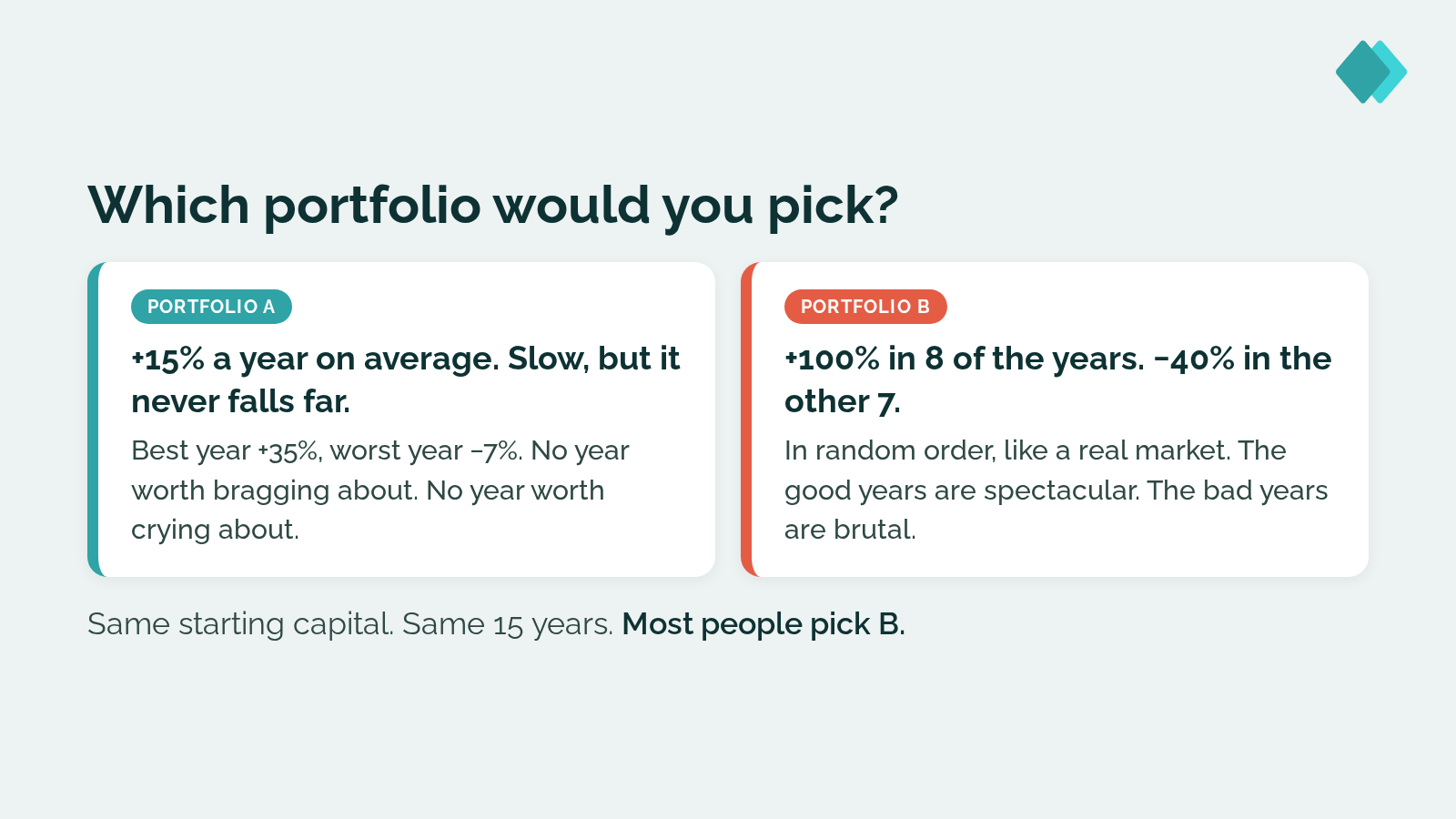
Here is a question I ask on almost every first call with a prospective client. Two portfolios, same starting capital, same fifteen years.
Portfolio A returns about 15% a year on average. Slow, but it never falls far. Its best year is +35%, its worst is −7%. No year worth bragging about, no year worth crying about.
Portfolio B returns +100% in eight of the fifteen years and −40% in the other seven, in random order, like a real market. The good years are spectacular. The bad years are brutal.
Which one do you want?
Most people pick B. And honestly, I understand why.
The treasure-hunting mentality
Who doesn't want to find the next multibagger? The buried treasure that goes up 1,000%. Put in US$6,000, take out US$60,000. In Indonesia we even have a name for the hunt: cacing-cacing naga-naga, "worms and dragons". You buy a tiny stock (a worm) hoping it turns into a dragon.
And let's be honest about the other reason, because nobody says it out loud: ego. "I got 10x on this stock" is a much better story at the bar, or in the group chat, than "my portfolio went up 15%". Nobody has ever gone viral with a 15% year.
What people rarely account for is how rare the treasure actually is. Genuine 10-baggers are needles in a haystack, and the haystack is on fire half the time. I used to build credit-scoring models for a living, and the first thing you learn about rare events is that the stories you hear are the survivors. Nobody posts the worms that stayed worms.
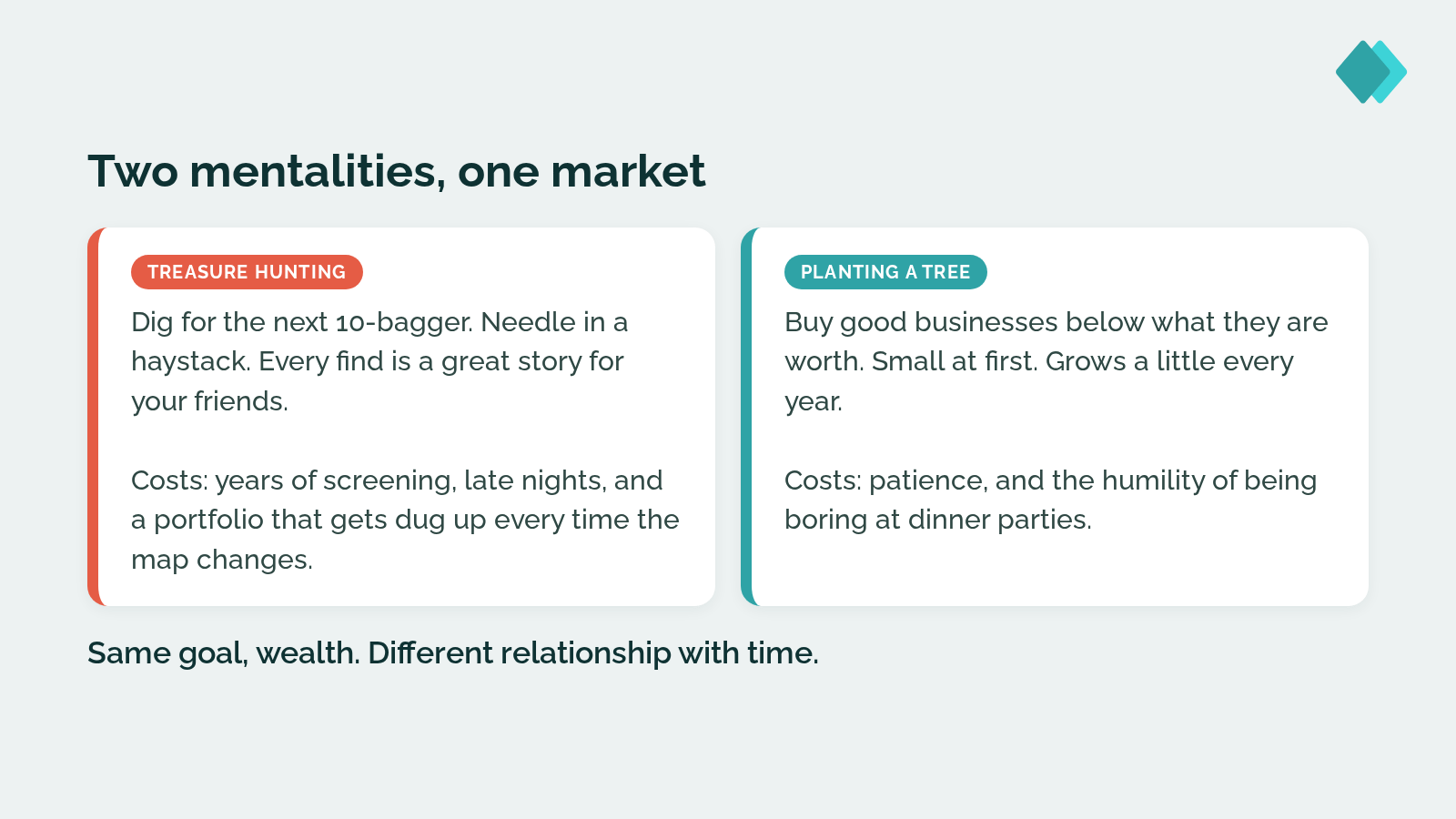
Portfolio A is the opposite mentality. Not treasure hunting. Planting a tree. Small at first, grows a little every year, and you never dig it up to check the roots.
The early years feel terrible
I won't pretend Portfolio A is fun at the start.
Year one: 1.17x. Year two: 1.45x. Year three: 1.65x. Three years in and your money hasn't even doubled. Meanwhile Portfolio B is at 2x after year one and 4x after year two. At this point B looks like the obvious winner, and the people holding A look like they are missing out.
Hold that thought.
Now run it for fifteen years
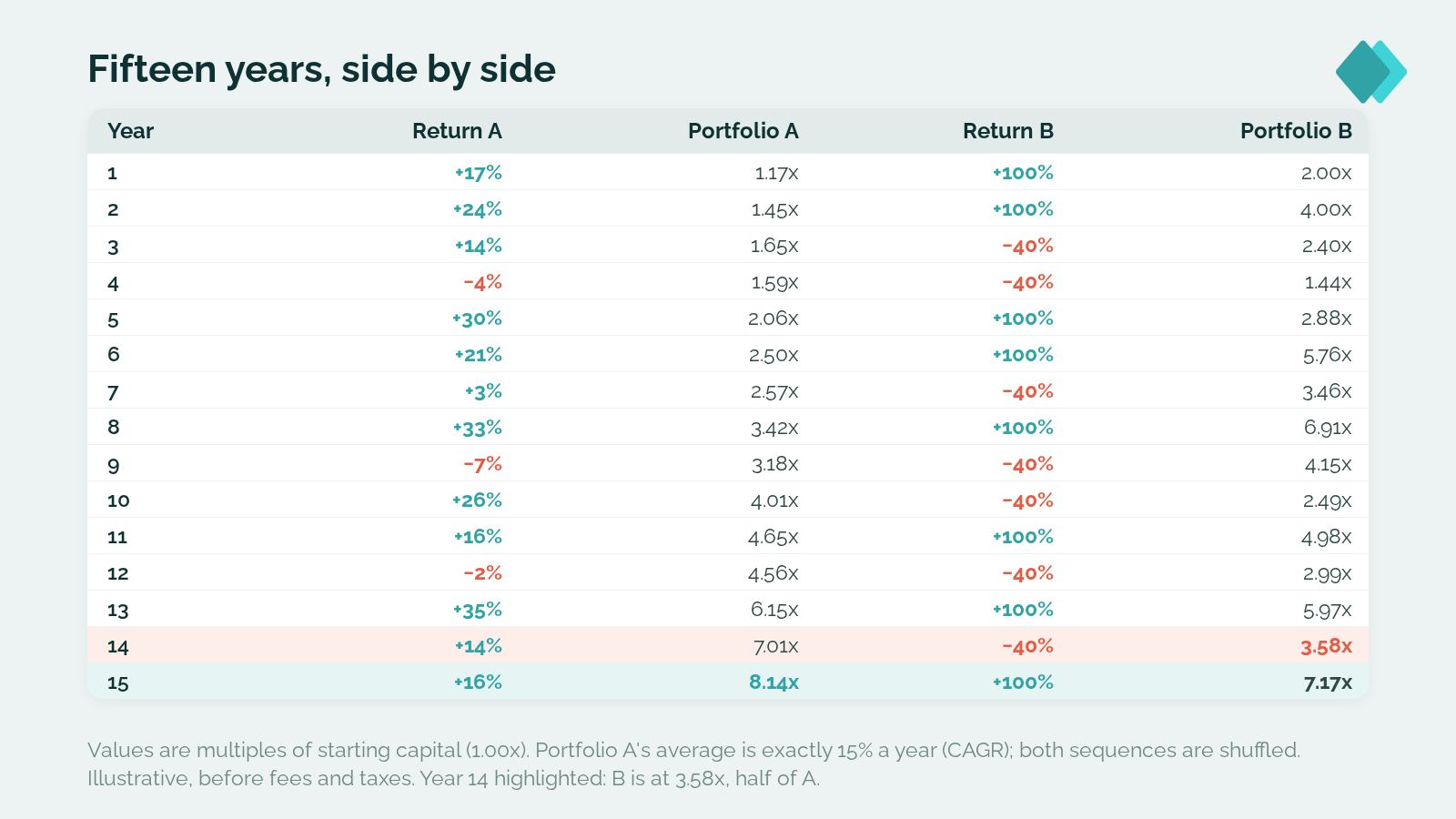
Portfolio A finishes at 8.14x its starting capital. Portfolio B finishes at 7.17x.
The tortoise wins. Not by a landslide, but it wins, despite B having a "much higher" average return. On US$60,000 (roughly Rp 1 billion, the number I use with Indonesian clients), that is about US$488,000 versus US$430,000.
And here is the part that surprises people the most: it does not matter in which order B's good and bad years arrive. Multiplication is commutative. Shuffle those eight +100% years and seven −40% years any way you like and the ending is always 2⁸ × 0.6⁷ = 7.17x. The order changes only one thing: how painful the ride is.
What the table hides
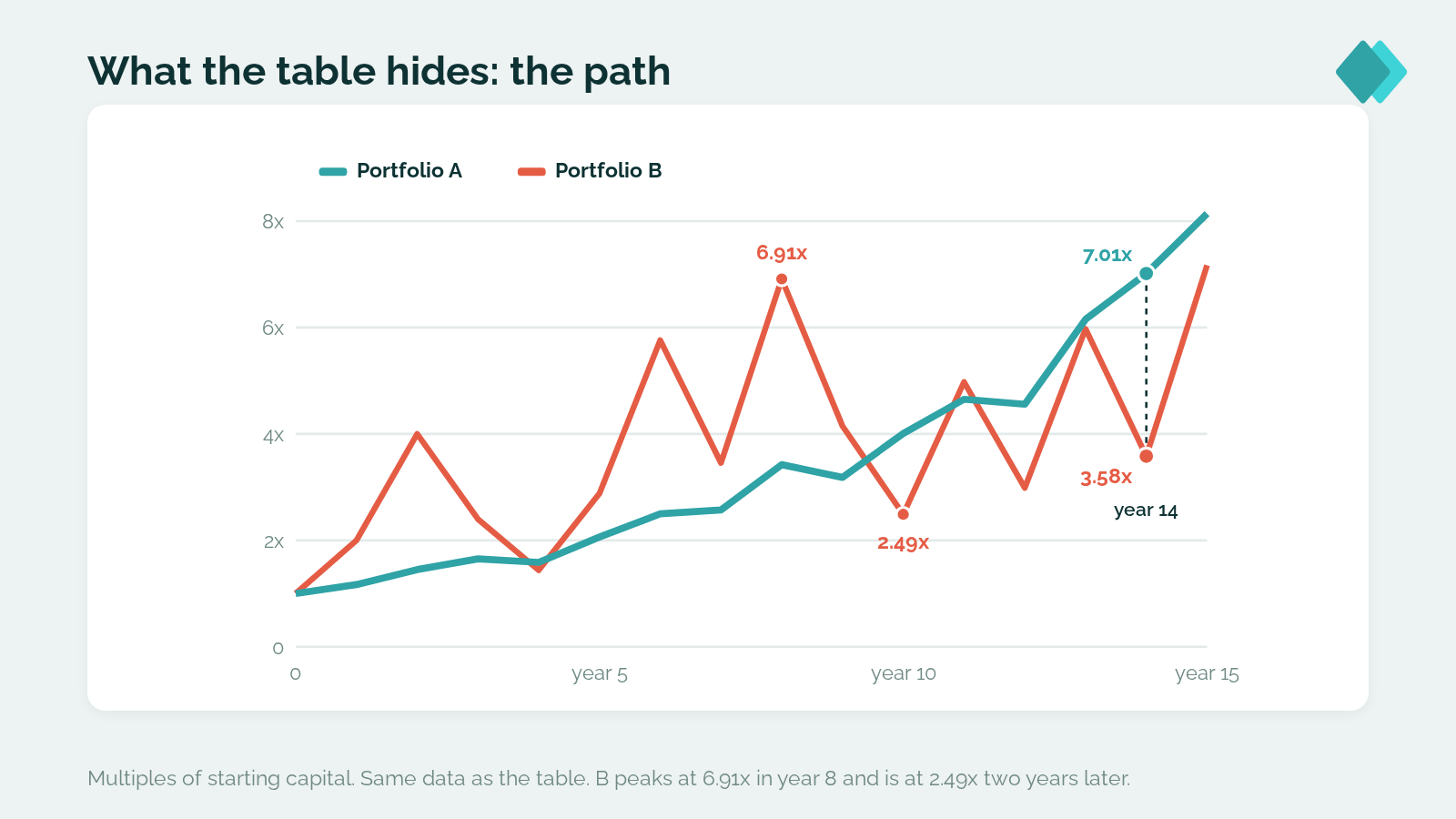
Look at the red line. In year 8, Portfolio B touches 6.91x. Two years later it is at 2.49x. It lost 64% of its value in 24 months. Then it does it again from year 13 to year 14.
Now look at year 14 specifically. Portfolio A is at 7.01x. Portfolio B is at 3.58x, half. B's ending only looks close to A's because, by luck, year 15 happened to be one of the good years. If you needed the money in year 14, for a child's university fees, for a house, for a parent's surgery, you would have cashed out with half of what the tortoise had.
Portfolio A also has red years, three of them. They are shallow. That is the entire difference.
"But B's average return is more than double!"
It is. And that is exactly the trap, so let me be precise about it.
Take the fifteen yearly returns of Portfolio B and average them. You get +34.7% a year. Do the same for A and you get +15.7%. On paper, B is more than twice as good.
Now look at what compounding actually delivered. A: 15.0% a year. B: 14.0% a year.
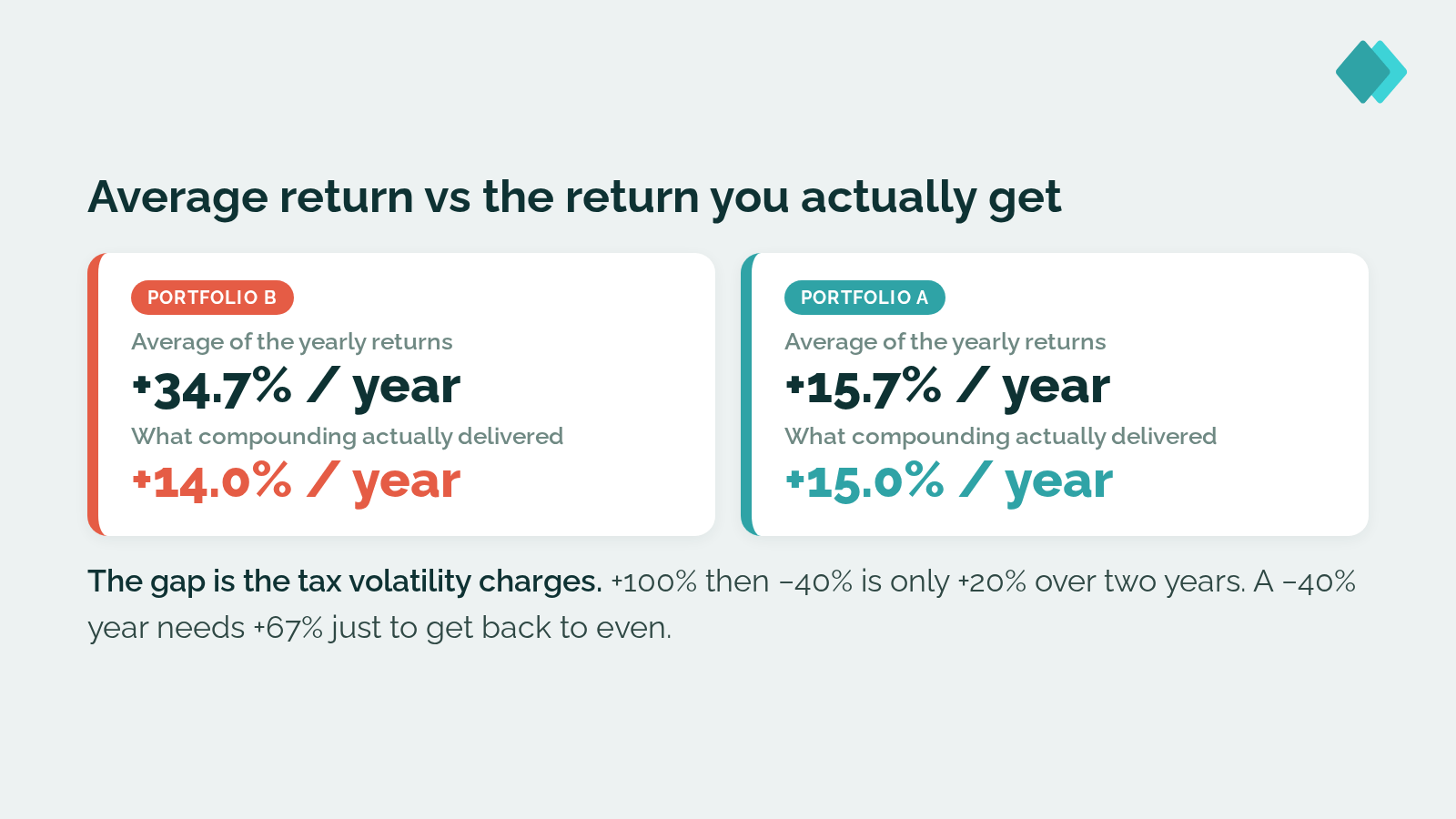
Twenty percentage points of "average return" evaporated. Where did it go? Into the arithmetic of losses. A +100% year followed by a −40% year is not +60%. It is 2.0 × 0.6 = 1.2, or +20% over two years. And a −40% year needs a +67% year just to get back to where you started. Losses and gains are not symmetric, and the bigger the swings, the bigger the gap between the average you brag about and the money you actually have.
Compounding does not care about your average. It only cares about how deep you fall.
In finance this has a boring name, volatility drag. In my old job we would have called it the difference between the mean of the training set and what the model does in production. Same idea. The average is not the thing you get to keep.
The price that isn't in the table: your mental state
The simulation above is a spreadsheet. It assumes a person who sits through fourteen years of ±40% swings without doing anything stupid. I have met very few of those people. I am not sure I am one of them.
In the real world, Portfolio B means: put in US$6,000, watch it become US$3,600. And if the bad years arrive back to back, as they did in the simulation, US$2,160. Are you actually going to sit still?
Because the −40% moment is precisely when the irrational decisions show up. Panic. Cutting losses at the bottom. Switching strategies. Or, out of pure desperation, trying to call the top and the bottom of every stock, which is neither realistic nor necessary for success in this business.
And remember: in the real world you do not get the schedule. You will never know in advance which year is the +100% and which is the −40%. The only certainty is that if you bail at the bottom, the compounding is broken right before the part that would have paid you.
So in practice, Portfolio B's real-world result is usually worse than the simulation, because the simulation assumes nobody flinches.
The second price: your time
Treasure hunting eats time. Screening hundreds of tickers, watching the group chats, late nights on annual reports of companies you will never buy. All of that to find one needle.
Now imagine spending that same time on something with a far higher hit rate: your job, or your business. The output of that effort becomes extra ammunition for Portfolio A.
Suppose you add just 10% of your original capital to Portfolio A every year, out of earned income. Fifteen years later A finishes at 12.8x instead of 8.1x. Nearly double Portfolio B. The tortoise, fed regularly, is not even a close race any more.
We eat with money, not with percentages
This is the sentence I would most like people to take away.
Investing is not a competition for the highest return. It is a search for the most stable return you can compound a large amount of money on, for a very long time.
That distinction is also why the wealthy keep getting wealthier without doing anything heroic. 15% on US$600,000 is US$90,000 a year. To earn the same US$90,000 from US$60,000 you would need +150%, every year. One of those is an investment strategy. The other is a lottery habit.
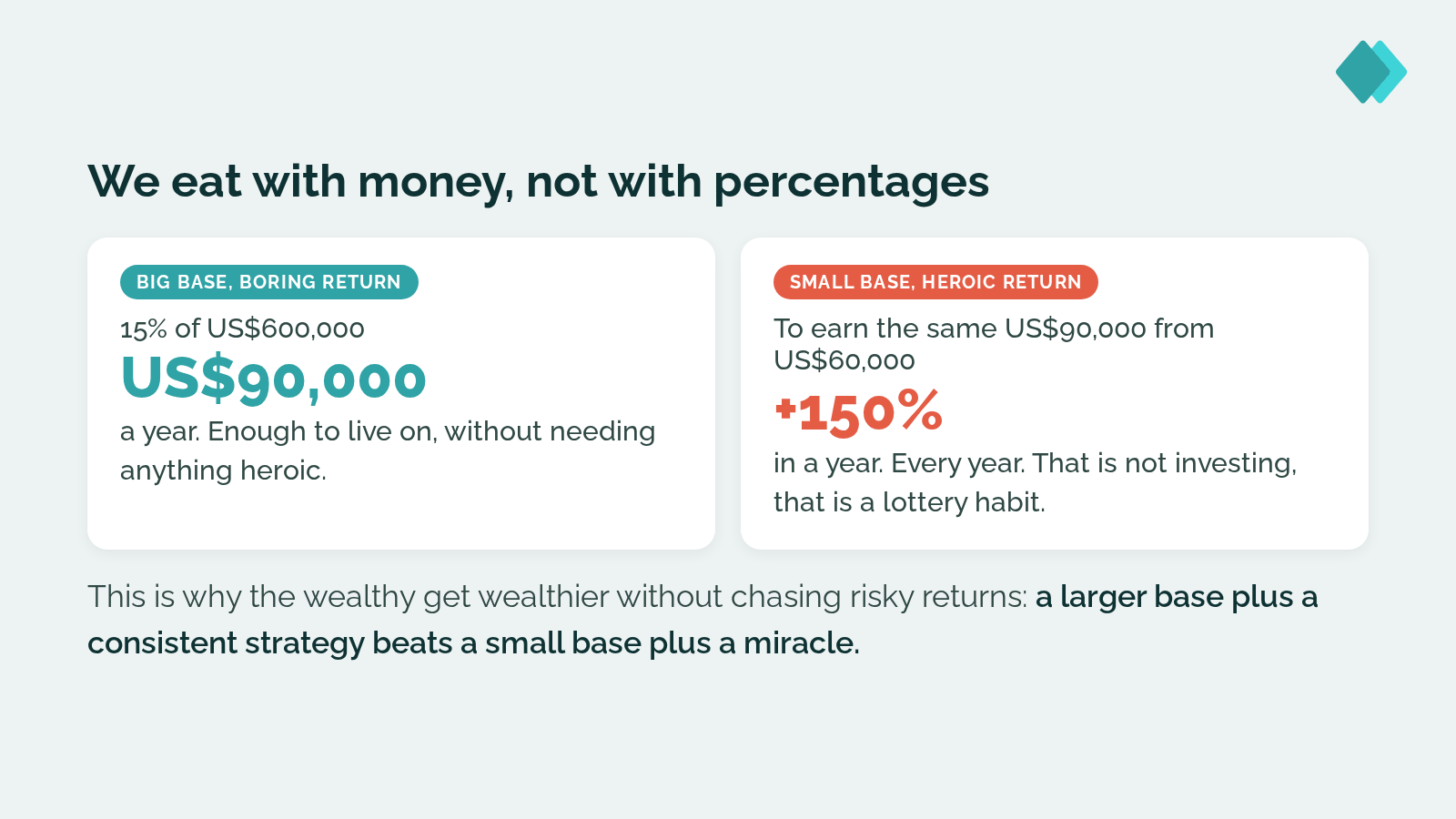
A larger base plus a consistent strategy beats a small base plus a miracle. Nobody who is already rich needs to hunt dragons. That should tell you something about how the rich got there.
Closing
One honest caveat, because I don't want to oversell a spreadsheet: this is a stylised simulation. Real returns are not this neat, and a real 15%-a-year portfolio is hard work to build and harder to hold. The point is not the specific numbers. The point is the shape: shallow drawdowns compound; deep drawdowns, however exciting the recoveries, quietly tax you every cycle.
At Recompound we are not hunting the next multibagger. What we chase is more boring: consistent compounding with drawdowns kept in check, so that our clients can actually stay in the game until the end, without cutting losses at the bottom. Downside first. Upside takes care of itself.
If you would rather have the dragon, I understand. Just read this post again in year 14.
See you on the next one.
This is why I think drawdown control matters more than people realize. A high return strategy can still be a poor compounding machine if the path is too volatile.