



Disclaimer: Everything in this post is my personal opinion, written for educational purposes. It is not financial advice, and nothing here is a recommendation to buy, sell, or hold any security. Understanding a business better does not eliminate the risk of loss, and no approach guarantees a positive return. Please do your own research and consult a licensed professional before making investment decisions.
p.s. shout out to Telin and Nadia Harsya for the kind opportunity.
I have attempted to write this essay a number of times.
In a nutshell, Budi the investment advisor was invited to present at Telkom. Room full of managers, a few VPs. It makes us sound like a big company that is main stream, and I’ll admit that it is a nice feeling when you still spend half your week explaining to people how Recompound works.
But every time I drafted that version I got three paragraphs in and stopped, because I could not answer the only question that matters: what am I actually trying to say?
A post about presenting at Telkom is a post about us. And nothing that happened in that room was about us.
In the presentation, Budi had spent about forty minutes explaining that a share is a piece of a business. That when you buy stock, you are buying a slice of a company’s ability to generate profit. Not a lottery ticket.
Then a man put his hand up and said, roughly:
I still don’t understand stocks. I particularly do not want to invest in Indonesian stocks because of the depreciating Rupiah. Wouldn’t it be better to invest in a real business?
My first instinct was that this was a comprehension problem. Something about lack of financial literacy. Something we needed to explain better, or louder, or with more examples. Like showcasing long term depreciation of Rupiah vs USD. Or highlighting companies in IDX with double digit ROEs but traded at rock bottom valuations.
Boy that instinct was wrong because assuming that my instinct is correct, it means that we blame the user. And after much reflection, I don’t think that the hardworking Telkom employee is wrong.
I only have the language to explain why that is wrong because of a book I read for reasons that had nothing whatsoever to do with markets: Don Norman’s The Design of Everyday Things. A book about door handles. Stove knobs. Why I struggle with using the microwave, sometimes.
It turns out the market is a product of design too. Which has its own consequences.
The Norman Door
There is a door in your life that you push when you should pull.
You know the one. That annoying door with a flat metal plate on one side, handle on the other. You walk up, you push, nothing happens, and for about half a second you feel like an idiot. Then you pull, and you walk through, and you never think about it again.

These are now literally called Norman doors, which I find very funny. The man wrote a book explaining that bad design is not your fault, and his reward was to have every terrible door on earth named after him. There is an entire Tumblr of them, submitted by strangers, still going — which tells you the problem is not exactly rare.
The book opens by refusing to accept your embarrassment.
“When you have trouble with things — whether it’s figuring out whether to push or pull a door or the arbitrary vagaries of the modern computer and electronics industries — it’s not your fault. Don’t blame yourself: blame the designer.”
And elsewhere, the sharper version: human error is usually the result of poor design. It should be called system error.
I will come back to the man in the room at Telkom, but to get there — from a door handle to a stock exchange — we need the two ideas the book is actually built on.
A triangle
Now imagine yourself as a designer. You build a thing that is intended for use to your users. The thing you design is intended to solve your user’s problem. For example, if your thing is a door, that door helps your user solve their problem of entering the building.
Now designer has a model in their head of how the thing works and what it’s for.
The user also builds their own model of how the thing works from what they can observe.
And in between there is the product, the actual object, sitting there in the world.
Now the designer never gets to talk to the user. As Norman puts it:
“Good design is also an act of communication between the designer and the user, except that all the communication has to come about by the appearance of the device itself. The device must explain itself.”
The visible surface of the thing such as what it shows you, what it lets you touch, what it reports back is what Norman calls the system image. And whatever the user ends up believing about the thing gets built out of that surface, because there is nothing else to build it out of.
If the system image communicates the designer’s intent, you get a good door. If it doesn’t, you get a man standing in a lobby, pushing and pulling not knowing how to open the door.
Conceptual Model
There’s a proper name for the thing the user ends up with: the conceptual model. A conceptual model is your working story of how a thing behaves. The simulation running in your head that lets you predict what happens if you do X to that door.
And here is the part that gets people: a conceptual model does not have to be technically accurate. It only needs to be functional. You do not need to understand a refrigeration cycle to keep milk cold. You need a model that reliably predicts what happens when you turn the dial → the fridge becomes cooler or warmer.
Now a good and bad system image is not that intuitive to distinguish. Because as what the Norman door example above suggested, a bad system image means that it is confusing and frustrating to use isn’t it?
Well not really.
Norman’s own example is his refrigerator, and I like it because he is the one who ends up looking funny in it.
It had two dials. One labelled for the freezer, one for the fresh food compartment. So he built the model any of us would build: two dials, two compartments, two cooling systems. Turn this one to make that one colder.
Nothing about that is confusing. It is clean, obvious, and usable on the first try.
But it is also completely wrong.
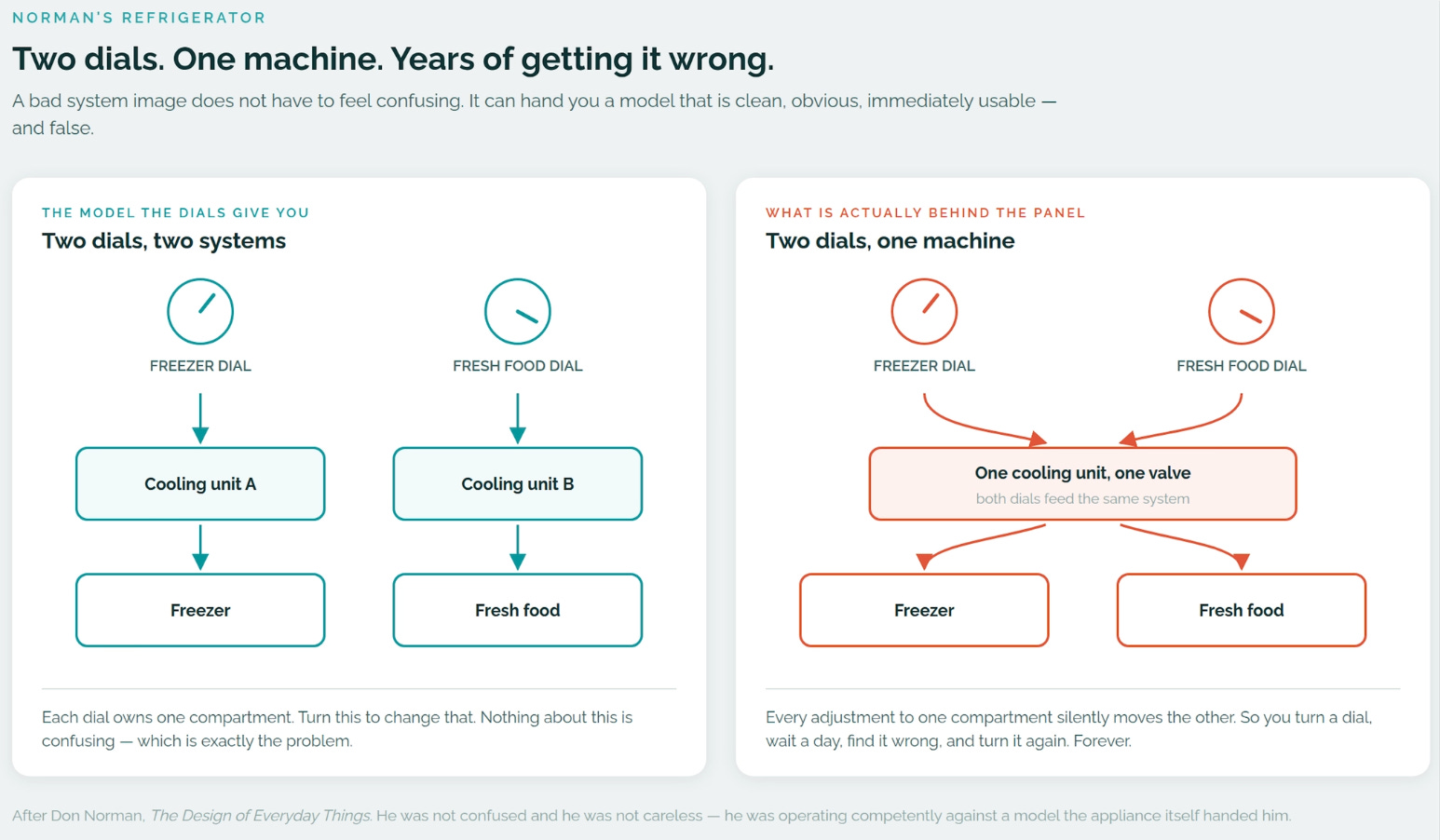
There was one cooling unit and a valve dividing the cold air between the two compartments. Both dials fed the same machine. Which means every adjustment he made to one compartment silently moved the other.
So he would turn a dial, wait a day for the temperature to settle, find the result wrong, turn it again, wait another day but never quite converging.
Lets sit with what that means. He was not confused, and he was not careless. He was operating correctly and intelligently against a model the appliance itself had handed him. The two dials told him there were two systems where there is actually only one.
That is what a bad system image actually does. It does not leave you confused because confusion at least makes you stop and ask someone. It hands you a clean, confident, wrong model, and then you act on it competently, for years, wondering why the results never quite come.
So, the product here is the capital market. What is its system image, and what conceptual model does it hand you? What is supposed to happen when you buy a share of a company from the stock market in your mind?
What the market shows you
Open your sekuritas (broker) app. Right now, if you like.
A column of four-letter tickers. A price beside each one. That price in red or green. A percentage change since this morning. A total at the top, also in red or green. A time selector that opens on 1D. Somewhere a running tape, and a headline about something a foreign official said last night.
That is the device explaining itself. That is the entire communication from designer to user.
Here is a Tuesday.
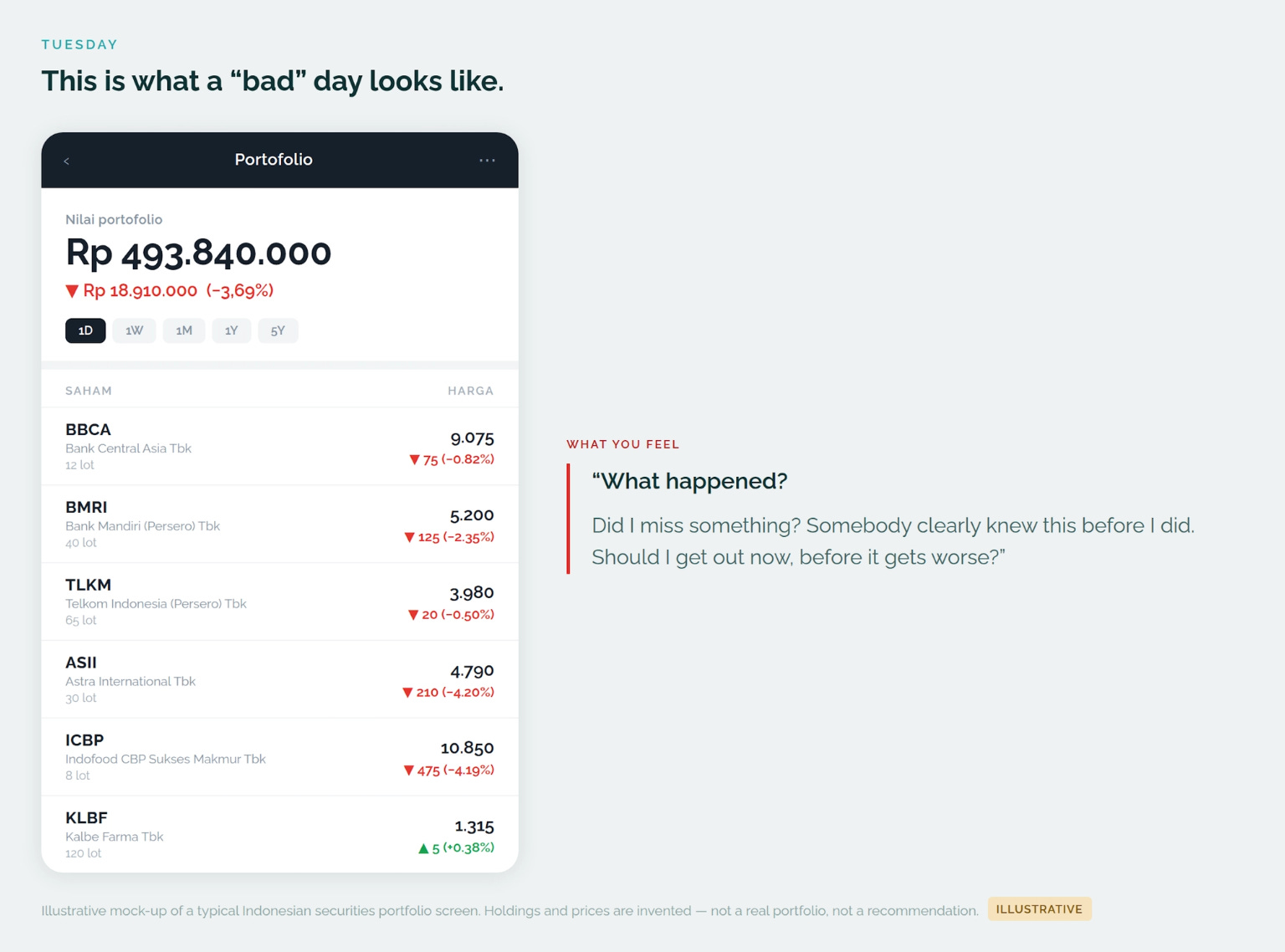
You do feel something in your gut after reading the above don’t you? Not to worry, I feel it too.
Now here is the portfolio on Wednesday, one day after.
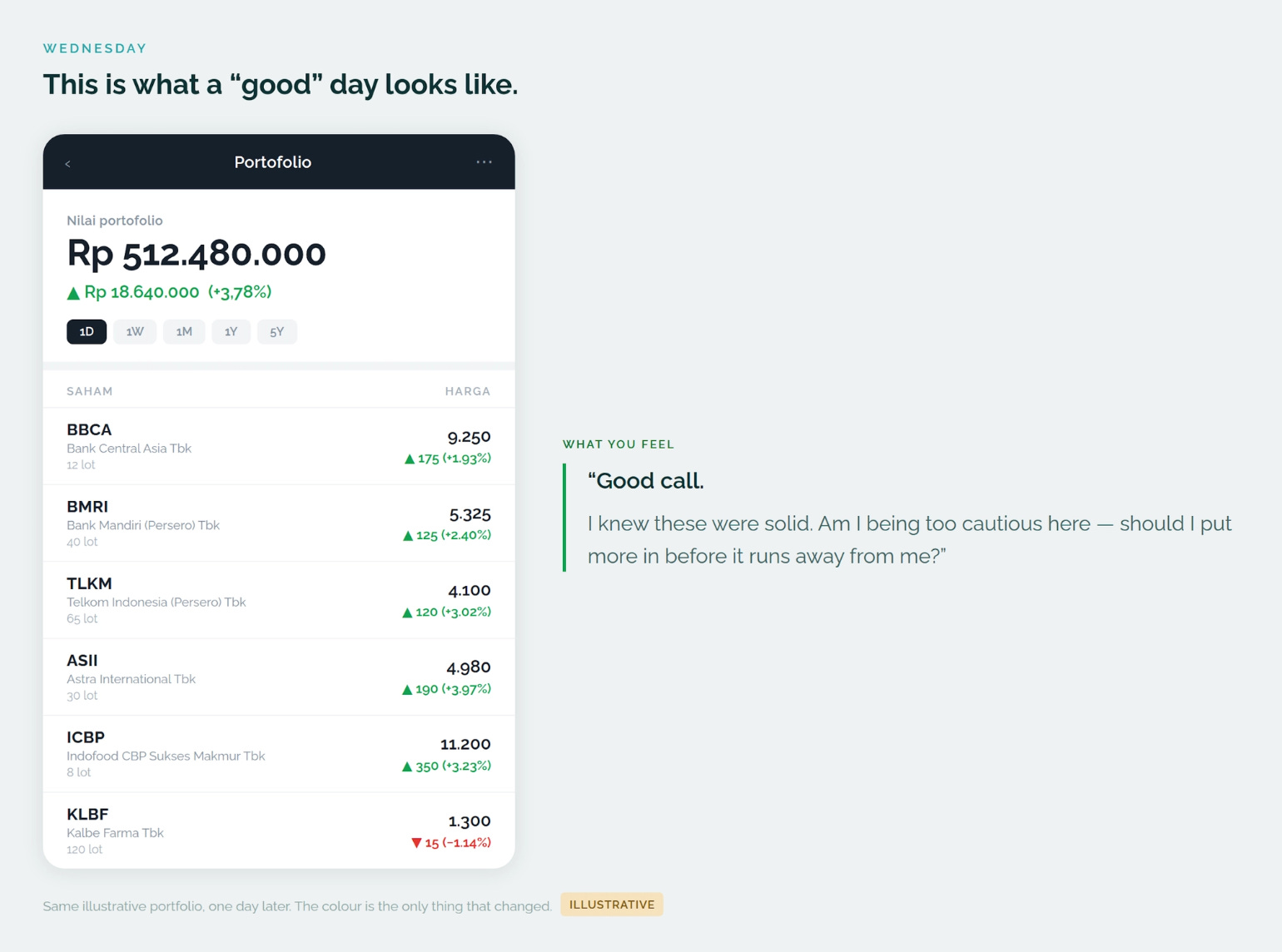
Do the underlying businesses change? Astra? BCA? Mandiri? Telkom?
Well most probably nothing happened to any of those company. The board of directors are the same, business model is the same, marketshare is pretty much the same.
The only thing that changed was the colour of your app.
The colour is not innocent btw. The colour tells you on Tuesday to ask if you should sell your position. On Wednesday, it tells you that you are clever and you should probably buy more. It does not have a memory and it does not mention about the details that you own.
So what conceptual model would a reasonable person build with this design? Well the answer is quite obvious:
This is a thing whose number moves up or down. My job is to guess which way it moves next.
That model is not a failure of intelligence. It is a faithful, accurate reading of the interface in front of them. It is what the device said.
Here is the whole thing in one picture.
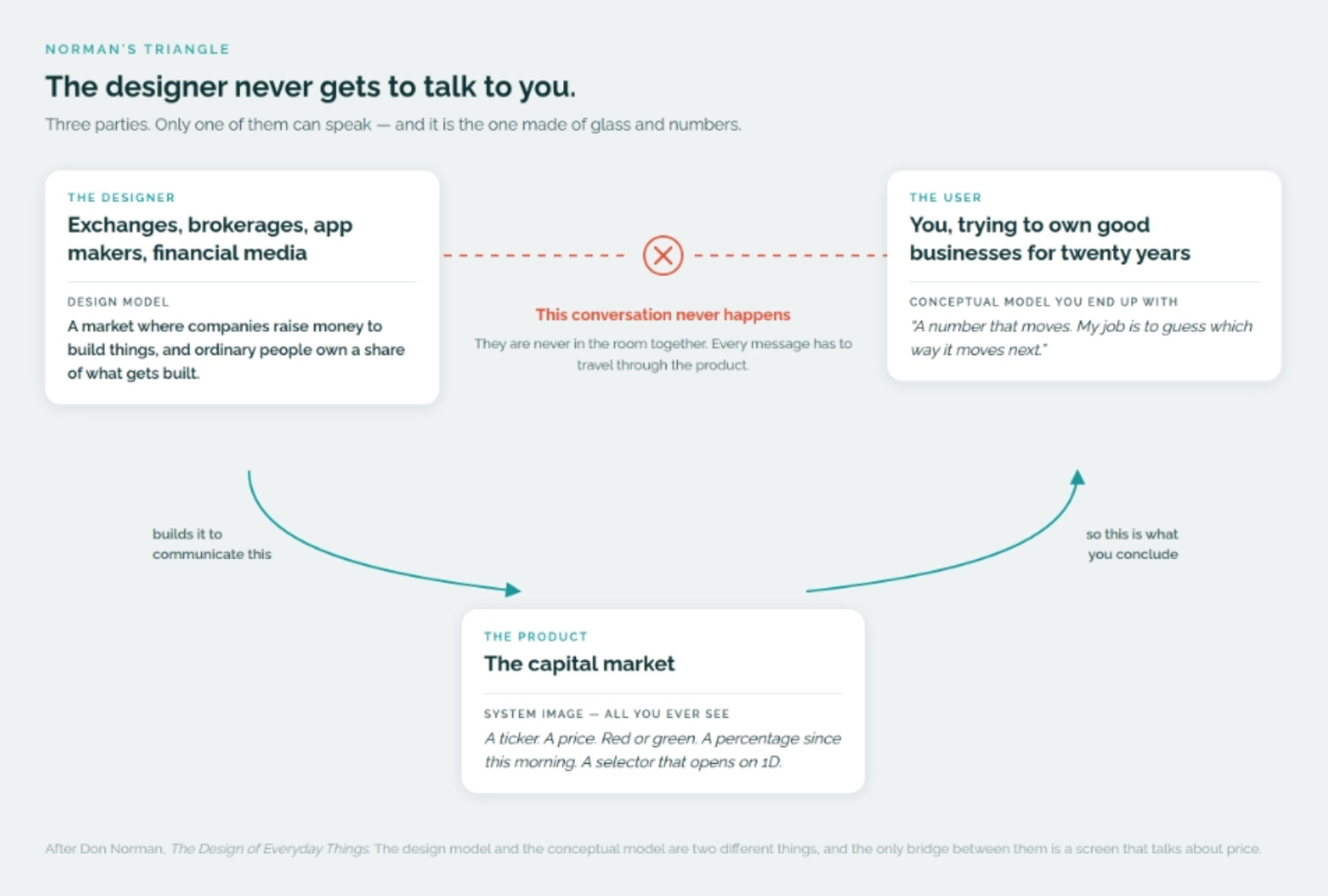
On the left corner, the market is what the thing was built to be. On the right, what people actually end up believing it is. Those are not the same sentence, and they are not even about the same subject. One is about businesses, the other is about a number.
And the thing is, it is actually a pretty darn good design
This is the part I got wrong for quite some time.
That interface is not incompetent. It’s superb.
Price, volume, spread, order book, time, volatility. For a trader, that is a beautifully designed cockpit. Every single element maps directly onto a decision they have to make in the next few hours. The feedback loop is tight, fast, and honest about exactly the thing they care about. If you handed a trader an interface that showed them a company’s ten-year return on equity and hid the bid-ask spread, you would have ruined their tool.
Good design is always good for somebody. The only real question is: for whom?
Well from how the interface was designed, refined, and marketed, it is no brainer that it is good design for people trading on a more short term time horizon.
So the interface was built for traders, but handed to everyone.
But the market has another job
Allowing people to trade is not the only reason why stock market exists.
If you strip it back, a business is a unit through which a society converts effort into value. The capital market is the invention that lets those businesses raise money to build more of it such as factories, hiring, distribution, research. And then it lets ordinary people own a share of the result.
Growth on one side, participation on the other. For all its imperfection, I believe capital market is one of the most significant invention of modern human civilisation.
So consider the other user. Not the trader. The doctor in Surabaya with a busy practice, the founder with cash flow she doesn’t want sitting in a deposit account, the Telkom VP with twenty working years ahead of him. Their goal is: own a piece of Indonesian productivity for the next two decades and don’t screw it up.
Now hand them that same screen.
Norman has a word for the relationship between what you’re trying to do and what the interface lets you perceive and control. He calls it mapping. Good mapping means the controls line up naturally with your intentions. For example, the stove knob that’s positioned like the burner it turns on.
For the long-term owner, the mapping isn’t just weak. There is essentially nothing on that screen that maps to their goal. Not one control, not one readout. Every visible element is about the next few hours.
Even worse feedback: confident about the wrong thing
Norman has an idea that I think is the sharpest tool in this whole argument. He calls it the gulf of evaluation: how hard it is, from what the system shows you, to work out what state the system is actually in.
Again, the market does not give you no feedback. It gives you excellent feedback. It just happens to be feedback about a state you probably should not care too much about as a long term investor.
If your goal is to own a productive business for twenty years, the state you need to evaluate is: is this business still earning more than it did, still run by people who are competent, still defensible? That state changes maybe four times a year or even less.
Imagine an alternative universe where you are not getting any feedback from these apps. You probably will go and try to find the real indicator. Business performance from public expose, information from the investor relations website, and so on. But the feedback is too excellent, so it does something worse. It convinces you that you are paying attention to the right things.
Benjamin Graham said the market is a voting machine in the short run and a weighing machine in the long run. I have read that line time and time again and understood it better through Norman.
The interface shows you the vote.
The business you actually own is the weight.
We keep checking the interface, so we reason around the interface. Not the actual thing.
Remember the Tuesday and Wednesday screens? Here are those same two days, drawn from a long-term view.
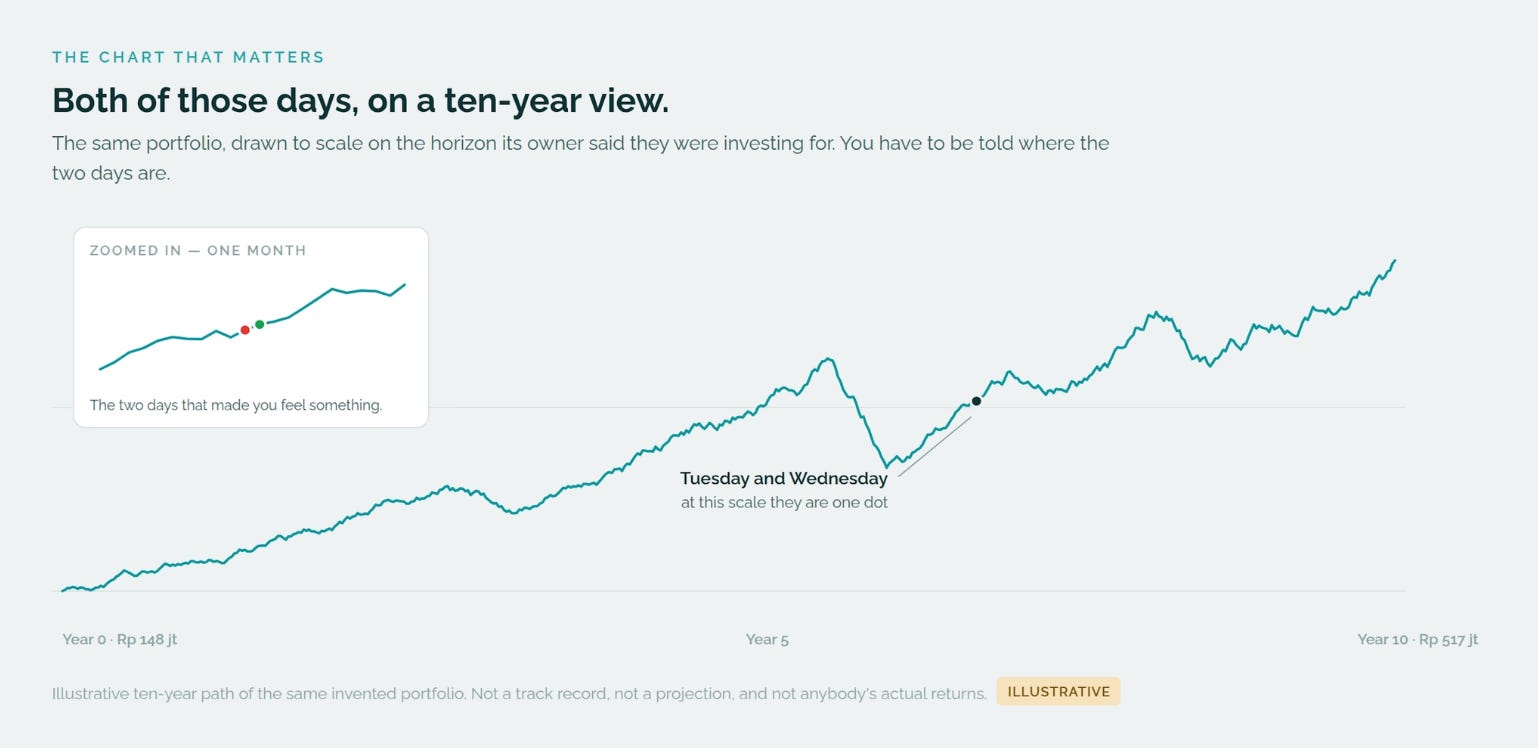
In your head those two days are miles apart. On the chart they are one dot, and you only had to be told where to look.
Good questions from good people
Now go back to Telkom, and look at what people asked in the Q&A.

What will MSCI do to the Indonesian market. What happens if Trump tweets something tonight. Is the US market simply better than ours. How can equities work if the rupiah keeps weakening.
I want to be careful here, because the easy read is that these are questions from people who should know better. Majority managers and above. Some VPs. Smart, ambitious people who run functions inside one of the largest companies in the country.
They were not asking bad questions. Given their conceptual model, they were asking the correct questions.
If you believe you are holding a number driven by news, then studying the news is the rational thing to do. Every one of those questions is well-formed and exactly what a competent person would ask.
And the man who said he’d rather invest in a real business? Under Norman that isn’t a contradiction at all. It’s a coherent sentence from someone whose conceptual model of “stock” is a screen and whose conceptual model of “business” is a thing that makes money. Two dials, two systems.
He was not failing to understand Budi.
He was telling us, precisely, that the system image had never communicated the design model to him. Forty minutes from Budi was up against twenty years of a screen.
Taught helplessness
There’s a cost to this as Norman describes the loop precisely: you fail at something, you conclude it’s your fault, you conclude you can’t do this kind of task, and you stop trying. He calls it learned helplessness.
Saya nggak ngerti saham.
I have heard this sentence a lot. It is never said as a neutral fact. It is said the way people say they are bad at maths, with a sheepish smile and a small shrug.
But what they mean really is that they don’t understand MACD. Or Ichimoku, or the Kijun line, or RSI divergence, or Fibonacci retracement, or bandarmology, or flow. That is the syllabus they believe they failed.
Well, we don’t know most of that either.
I don’t. Budi doesn’t, the licensed advisor, the one standing at the front of that room. Ask either of us to read an Ichimoku cloud and we would have to look it up, and we would probably still get it inaccurate.
And we don’t feel stupid about it.
Not because we are clever, but it is because none of it belongs to the job we choose. The syllabus for the job we are doing is much shorter than anyone tells you. Am I buying this asset for less than its worth, or not?
That is most of it (not easy) but almost none of it is on the sekuritas screen.
So when somebody tells me they don’t understand the stock market. I believe that it is not really a human error, it is more of a human reading a product that is intended for a different set of audience.
So what to do
Here is the smaller, less inspiring, but actually works, thing to do. Two changes to your environment. Zero changes to your character.
One: turn off the price notifications. Remove the thing that reaches into your pocket to tell you about a variable you have already decided is not your variable. Takes about forty seconds, once, and then it is done forever.
Two: put one recurring entry in your calendar for the first quarter of each year, when the companies you own publish their full-year numbers. Not to trade on. To read. That is the other gauge, and since no app will ever surface it for you, the calendar has to.
Or of course if you are fortunate enough to have access to your Recompound dashboard, you can go there once a month and stay tuned for updates on the investment thesis published ;)
Norman’s actual lesson isn’t try harder, it is change the world so the right thing is the easy thing.
Cheers!