

Disclaimer: This article is my personal opinion, written for educational purposes only. Nothing in it is financial advice, and nothing here is a recommendation to buy, sell, or hold any security. Client age figures are from our own records as of August 2026. Client messages are quoted verbatim but anonymised, with stock tickers masked, and shared with respect: every one of them could have been written by me at some point in my life. The studies cited are about smoking cessation and goal-setting, not investing; I use them as an analogy, not as proof that any investment approach works. Investing carries risk, including loss of capital. Please do your own research and speak with a licensed professional before making decisions.
There is one concept I believe in that I have never seen in any finance textbook:
People have to get wrecked first. Then, and usually only then, do they change for the better.
Indonesian has the perfect word for the state that produces this change, and since a good share of you reading this are not Indonesian, let me spend a paragraph on it, because the whole post hangs on it.
What "kepepet" means
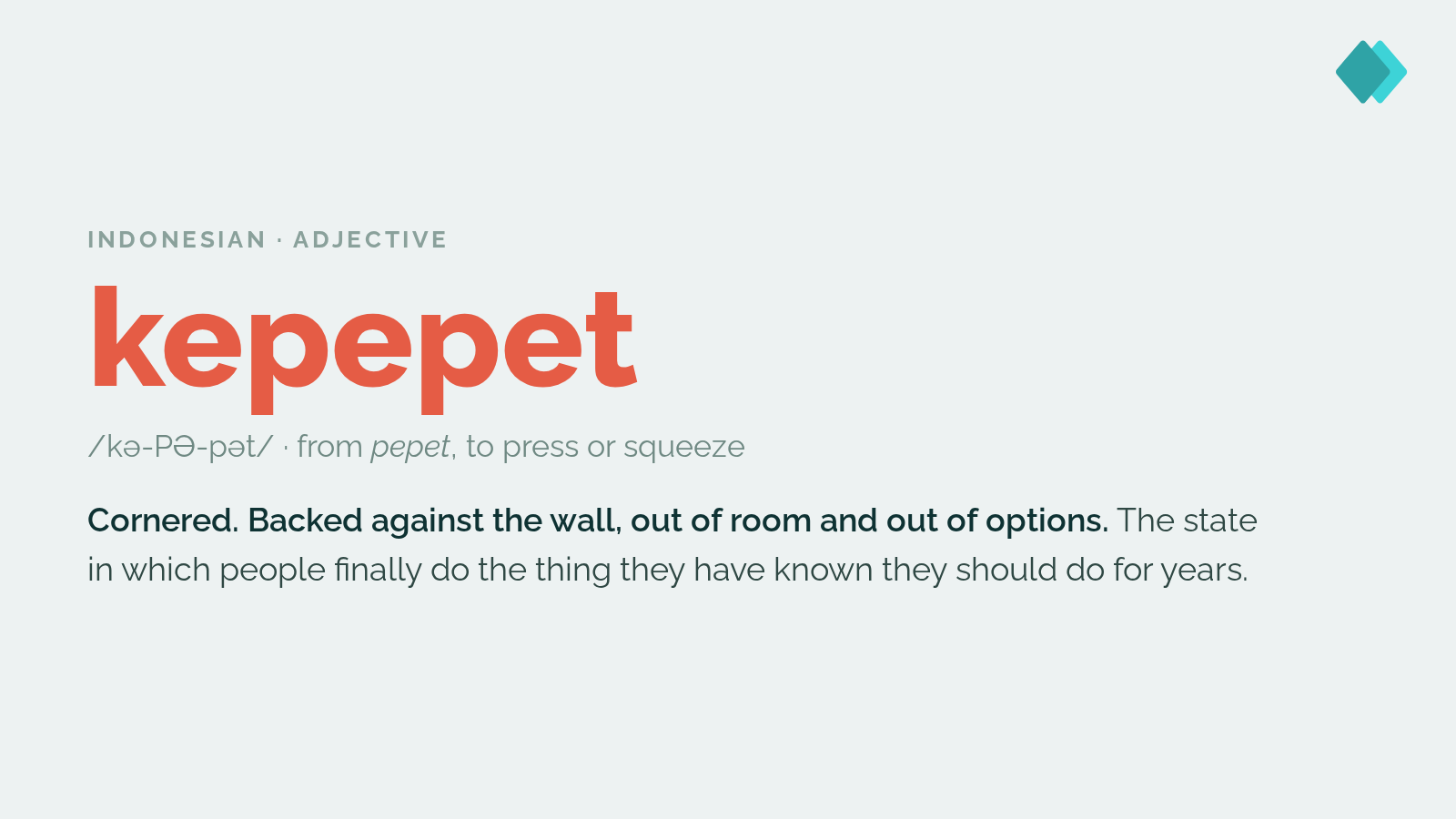
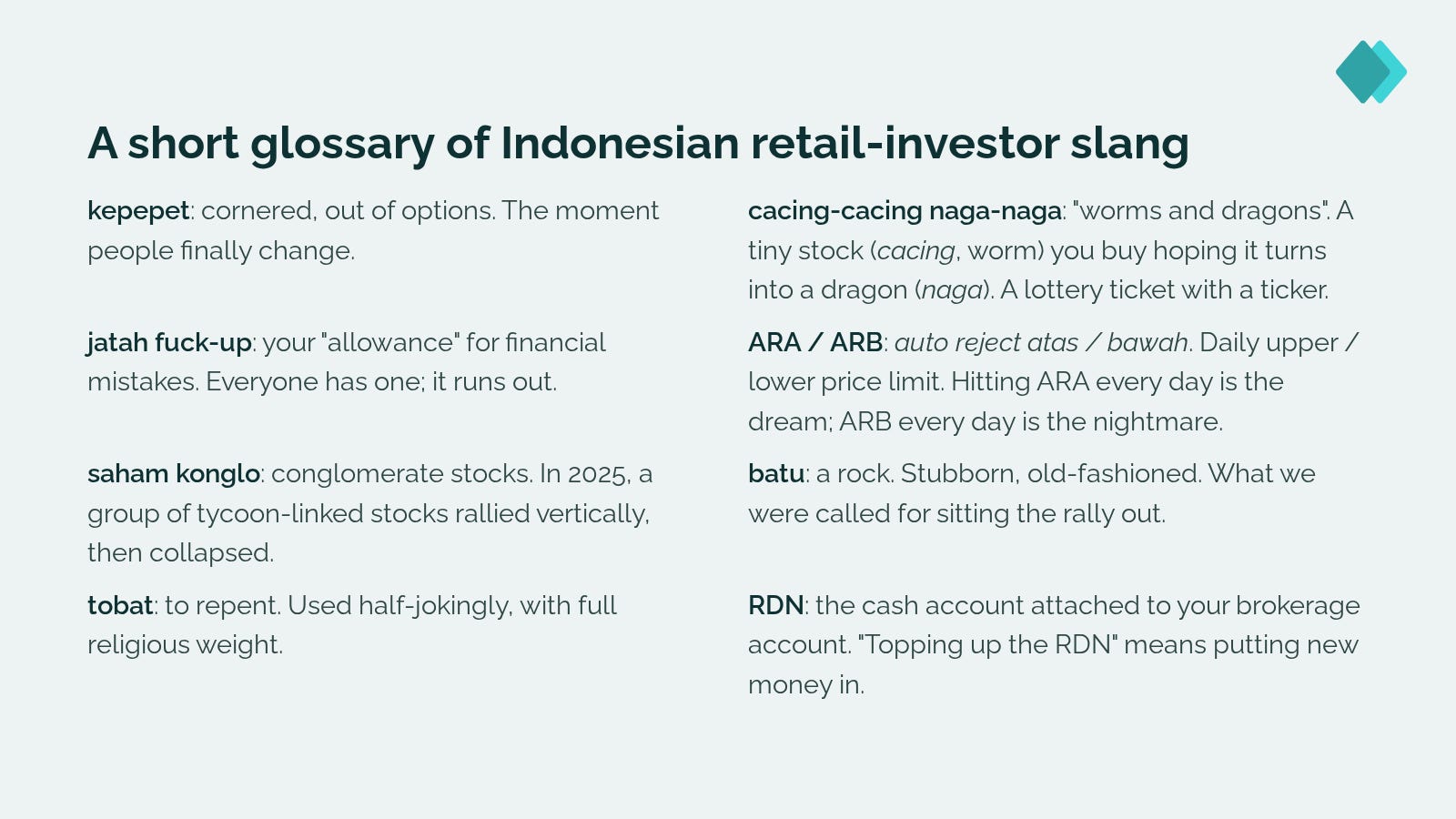
Kepepet (roughly "kuh-PUH-put") comes from pepet, to press or squeeze. It describes being cornered: backed against a wall, out of room, out of options, out of time. It is the word you use when you finally pay the bill on the last day, or take the job you swore you'd never take, or sell the motorbike because the rent is due tomorrow. There is a well-worn Indonesian saying that the most powerful force in the universe is not love or money, it is the power of kepepet, because a cornered person will do things that a comfortable person has been "planning to do" for ten years.
It is not a pleasant word. It is also, after a few thousand user calls, the single most reliable predictor I know of whether someone will actually become a long-term investor.
Let me show you where that belief comes from. Spoiler: it starts with a number almost everyone guesses wrong.
The age question
The question I get asked most often at dinners, right after "so what do you actually do":
"How old are your clients, on average?"
Almost everyone guesses early twenties. Fresh graduates, first brokerage app, first taste of cuan (Indonesian slang for profit, borrowed from Hokkien). It's a reasonable guess, but wrong.
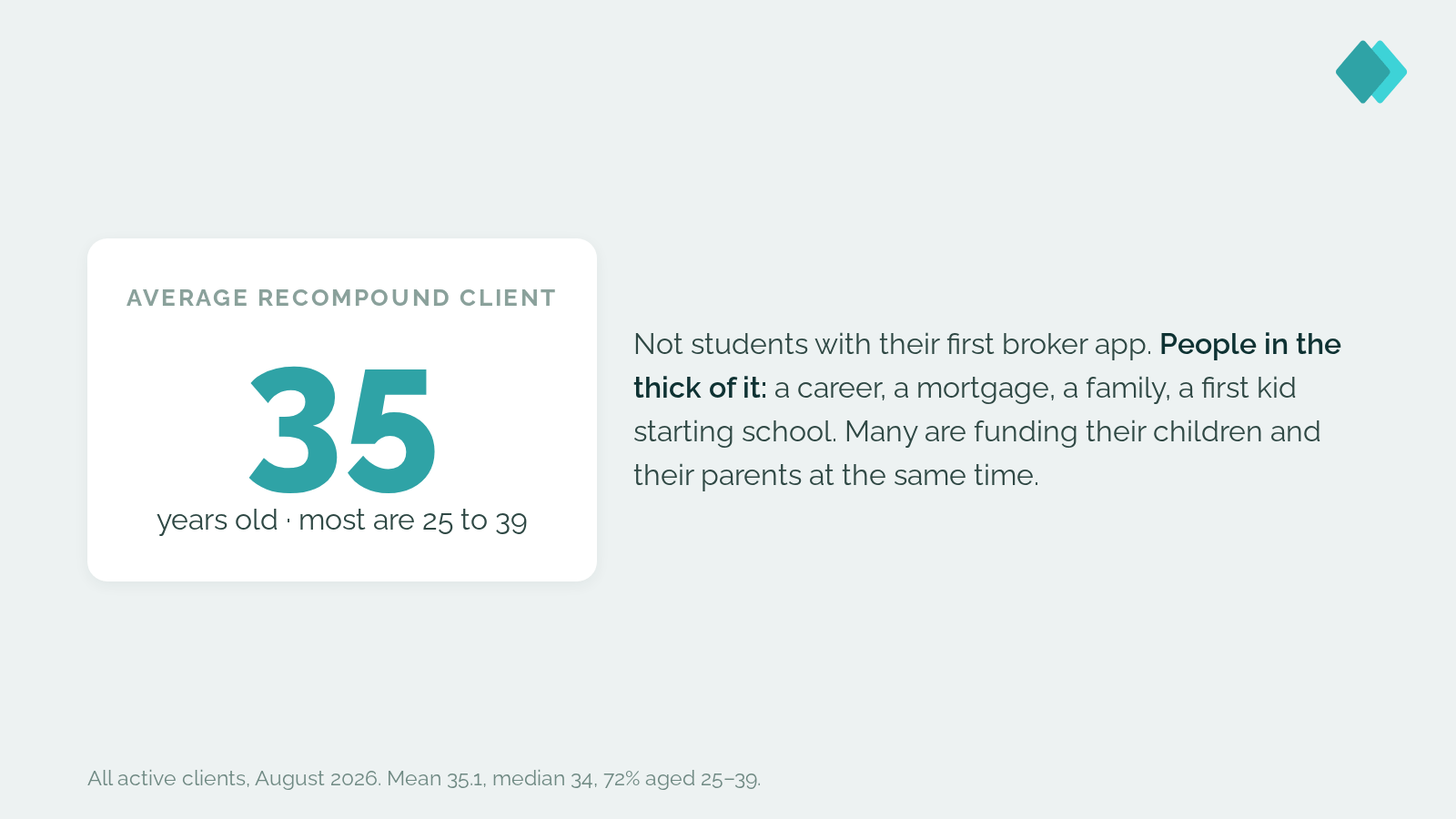
Our average client is 35. The majority are between 25 and 39. People in the thick of it: a career, a mortgage, a family, a first kid starting school. A good number are the sandwich generation, funding kids and parents at the same time.
When I first pulled this number, I was puzzled. Why not the young ones? They have the longest runway. Compounding should matter most to them, and they're the ones posting about stocks all day.
The answer only showed up after Toby and I had personally taken thousands of onboarding calls. The surface reason is always the same: "I'm busy." True, but not the real reason. If the conversation goes deep enough, a more honest sentence comes out. It's phrased a hundred different ways, but it always means the same thing:
"Jatah fuck-up gue udah makin tipis."
Literally: my fuck-up allowance is running out. Jatah is a ration or quota, the kind you get for rice or fuel. The clients' phrase, not mine, and I've kept it because no polite translation carries the same weight.
The allowance
Everyone starts adult life with a quota of financial mistakes they can afford to make. It isn't written anywhere. Everyone knows it's there, and everyone spends it.
Following a friend into a stock. Chasing the hot coin. Hunting the next multibagger. In Indonesian retail slang, hunting cacing-cacing naga-naga: "worms and dragons". A cacing (worm) is a tiny, illiquid stock, often trading near the exchange's minimum price; the dream is that your worm turns into a naga (dragon), a ten-bagger. It's a lottery ticket with a ticker symbol. Going all-in with Rp 10 million (about US$600) hoping it becomes tens of billions. Or the slow-motion version, which is the most common one I see: investing for years, making great money in the bull market, and giving all of it back in the bear market.
At 22 this feels like an adventure. At 35 it feels different, because life's invoices have arrived: household costs, school fees, a parent who needs help. And you look back and realise that after years of "investing", the money has not actually gone anywhere.
The science has a name for this
For a long time I thought this was just a Recompound observation. Then I went looking, and it turns out medicine has been documenting exactly this pattern for decades. They call it a teachable moment.
Take smokers. Doctors tell them at routine check-ups, year after year, that smoking will kill them. In studies of that kind of routine advice, roughly 2 to 10 percent quit.
Now take smokers who have just had a heart attack. In one study of acute coronary patients, about 70 percent quit within a month, and two-thirds were still off cigarettes a year later.
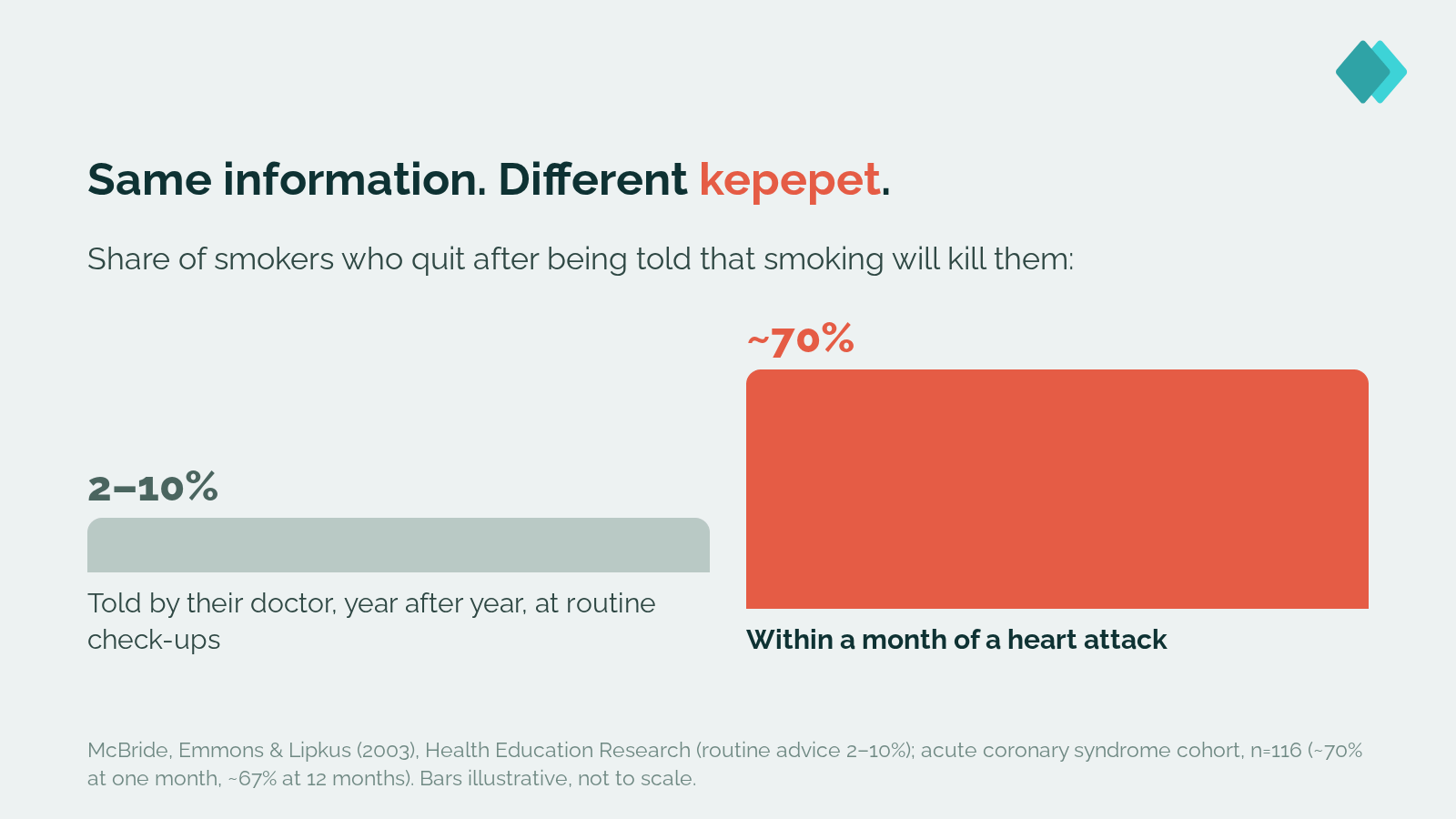
One. more. time. The information is identical in both groups. Smoking kills you. Nobody learned anything new in the ambulance.
The only variable that changed was kepepet.
There is a gentler cousin of this, documented by Wharton researchers under the name fresh start effect: people's commitment to change spikes right after temporal landmarks. New year, new month, and especially birthdays. Turning 30. Turning 35. A first child. Quiet alarms, but they ring deep, and the message is always the same: your playing-around allowance is almost gone.
We watched this happen live in 2025
Theory is nice. Let me show you a teachable moment on the Indonesian stock market. A little context first for readers abroad.
In 2025, a group of stocks linked to Indonesia's big family conglomerates, saham konglo in local slang, went to the moon. Not "had a good year" vertical: hitting the exchange's daily upper price limit (locals call it ARA, auto reject atas) day after day, on valuations that had stopped meaning anything. Every group chat was on fire. We sat it out, and we got criticised for it, including by our own clients. We were stubborn as a rock. Here is a sample of what landed in our WhatsApp that year, verbatim, anonymised, tickers masked, with translations:
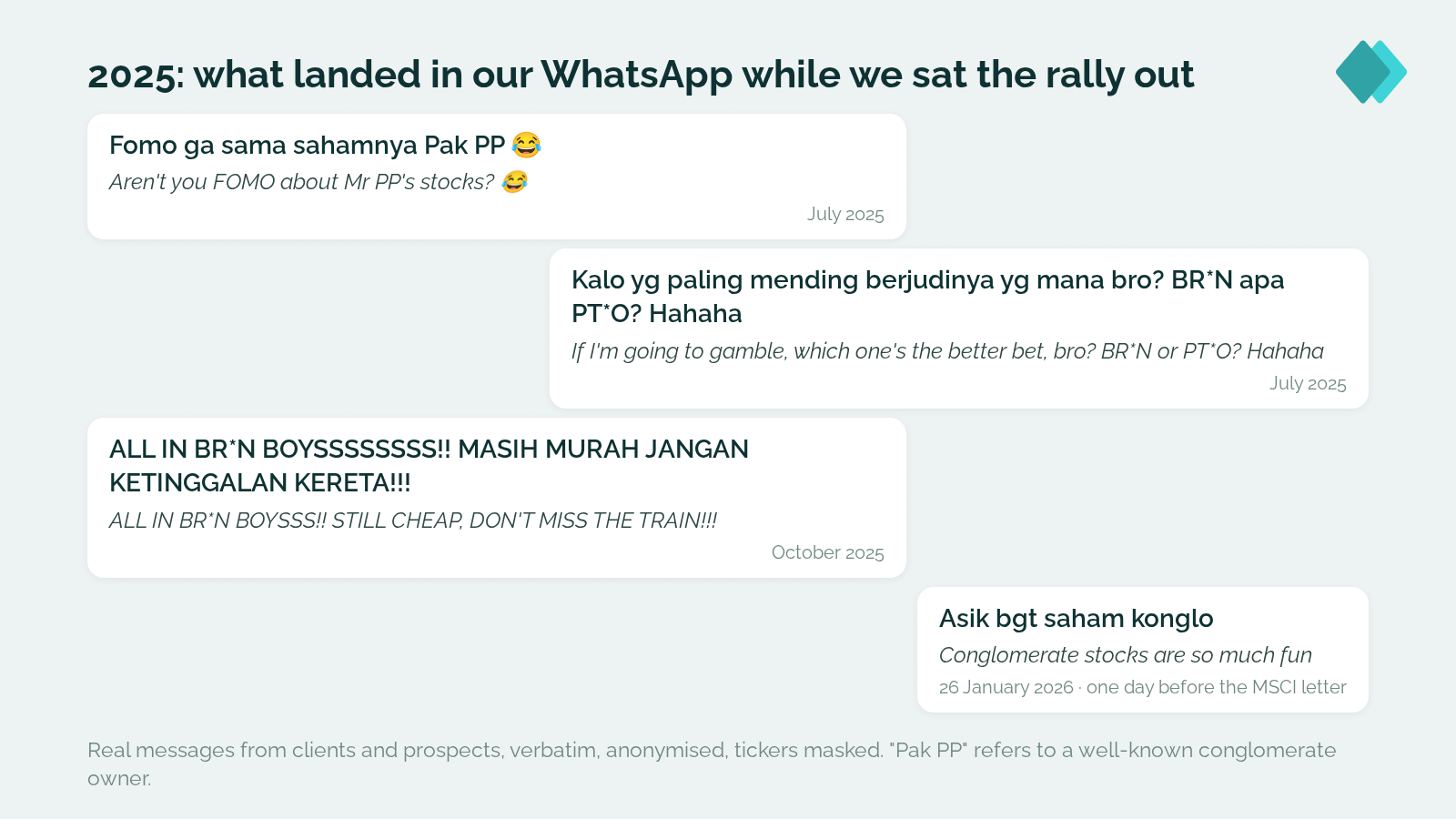
"Fomo ga sama sahamnya Pak 😂" (July 2025)
Aren't you FOMO about Mr 's stocks? 😂"Kalo yg paling mending berjudinya yg mana bro? B*N apa P*O? Hahaha" (July 2025)
If I'm going to gamble, which one's the better bet, bro? B*N or P*O? Hahaha"ALL IN B*N BOYSSSSSSSS!! MASIH MURAH JANGAN KETINGGALAN KERETA!!!" (October 2025)
ALL IN B*N BOYSSS!! STILL CHEAP, DON'T MISS THE TRAIN!!!"Asik bgt saham konglo" (26 January 2026)
Conglomerate stocks are so much fun
Look at the date on that last one. It was sent one day before MSCI sent what I've come to call its love letter to our exchange.
On 27 January 2026, MSCI, the index provider whose classifications decide where trillions of passive dollars can go, put Indonesia under review for a possible demotion from Emerging Market to Frontier Market status. The behaviour of exactly those conglomerate stocks was one of the main triggers. These stocks collapsed. Yesterday's daily upper limit became today's daily lower limit (ARB, auto reject bawah), berjilid-jilid, volume after volume, like a bad soap opera. At its worst, the Jakarta Composite Index was down about 42% from its peak.
And the same people who sent those messages? Tobat. Repented, in the full religious weight of the word. Some had the courage to cut their losses and then genuinely changed how they invest. Others surrendered, stuck in their positions, waiting for the price to come back to what they paid.
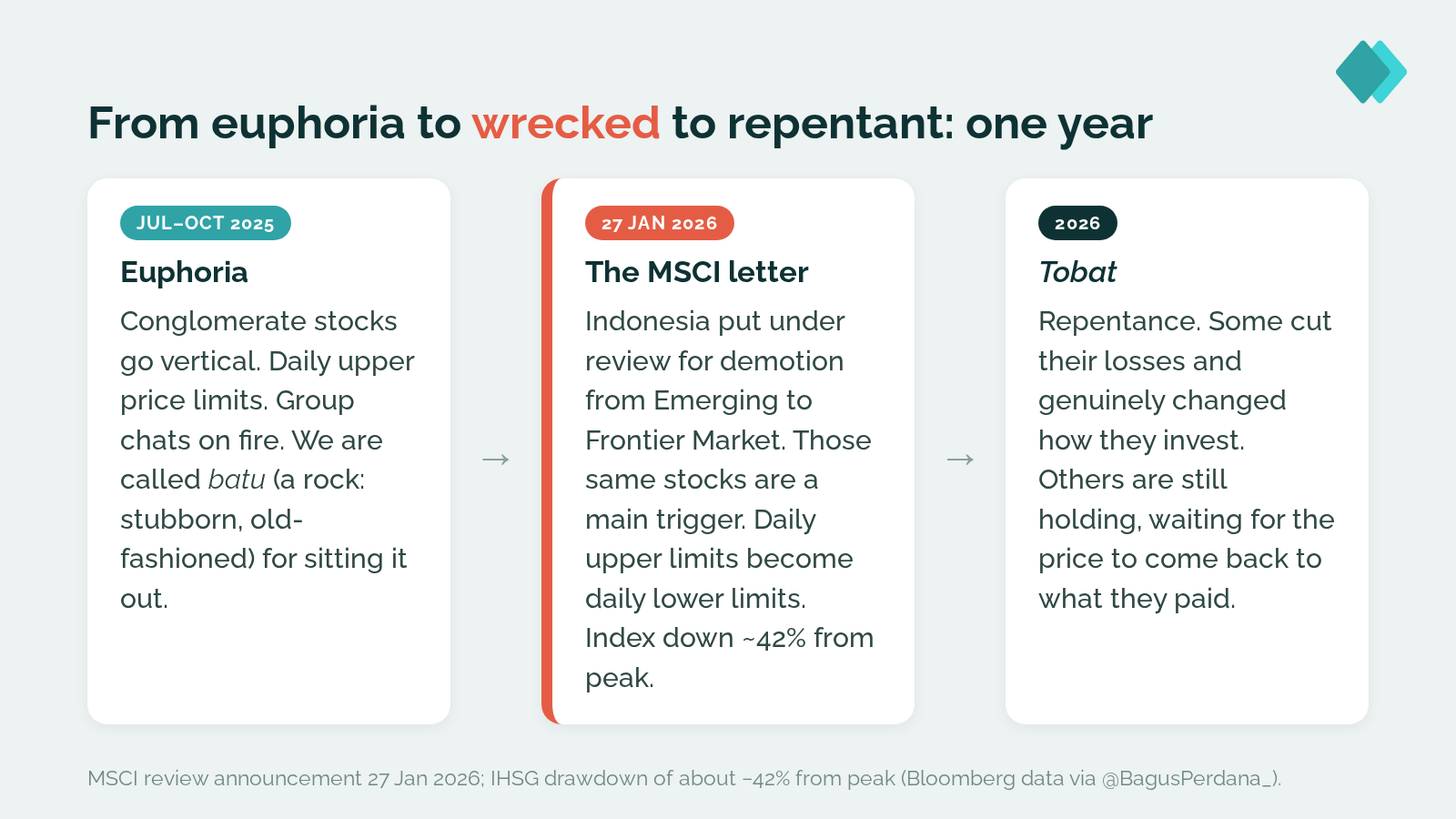
From total euphoria to wrecked to repentant took about one year.
I'm not sharing this to gloat. Being batu for twelve months while your clients call you old-fashioned is not fun, and I'd have preferred to be proven right in a cheaper way for everyone. I'm sharing it because it is the cleanest teachable moment I have ever watched in real time.
And then they actually change
This is the part that makes me keep believing in kepepet rather than resenting it.
Once someone is cornered, they genuinely change. The client who was all-in on a dragon stock last year is now asking about moats, valuation, whether the dividend is sustainable. Their portfolio stops being a casino and starts being a compounding vehicle. Slow, but more sure, towards financial freedom and a retirement that doesn't depend on guessing blindly.
That is the power of kepepet. It is not a nice power. It arrives as a heart attack, or a 42% drawdown, or a school bill on the same day as a margin call. But I have never seen anything else work as reliably. Not books, not YouTube, not us.
Closing Remarks
You can't manufacture kepepet on demand, and I wouldn't wish it on anyone. But you can borrow a little of it before the market lends you the real thing at a much higher interest rate. Two things.
One: write the sentence yourself, today. "My allowance runs out on (date)." A year, an age, an event: first kid, fortieth birthday, parents retiring. Then put that date in your calendar with a reminder. This isn't about discipline. It's about turning a vague feeling into a concrete thing, which is exactly what the fresh start research says actually moves people.
Two: send this to the friend who is still hunting dragons. Not to lecture. Just while their allowance is still there. A teachable moment delivered by a friend costs a lot less than one delivered by the market.
And if you're one of the 35-year-olds who has already had your moment and would rather never have another: that is, more or less, exactly who we built Recompound for. Every client gets their own WhatsApp group with us, and the penguatan iman (faith reinforcement, what our clients call the pep talk they need during a crash) is free.
See you on the next one.
References
McBride CM, Emmons KM, Lipkus IM (2003). "Understanding the potential of teachable moments: the case of smoking cessation." Health Education Research 18(2):156–170. Routine clinic advice: 2–10% cessation; hospitalisation or diagnosis: 15–78%.
Acute coronary syndrome cohort (116 patients): ~70% quit at one month, ~67% abstinent at 12 months (Journal of Smoking Cessation).
Dai H, Milkman KL, Riis J (2014). "The Fresh Start Effect: Temporal Landmarks Motivate Aspirational Behavior." Management Science 60(10):2563–2582.
Marks H. The Most Important Thing (the six-foot man and the five-foot stream).
MSCI review announcement, 27 January 2026; IHSG (Jakarta Composite Index) drawdown of approximately −42% from peak (Bloomberg data via @BagusPerdana_).
Client age data: all active Recompound clients, August 2026 (mean 35.1, median 34, 72% aged 25–39).