


Disclaimer: story written in this article not a real story. This story is fabricated based on many many calls that I take with potential customers. Also any mention of symbols, ticker or investment instrument is not to be construed as financial advice. This article is for educational purposes only to help readers reflect and see things from a different angle.
In a Gmeet meeting, a potential customer sat on his desk with a blurred background. I could tell from his expression that he was worried. I cordially invite him to share his investment experience. He muttered that he has two main investing portfolio comprising of Indo stocks. One is for long term and the other is for short term.
The idea for the long term portfolio is sound, he would only buy bluechip stocks that are perceived to always go up in price. This makes sense because the companies inside the portfolios are truly well known. Consumer juggernauts all the way to big banks. These aren’t the type of companies that go missing tomorrow.
Then, on the other hand, the short term portfolio is for him to do trades based on market psychology, employing various trading strategies. It tends to contain riskier plays. Often companies that are gossiped to be the next big thing in terms of its price action. The term for this changes depending on which class of investors they are.
Conglo 2025: cacing-cacing naga-naga
Covid 2021: saham pompom
Late 2010s: saham gorengan
1990s-early 2000s: saham bandar
Nowadays in light of the MSCI phenomenon, It is not uncommon at all to see -80%, -60% floating loss of “conglo stocks” that were popular in 2025.
From this, I could tell that most investors already have given up stocks completely. They usually will blame the government and everyone else but themselves about the current predicament. However, there is a small minority who’s brave enough to lean into the fear and take this moment as an opportunity to raise their standards in investing by calling us.
Meanwhile for big banks portfolio is now down 26.2% and the person is usually not too worried because they believe that big banks would grow in the long term. What becomes the point of contention is usually opportunity cost. Is my money working as hard as possible at the current moment? While they wait for the drawdowns to recover.
Now I have seen this a million times
So I thought that this is just the “norm”. Every other professional that I have spoken to over the last two years has the same two buckets (kantong investasi). But to me it is quite confusing.
Why when people have different financial goals, different time horizons, different family context, and so on, somehow converge on the same two buckets, weighted roughly the same way.
And they are smart enough to know that it doesn’t work for most people, perhaps including themselves
For the long term portfolio, they’d know that they are making the dangerous assumption that the price they pay for a share does not matter. The better and more popular the business, the more expensive it gets. And that’s fine by them because they believe that in the long term, the prices of these great companies will always go up. But they also know that when expectations are unmet, the share price could be severely punished. Famous example is Unilever.
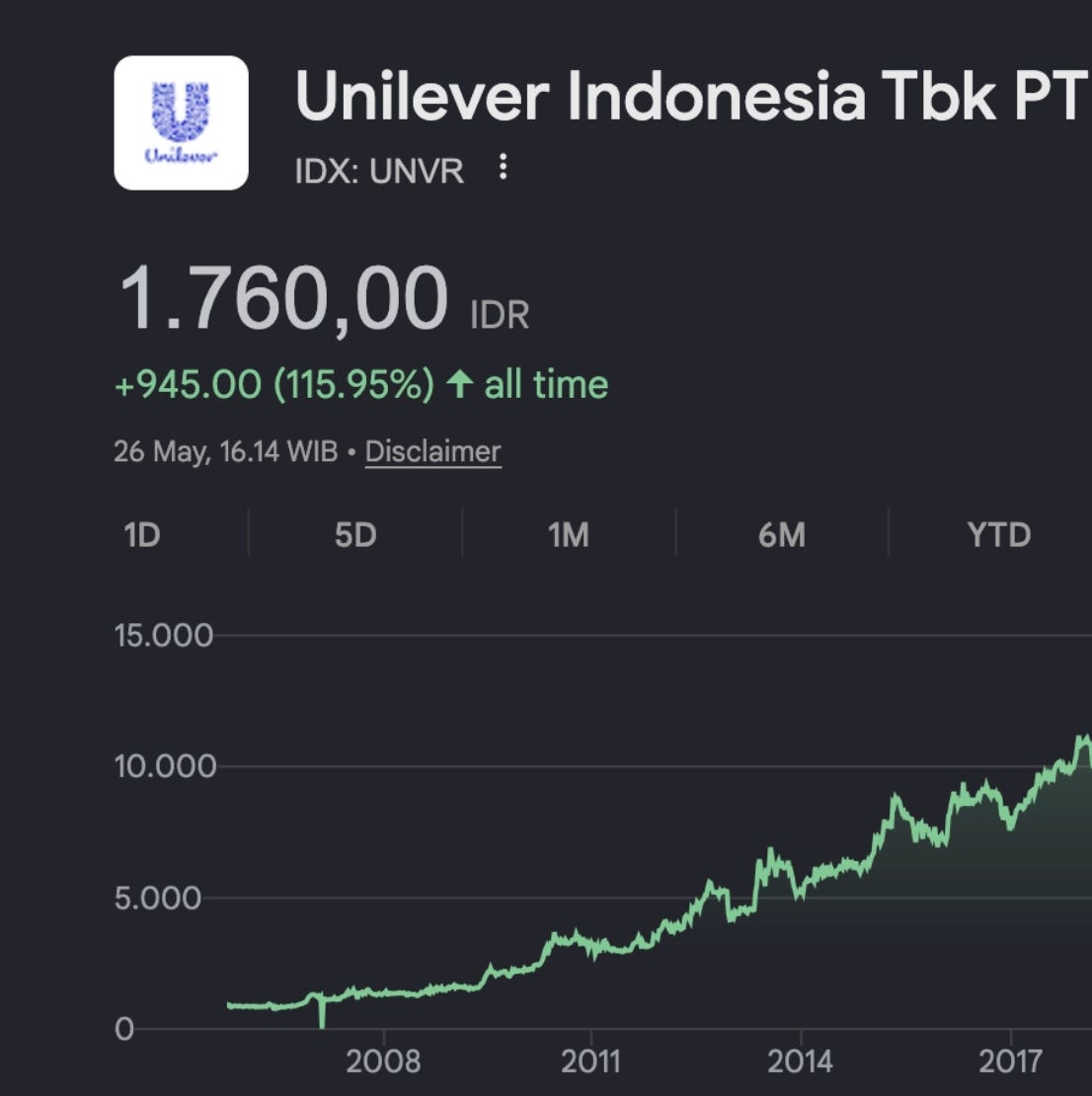
Picture this in the mid 2010s, the stock has been rallying for well over a decade (see price chart above). It was championed by brokers, influential people as the stock that is considered evergreen. I still remember how the stock was sold to me personally (I was still in high school back then more than a decade ago).
Broker: Toby, do you know what people would still do during an economic crisis?
Gullible highschooler: What?
Broker: People would still take a shower. So companies selling soap like Unilever will always be relevant. That’s why it is an evergreen stock that will always go up in the long run.
Gullible highschooler: Wow!
Fast forward about 10 years later~
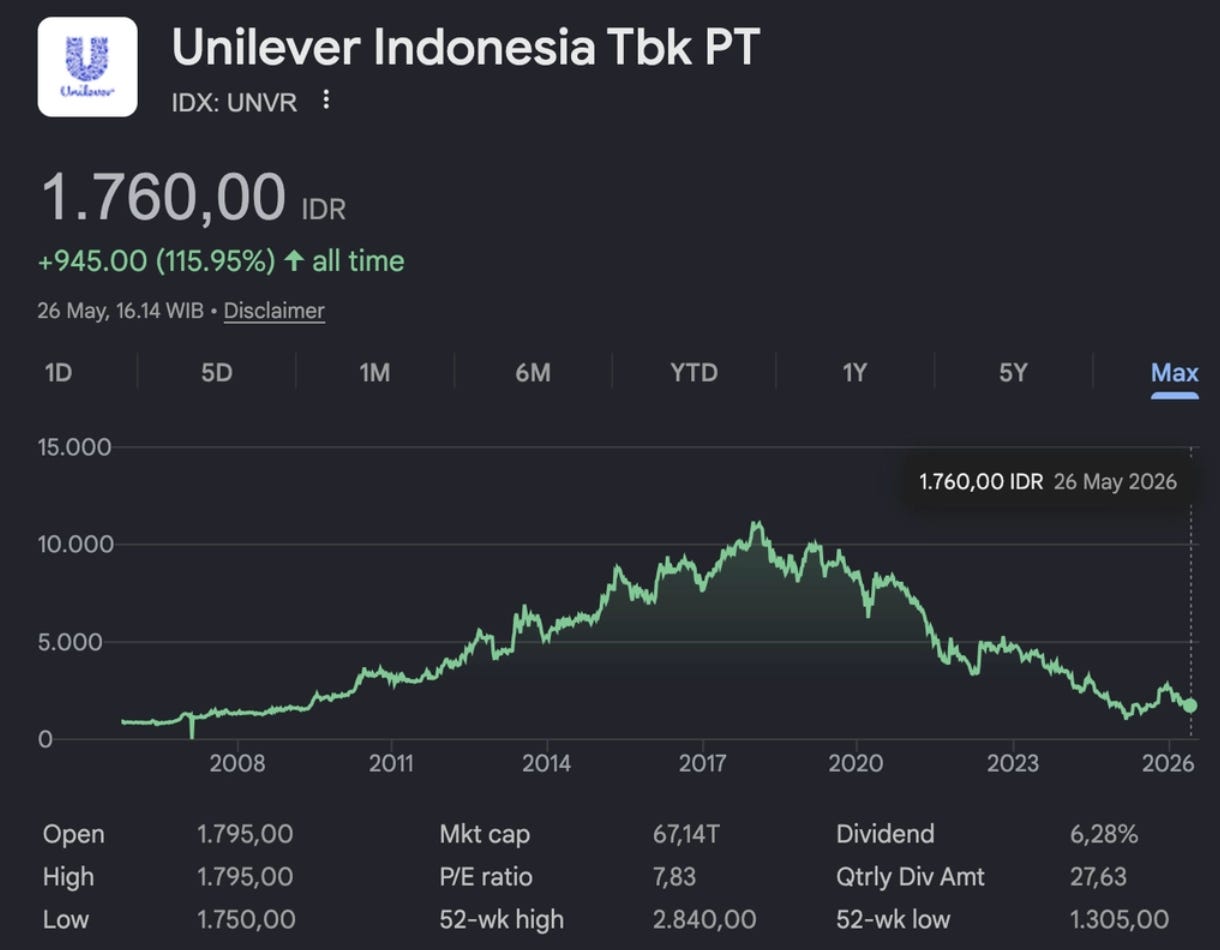
I am not saying that Unilever is a bad company. It is big and massively profitable. It’s just that I bought that company at a huge premium when I started my foray into stock investments. It taught me that you could not blindly buy an asset without caring about its price relative to the value of the company, no matter how good or famous or resilient they are.
For the short term portfolio, the flaw is easier to spot.
It fails the survivorship test
The successful trader on Instagram is a sample of one drawn from a pool of ten thousand. The other 9,999 abandoned their accounts and went back to work. The IG algorithm does not show the ones who went back to work. The trading course teacher does not talk about them. We build our worldview on a curated selection that is, by definition, statistically unrepresentative. And we know this.
The people I’ve met who run these two strategies are intelligent and genuinely knowledgeable. Many of them are doctors, engineers, consultants, founders. If you sat down with them and explained the flaws, they would nod and they will understand the risks of investing in this manner.
Yet they would go back to their portfolio and do the same thing especially at times when the strategy appears to be working.
So why do people want something, but they still do the opposite
Talk to the same people about FIRE. Financial independence, retire early. The movement that explicitly says the goal is freedom from financial obligation. Lower your costs, raise your savings rate, escape the salary trap and live from your investments.
Many of the people in the two-bucket portfolio also love FIRE.
And yet they still want to expose themselves to at least a decade long financial commitment with an uncertain (adjustable) expense that could elevate their future living expenses dramatically.
a.k.a.
They still want to buy a house.
Not just any house.
The house their peers, family, relatives, significant other would approve. These people believe in financial freedom. They want it. But they also sign the largest obligation of their lives, because of a widely held wisdom which is:
properti pasti naik (property will always go up)
Despite the elevated property prices especially high relative to average income earners. Despite the weakening demand. Despite the low yield. Properti pasti naik.
Therefore, they lock themselves up to a huge financial obligation. In their minds, if they need the money suddenly, they could always sell that property. Yet they also know that property is not a liquid asset.
Note: I am not saying that all property investments are bad here. But the kinds that I am hearing certainly is. The people I’ve heard about like to punch way above their pay grade to take up a huge mortgage and commit themselves to a long tenure of financial obligation.
So the puzzle seems to have layers here. Not just in investing in stocks.
I am seeing genuinely smart people making suboptimal decisions when they have rational knowledge that their decisions aren’t optimal. I mean you can agree with me that information is not the bottleneck here.
Even compute and analysis is not. You can ask Claude to make a financial projection for you for your purchase of a recent home. You could estimate your living expense and run simulations having 1, 2 or 3 kids now. If you don’t do it with AI, you could do it with a certified financial planner too. Its no longer expensive nor inaccessible for you to have this knowledge.
So something else is doing the steering of behaviour here.
What an academic says about this
Robert Cialdini is a social psychologist at Arizona State University. He is widely known for the book Influence: The Psychology of Persuasion, has sold millions of copies (hopefully I can sell that many books next time 😝). It is the foundational text on what he calls compliance. On how people behave.
There are many conditions in which people would be “obliged” to behave in a certain way. They are reciprocity, liking, consistency, authority and social proof. His point on social proof finally gave me some sense for what I have been watching all this while.
Cialdini starts with a grim example.
The name was Kitty Genovese in 1964, New York. She was attacked by a man that lasted for more than half an hour, outside her apartment building. The craziest thing is that there were 38 neighbours who saw or heard parts of it from their windows. None of them came down to help Ms Genovese. None of them called the police until it was too late. The journalists who wrote about it framed it as a story about people becoming more individualistic in New York. To be honest, I would probably write the same thing if I were to be the journalist.
But Cialdini does not agree with this. He argues that witnesses were not apathetic. They were reading each others’ action. Each person looked out their window, saw nobody else doing anything, and concluded from that absence: this must not be the kind of emergency that requires my action. The more witnesses there were, the less likely any single person was to act — because each additional silent observer made the social signal of inaction louder.
This case became very famous it earned a name called the bystander effect. When you don’t know that the situation is truly an emergency in public, you’d rather be a bystander and not do anything.
That is what Cialdini means by a behaviour that is driven by social proof. It activates under two specific conditions:
uncertainty about what to do,
and similarity to the people around you.
The Genovese witnesses had both. They were unsure what they were seeing — was it a domestic dispute, a prank, a real attack? The fact that the event occurred in the evening was a clear smoking gun. They assumed the other watchers were people with judgement roughly like theirs. So they used each other’s inaction as evidence. And Ms Genovese died in the incident.
To me the negative example showcases how powerful this social proof effect is in our behavior.
Another more grim example, we might think that we love our lives. But Cialdini puts forth another example of Jim Jones’s Peoples Temple in Guyana, 1978. Cult members voluntarily commit suicide by consuming poison after they receive the instruction from the leader and after seeing that others oblige. Over 900 people died that day. Many of them watched their neighbours drink first.
If people can kill themselves because of social proof, I’d bet my money that people can buy a house because of social proof 🙂
So here’s what you can observe
Remember that brilliant cousin or university friend you met for dinner the other day? Perhaps they announced that they have just recently purchased a house. An expensive one that is beyond their pay grade at the moment. They say that they take a 20 year mortgage to finance the house and the rates are adjustable after 5 years of instalments.
How do you feel?
Maybe after reading this blogpost you’d feel like:
Naahhh, I don’t want to buy that kinda house. That ain’t me Toby.
But imagine you meeting your parents and they naively ask,
David, when do you plan to buy a house for yourself? You’re not going to rent forever are you?
How would you feel then?
It is a similar innocent question as to when do you plan to have kids? Or when do you plan to get married? They mean well but it is still a loaded question. A question that requires deep thinking and deliberation instead of one that has to be acted upon after seeing your friends’ answers to them.
Stock investments is the same
How would you feel when you know that your smart friends are owning big banks alongside you and DCA-ing S&P500 religiously?
Remember that stock investment has 2 things that social proofs tend to work on really well:
Uncertainty
Similarity of what people around you do
You very well know that you don’t know what the US president would say or do tomorrow. And today you brush aside his brash actions because your AI stocks are still bringing in acceptable returns.
But what if they stop delivering the returns you’d expect?
How would you feel?
Will you be blaming the US government? Or will you realise that perhaps copying what others are doing at the moment is not the most prudent investment decision?
Most will do the former. A tiny minority will do the latter.
So arming yourself with knowledge is not enough
Social proof is a powerful force and I think that rationality is not a strong enough weapon to overcome it. I believe that combatting conformist thinking requires you to change which signal is closest to you.
Practically, that means three things.
First, get explicit about your own goals on paper, in your own words, before considering anyone else’s opinion. Read them more often than you read your family or friends’ WhatsApp group.
Second, surround yourself with at least one person who is a contrarian, and whose opinion you cannot easily ignore.
The third thing is ask yourself:
“Would I still want to own this thing if nobody knew?”
If the answer to owning something is yes based on your calculations and honest preference, then it is likely a good deal. But if the answer is no; then you probably have to think twice or thrice before pressing that buy button.
It is one thing to buy because you want it for your own interest (be it present or future). And it is a completely different thing for you to buy because you want to fit in.
Knowing the difference helps.
Cheers.