

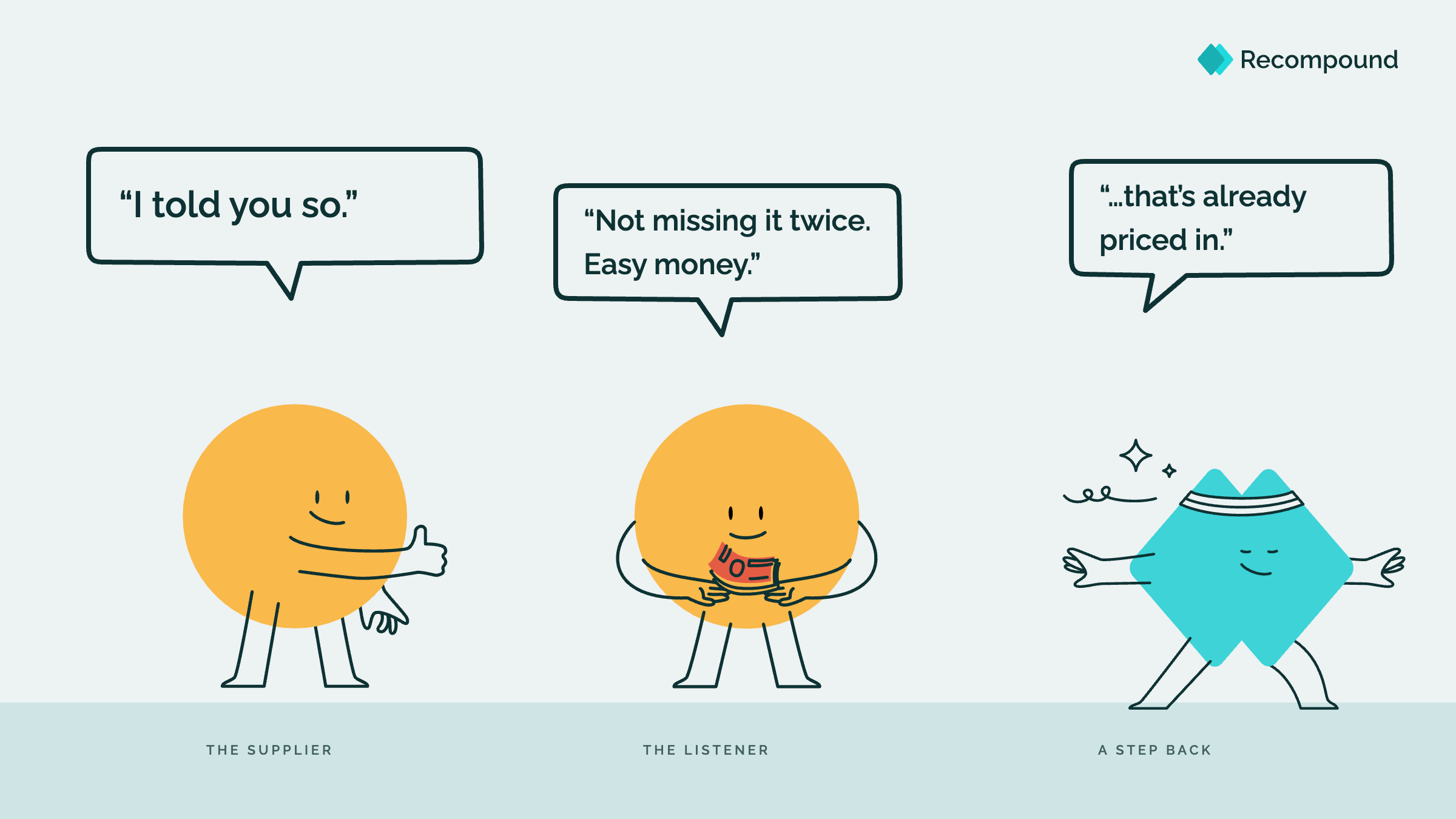
This is an essay about a common phenomenon that I see in the investing world. In this funny and counterintuitive world of investments, “I told you so” gets thrown quite a bit. People mention “I told you so” when they have made predictions in the past about future events and be proven right at some point in the future. Now it is worth for us to examine this phrase more closely because its effects might be more influential than we originally thought as investors.
In this article, I will be arguing that the phrase “I told you so” could be very expensive for investors like you and me alike. And how expensive it is likely stems from how much it influences us to commit misjudgement on our investment decisions.
Obviously this is an exposition and a personal opinion of mine. I definitely would be interested to hear your thoughts on this matter as well, especially after considering the angle I choose to see it from. Perhaps there’s a different way of looking at it that is also worth looking into.
So how do we attempt to evaluate the power of this beast
I have been thinking about explaining the influence of the phrase “I told you so”. And how it could be leaving a pernicious effect on investors. But it almost feels like I am short of tools to do so. So it becomes to be a lot more wishy washy, or yappy as the Americans would call it.
Thankfully we are very fortunate to be sitting on the shoulders of giants.
Charlie Munger has discussed about the Psychology of Human Misjudgement that are shaped by tendencies. In his book, Poor Charlie’s Almanack, there are 25 of them. I will not list them all here but, to start I will mention the most powerful psychological force that causes misjudgement.
That is the Lollapalooza.
Lollapalooza refers to several psychological tendencies that act together to produce extreme results. Munger saw this as the most important one. He also explains his conviction in investing in Coca Cola with Lollapalooza. It is described as a very powerful force that causes the population addiction towards sugary fizzy drinks and in turn, his wildly successful investment in Coca Cola.
Think about it, your decision to habitually drink Coca-cola is a misjudgement isn’t it? Especially considering the fact that it is sugary with limited health benefits. How on earth a large swathe population in the globe able to drink Coca-cola and make its company such a successful one? Well Munger discussed that in detail in his book. But Lollapalooza, or the confluence of psychological tendencies he argues, explains the phenomenon quite neatly.
So lets get back to “I told you so”
The reward for us to understand “I told you so” from a Lollapalooza perspective is that we can make sense the perennial misjudgement of the population when it comes to investing. Yes, even when analytical tools, information, expert opinions, research, etc becomes widely abundant for an investor to consume before making an investment.
Now first off, phrase I told you so has two sides to it. You have the listener side and the supplier side.
For the listener of “I told you so” the effect of this phrase is that it tends to forms trust to one who says it
I think you could imagine it yourself. A person with titled credentials, posting screenshots about their correct predictions. Saying confidently that they have called this from a few months back. Usually this would be in the form of a social media post with real screenshots of their positions.
Now the phrase is not exactly “I told you so” but the gist of it is “I told you so”.
The effect such post for a handful of people is that we might think this person as a wizard. But here are the psychological forces that are at play that make you be more inclined to trust this person.
Authority-Misinfluence.
A number of correct calls that are curated well turns this person into an authority. Munger argues that we subconsciously obey authority even when the authority is wrong.
Availability-Misweighing.
And the correctness of this person really feels every where, in the moment and most importantly super relevant. The correct calls has a screenshot with the timestamp where the wrong ones aren’t discussed much.
Social Proof.
The post has 100,000 views and 2,000 likes. You see people commenting “what a legend” and other people clearly trust this person with the emoji. So it really appears like the crowd has done the due diligence for us, but have they really?
Influence-from-Mere-Association.
After a number of exposure, you start to associate the wizard with winning. Any new call, feels like a certain win. The call also feels like it does not have any risk or whatsoever. There’s no way the price is going to go down. Because he bought this stock A. This feeling arrives even before you begin to start evaluating your position.
Deprival-Superreaction.
The most painful part is that if you saw the call and you didn’t act on it while you see the price going up. That felt like a big insult to your intelligence. You should have just bought and it is easy money. So the next time this person speaks, you are not evaluating. You are making sure you don’t miss out twice.
Now the supplier side of “I told you so”
Here is the uncomfortable part. The person saying it is not necessarily a liar. They don’t necessarily have bad intentions too. What the person is doing is that they are responding to incentives. I mean if you are in the finance business, your moat comes from the trust that you get from your customers.
So here’s the psychological forces that act on the supplier.
Reward and Punishment Superresponse.
If you are confident and wrong. That call is forgotten within a week. But if you are confident and you make the right call, it will be remembered for years, screenshotted, applauded and reposted. So the incentive isn’t really to be right. But it is to be loud, confident and to make many calls. Because some will hit and some don’t. And heads I win, tails I don’t lose much.
Doubt-Avoidance.
And audience does not like doubt. People generally do not like uncertainty. What is a temporary cure against an uncertain world? Confident people. So if you qualify your statements saying out loud
Hey, my past performance does not guarantee future performance. And these are the risk bla bla bla.
you’d get zero engagement. But the confident ones get the engagement. And getting engagement feels pleasant 😉
Excessive Self-Regard.
Once you get a lot of likes, validation and good comments. You’d believe the validation. You’d believe that it was all skill and zero luck. He would regard himself more excessively, which makes him more confident on the next call.
Inconsistency-Avoidance.
And if the data changes, not towards this person’s favor, he would avoid being inconsistent with his statement. It is much more natural to say
diamond hands.
Thesis is still in play.
Even when the facts change. Backing down costs the authority that he built earlier.
So here’s the twist
Now I suppose that if we put the two sides together, we get the Lollapalooza effect. We have four or five tendencies on the listener side and then we also have four or five tendencies on the supplier side. All firing from:
“I told you so”
Which is why strangely enough, the phrase is capable of building more trust. And the track record, performance, etc is something that you evaluate after.
Here’s the promised plot twist. If we apply second order thinking, it should follow that by the time you hear the phrase “I told you so”, the event has happened and the asset has been priced in because no new information is there. So you are right to say that it is a good call, but you don’t really make money.
Yet because the psychological forces that act on us is so powerful, a large number of the population seems to be baking “I told you so” in their investment decisions without them noticing. As a result, I believe it might have caused quite a bit of misjudgement and in many cases, suboptimal results too.
Closing Remarks
I don’t think the answer is to “be more rational” or be “more intelligent”. Munger spent his whole life studying these tendencies and still said he fell for them. And of course I still fell for them too ✌🏿
One potential solution is to discuss them more often. Then once it is verbalised, we can take a step back and observe them more clearly.
Once done, it is more possible to see these psychological forces acting on us in real time and see how these forces can be at the root of our decisions. Because if we don’t have our guards on, this harmless phrase can really be quite expensive.
Cheers!
Disclaimer
Saham adalah produk berisiko tinggi. Nilai investasi dapat turun dan modal dapat berkurang (capital loss). Lakukan analisis pribadi sebelum mengambil keputusan. Layanan ini tidak sesuai untuk seluruh kalangan investor. Bukan ajakan membeli atau menjual efek tertentu.
Not a solicitation to buy or sell any security. Shares are high risk and can lose value; do your own analysis; not suitable for every investor.
Sounds familiar huh, heard it somewhere hahahaha