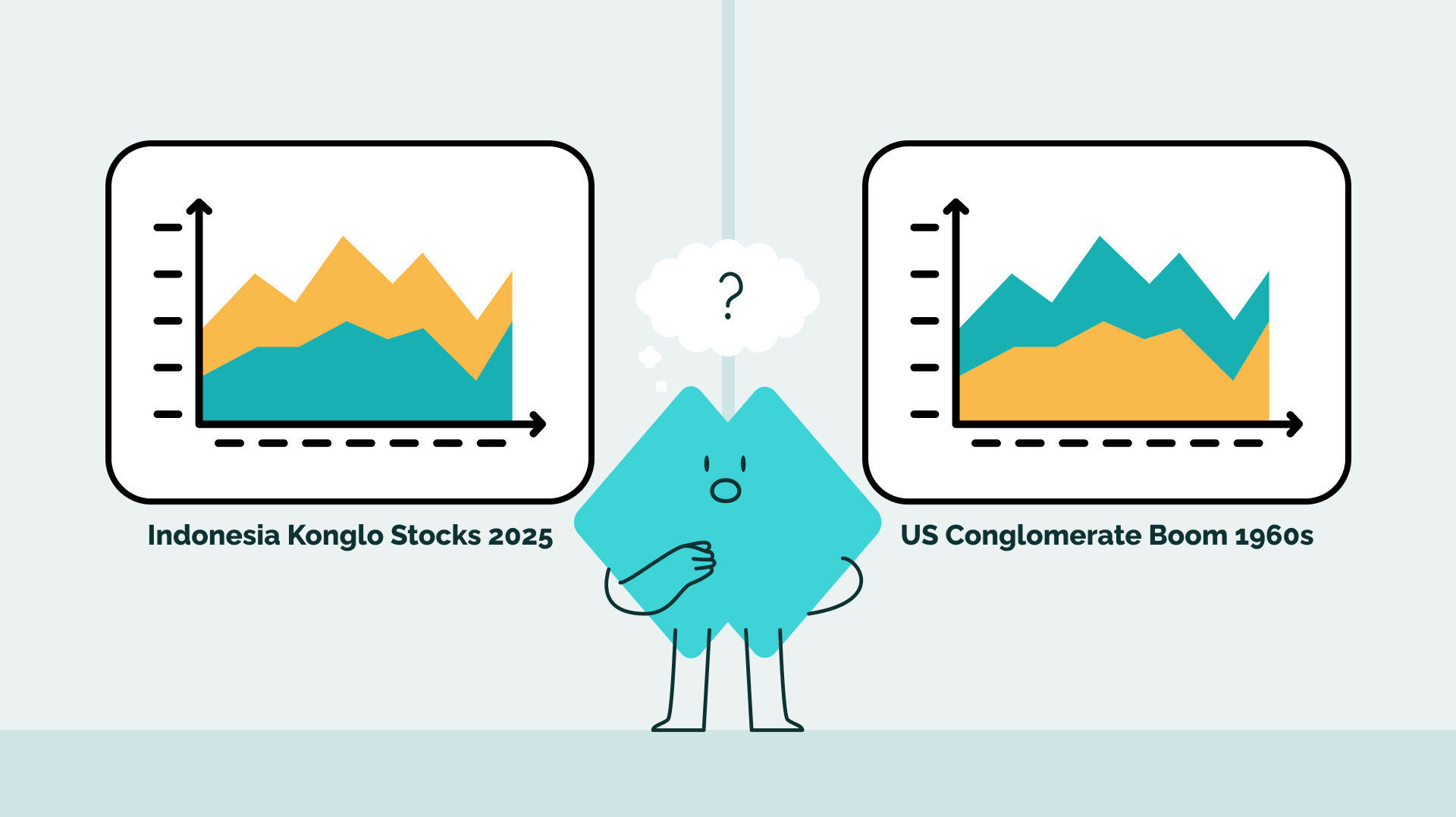
If you’ve been watching the IHSG lately, you’ve probably felt the FOMO.
You’ve seen the charts of certain IDX conglomerate stocks defying gravity, moving in vertical lines that make physics blush.
The common chatter in Jakarta coffee shops goes something like this: “Ah, this is just the Indonesian market being shallow. It’s a ‘bandar’ game. This doesn’t happen in sophisticated markets like the US”
To that, we say: Hell no.
If you want to describe the phenomenon into a single flowchart, this is what is essentially happening.
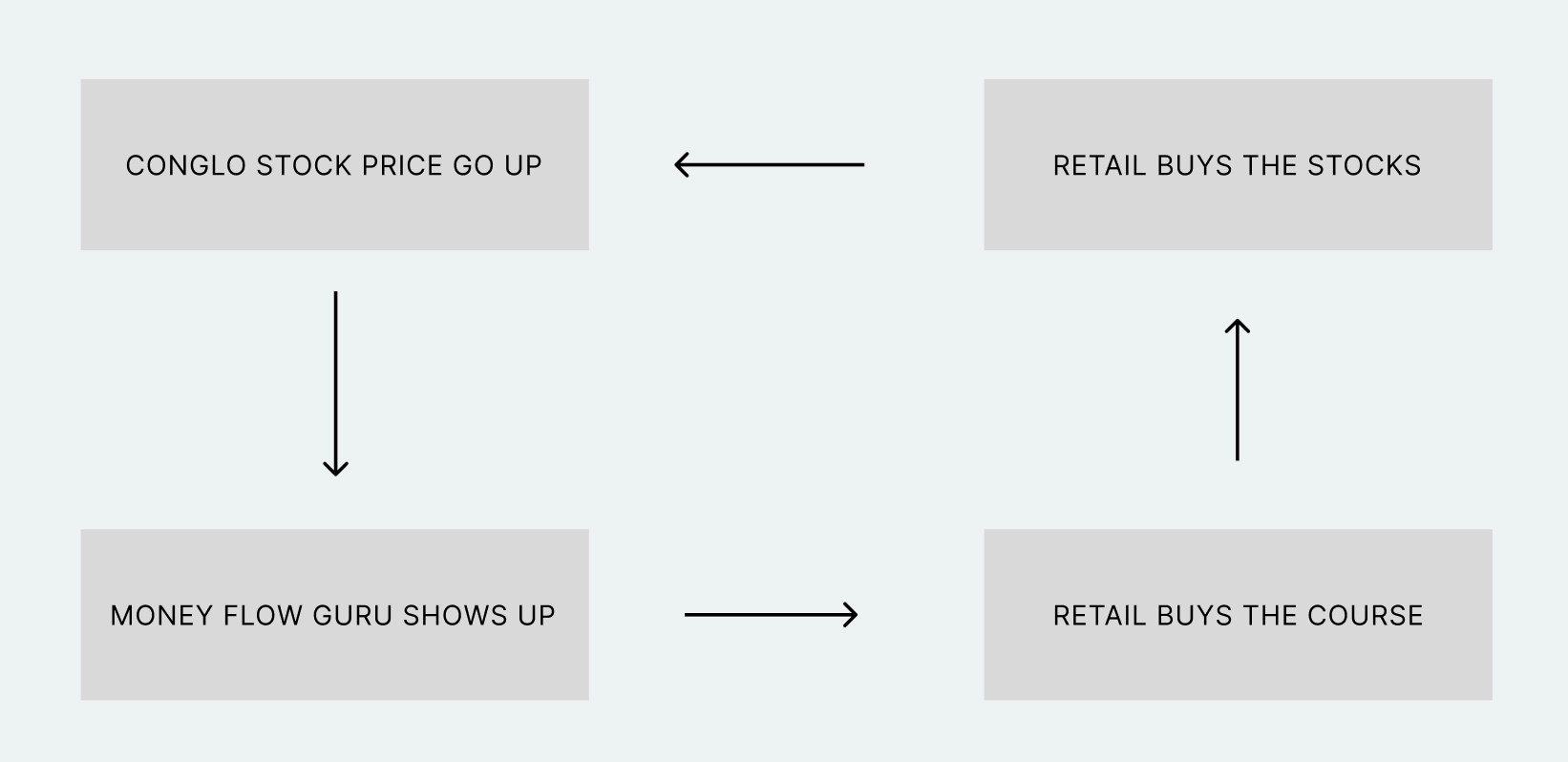
From the flowchart above, it is quite clear that “Konglo stocks” can be replaced with any other stocks such as digital bank stocks, sub-prime mortgages, etc.
Money flow guru can also be replaced by other gurus that pertains to the assets that are pumping. Retail can be replaced by anything that is essentially “dumb money”. People who buy stocks without a rational investment thesis.
So clearly this is not an “Indonesia problem”. It’s a human nature problem. We have seen it again and again in multiple different context that it really gets quite boring. And if you are reading this blogpost, hopefully you would “get” it and take the necessary caution.
As one investor Tiho Brkan noted, successful long term investing is the intersection of three disciplines: Philosophy, History, and Psychology.
If you want to understand why Recompound is sitting this one out, we have to look at all three.
1. HISTORY: The “Base Rates” of the 1960s
Tiho Brkan reminds us that “History teaches you base rates... and helps you understand the future.”
If you think this “Konglo” phenomenon is unique to us, let us introduce you to the US Conglomerate Boom of the 1960s, also known as the “Go-Go” era.
History is rhyming, and the rhyme scheme is alarming.
In the late 60s, the US market was dominated by “Conglomerates” — companies like LTV, Textron, and Teledyne. Their stock prices soared not because they invented groundbreaking technology, but because they mastered a financial magic trick.
But to understand how they did it, we need to introduce the man who cracked the code.
2. PHILOSOPHY: Who is George Soros and Why Should You Care?
“Philosophy teaches you how to think more accurately, critically and objectively.”.
George Soros isn’t just an academic. He is the man known as “The Man Who Broke the Bank of England,” making $1 billion in a single day in 1992. His hedge fund, the Quantum Fund, returned an average of 30% annually for decades, making him one of the wealthiest men alive.
When he writes about how markets actually work, smart investors listen.
In his classic The Alchemy of Finance, he explained the “Conglomerate Boom” using his theory of “Reflexivity”.
Here is the cheat code they used:
Get a High Valuation: Promote your stock until it trades at a massive premium (basically unrealistically high P/E that defies gravity).
Use Stock as “Currency”: Use your expensive stock to buy “boring” companies with real earnings.
The Illusion of Growth: Because you bought earnings cheaply using “expensive” paper, your Earnings Per Share (EPS) jumps up instantly.
The Loop: The market sees “growth,” pumps your stock higher, and gives you more power to do it again.
Soros pointed out that the fundamentals weren’t driving the price; the price was driving the fundamentals. It works beautifully—until it doesn’t.
3. PSYCHOLOGY: The Cautionary Tale of Gerald Tsai
“Psychology helps you to compete... by exploiting others’ mistakes.”.
The mistake being made right now is believing trees grow to the sky.
The 1960s gave birth to “Go-Go” fund managers who became celebrities by betting big on these conglomerates.
The most famous was Gerald Tsai of the Manhattan Fund.
Tsai was a rockstar. He raised record amounts of money from retail investors desperate to get a piece of the action on these “Konglo Stocks”.
But right at the peak of the mania in 1968, Tsai did something brilliant for himself but disastrous for everyone else—he sold his own investment management firm. He cashed out at the top.
And the retail investors who stayed in his Manhattan Fund? They got slaughtered.
Shortly after, the “Reflexivity” loop broke. Reality couldn’t sustain the high expectations. The Manhattan Fund lost roughly 90% of its value. The “King” had left the building with his cash, leaving the crowd to hold the bag.
Fast Forward to Indonesia, 2025
Does that story ring a bell?
We are seeing the exact same movie play out. We see conglomerate companies trading at eye-watering valuations—some at 600x P/E, while our biggest, most profitable banks sit at a humble 13x.
Instead of just buying earnings, the modern twist involves Index Inclusion to foreign indices like MSCI / FTSE and Real Asset Acquisitions. They use massive market cap leverage to acquire assets—sometimes booking “bargain purchase” gains to show massive accounting profits—which keeps Soros’ reflexive loop spinning.
Example: TPIA acquired Shell (https://www.idnfinancials.com/id/news/57590/akuisisi-aset-shell-membalik-kerugian-tpia-kini-untung-us1-6-miliar)
But critical thinking forces us to ask: Can this last forever? Soros warned that every boom fueled by a misconception eventually faces a “stress test”.
When the “underlying trend” (actual cash flow) cannot keep up with investors’ wild expectations, the reversal is usually violent.
A Serious Warning to Everyone (Including Our Own Clients)
We know some of you are riding this “Konglo” wave.
We get it — it’s fun to see green arrows.
But here is why Recompound has stayed far away:
1. We Advise Other People’s Money. Gambling with “Judai money” is fine. Advising on someone’s life savings is different. Riding a trend when expectations are priced for perfection is dumb. Our fiduciary duty is to protect your wealth, not to play “Pass the Grenade.”
2. No Trend Lasts Forever. If you are still riding, we aren’t telling you what to do—you’re an adult.
But for the love of God, do not add more funds. Especially if you are investing your retirement money. The risk-to-reward ratio at these valuations is terrifyingly skewed.
Why We Are Okay Being “Humiliated”
Since 2024, Recompound has notoriously avoided this trend. Some called us stubborn. Some called us dumb.
And honestly: it hurts to look like an idiot while your neighbor makes 100% returns on a stock while our stocks “only” made ~30%.
But we didn’t sit out because we hate money. We sat out because we respect History, Psychology, and Philosophy.
We refuse to participate in a trend where expectations are sky-high. Instead, we’ve been quietly accumulating what everyone ignored: Quality.
While the market chased the “Konglo” hype, we looked at the economic data:
M2 Money Supply is improving.
Loan growth and liquidity are turning a corner.
Quality name valuations are at multi-year lows, enabling them to distribute >8% dividend yield p.a. easily.
The divergence is extreme. If you strip out the top conglomerates, the IHSG has actually underperformed significantly—meaning real, quality companies are on sale.
We are okay suffering “humiliation” for 1-2 years. We prefer to be the ones well-rested and holding quality assets when the hangover hits and the market rotates back to sanity.
See you in 2026.


