

Disclaimer: this exposition is an editorial. It is not an academic paper and it should not be seen as facts. It is based on the author’s personal observation and experience. It does not constitute investment advice and is for educational purposes only.
I was playing with Instagram story and created a poll on Recompound. Market was horrendous. And I wanted to check our followers how worried they are about the market. It turns out that a good 30% of the responders were feeling worried. So perhaps this write up could be timely.
We all know where does the worry come from
First things first, we know that worry tends to come from the market itself. The modern stock market is not a place where real ownership exists for many people. It is a place where price movements gets sent to you every moment. Push notification, tickers, news commentary, now we have streams and social media, WhatsApp and Telegram groups among others.
You already know all of this. But it is important to repeat that the market ties you with a rope by design. You get pulled into it the moment you sign up.
Simple observation:
When you see the news saying anything good or bad about the macroeconomics, geopolitics, government policies, etc in whichever outlet, you would be pulled towards checking your investment application. You’d be wondering how does this news or event affect my investments?
This is normal because the market is in the business of transactions, and broadcasting prices loudly is what gets people to act. Feeling something every time prices move is what gets you to trade. Trades generate fees. Fees feed the entire chain.
So knowing where the worry comes from is a good starting point. But it is not good enough cure.
Where does this worry normally lead to?
Worry or anxiety is an unpleasant feeling. So when we are worried, we naturally seek for stimulus or information that counterbalances that worry.
How we do this is usually we search for answers to questions that we have in mind. Among others, these are primary questions that people have in mind:
How long is the market going to stay horrendous?
Have we made the right investments. I.e. will our holdings recover as the market gets better?
When these two answers are reliably answered by someone we trust, we’d find ourselves comforted. Someone we trust can literally be anyone:
It could be your financially savvy brother
It could be your capital market friend
It could be a YouTuber investment guru
It could be an intelligent guy on Substack
It could be your super smart colleague in the private equity space
You get the idea
While the claims and predictions from people you trust can make you less worried, I argue that the pleasant feeling tends to be fleeting. It is more similar to a pain killer that removes the pain. But likely that the underlying “sickness” is not attended to effectively yet.
Assume that my argument is valid, why do we look for claims and predictions as a natural response to cure our anxiety?
Let’s have a bit of fun first 🙂
Chris Williamson recently interviewed a mentalist named Oz Pearlman. Oz would guess names, birthdays, pin code or numbers they were just thinking about. By the end of the episode, Chris’ face was as red as cherry as he was defeated and felt like he’s a prey in water. Take a look, video is funny.
How do you feel after watching the video? I made Budi and Wilson watch the video at the office. Wilson was entertained. Budi was skeptical. Budi is way too analytical for this stuff. He thought that it must be set up. But I did observe both of them while they were watching. Both of them sat there momentarily in disbelief.
So why does this work? Why are we so intrigued?
Btw, if you say don’t feel anything, please stop trolling me haha.
My guess is because our brain is designed to assume that minds cannot be read. We go through our life thinking that our mind is private and ours alone to observe. What we consciously do not divulge, do not get known by others. So when somebody appears to be able to read minds, the experience feels like breaking law of nature.
Now let’s sit with this for a moment and draw parallel to investments.
Similarly, our brain is also designed to assume that markets cannot be predicted. So when a statement that “looks like” a prediction turns out to be true, the predictor becomes like a wizard. To wit, you could take a look to a conversation that was perceived to be a prediction.
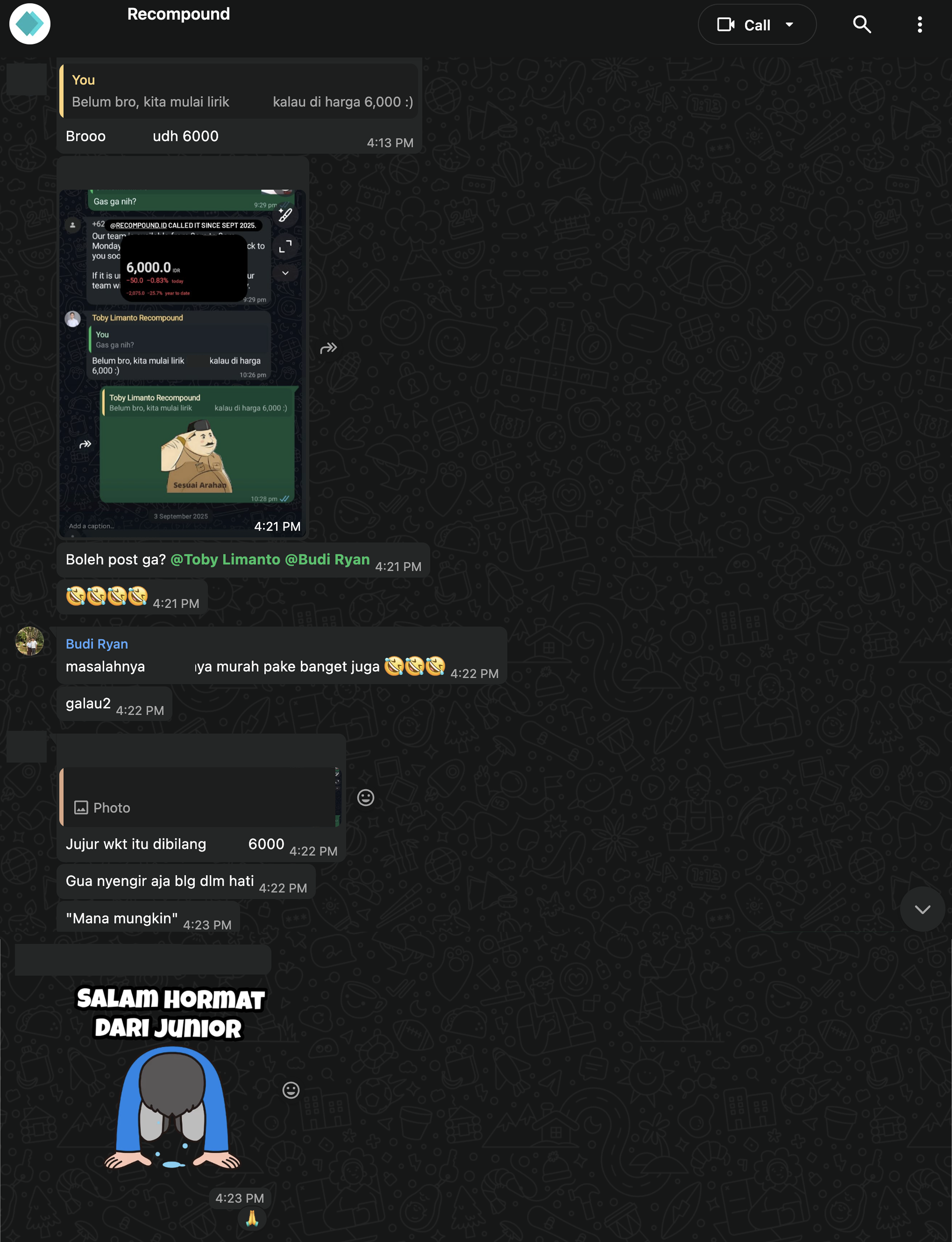
But I promise I didn’t make a prediction. I didn’t say that a certain stock would go to a certain price. I just said that we would be more interested if the price becomes lower.
So here’s what I hope is clearly demonstrated. The feeling when you see a magic trick is very similar, nigh the same as that feeling when you see a market prediction comes true.
That feeling is called wonder.
Wonder is a pleasant feeling when what you thought was impossible, happens. Then you would continue to want to know how on earth does that impossible thing happen.
A mentalist sells wonder through the illusion of accurately reading minds.
An investment person sells wonder through the illusion of accurately predicting the market.
That is the trick.
So what have we learned from watching a mentalist in action
We’ve learned that:
Worry comes from the market movement
Our tendency is to search for people we trust who have previously predicted the market because it has generated a sense of wonder.
When that trusted person makes another prediction that is in favour of your investments, you feel less worried.
So I hope that it is now clear why we naturally look for prediction from people we trust. Because accurate prediction generates wonder → which creates trust. The next time we feel worried, we would go again and seek for the prediction to alleviate our worries.
But here’s what Oz tells us about his tricks
Literally the first question of the podcast:
Chris: “You have said that your career is built on a lie. What’s the lie?”
Oz: “The lie is that I can read people’s minds. I can’t. I wish I could.”
Oz would be the first to tell you that what looks like mind-reading is a very sophisticated set of guesses, observations, and probabilities. The miracle, when you understand it, is just craft of creating an illusion that he’s reading minds.
He has nothing to gain by saying this. He says it anyway, because he is honest about what he does.
And I’d say this to everyone who happens to trust us as well. We believe that the market is too random to make predictions accurately 100% of the time. So we’d rather not make predictions. So when people ask:
“when is the market going to recover?”
“is the currency depreciation going to get better?”
“how is war uncertainty going to impact the market as a whole?”
We will be first to say that we don’t know.
But when we say we don’t know, it does not mean that you must be worried, quite the opposite
There is a neuroscientist named Lisa Feldman Barrett who wrote a book called How Emotions Are Made. She argues something that, if you take seriously, changes how you think about your own worry.
Her argument is that emotions are not universal, hardwired things that just happen to you. They are constructed in your brain, in real time, from concepts. And the most powerful thing is that concepts are not just built from experiences that you observe, but also from words of our language.
Human brains are very unique in the sense that we can construct a reality in our minds using words. The existence of reality depends on a perceiver. Think about it. What is money in a physical sense? Well it is a bunch of bits (or code) that is stored in the database of a bank. If you wire Rp 100.000,- to a monkey, the monkey will not feel a thing because that money to them is not real. But if you send that Rp 100.000,- to Toby. Toby will say thank you and go to Indomaret and buy a box of sparkling water. Indomaret would give Toby that box of sparkling water because they agree with Toby that his Rp 100.000,- is real.
Another example how we construct reality using words.
When you order from Domino’s, you do not say:
“Hi, I’d like a circular flatbread with tomato sauce, melted cheese, and pepperoni baked at 220 degrees. Please.”
You’d say:
“Hi, I’d like to order a pizza. Please”
The word makes the thing real, orderable, recognisable and most importantly gojek-able right to your door step. Without the word, you would have to assemble the concept from scratch every single time, and most of the time you would not bother.
Here is what this means for your worry. How to feel less worried
Barrett’s claim is that emotions as a reality are constructed the same way. The bodily sensations are real — a tightness in the chest, a tug in the stomach. The worrisome thoughts that occur on our mind is also real — I wonder if my investments are going to recover tomorrow or next week.
To feel less worried, you need a competing and name-able state. Btw, naming it is very important as I previously discussed the importance of names.
But what is a good competing state? One that has its own name? Without a competitor, worry has no rival and keeps running. We’d be looking for predictions to make us feel less worried and that’ll feel like a coping mechanism, rather than a long term solution.
Here is the awkward part. Many when asked to name the opposite of worry, would go for calm or peace of mind. But I think that these words are not good enough.
Calm does not specify what changed. If I tell you I am worried, and the next week I tell you I am calm, you do not know why. Did I take a holiday? Did I medicate? Did I just have a good day? Did the market rally? Did I sell everything? Calm describes a state of feeling without describing the underlying condition that produced it.
Peace of mind is something most people associate with a vague spiritual state. It does not feel achievable on a Tuesday morning while you are running a business.
Wonder, in case you are wondering, is not a good opposite too. Because wonder only happens when the predictions have come true. If I hear Warren Buffett says that market would recover, I’d feel wonder only after the market really recovers. Not when it takes another 5% plunge on a Tuesday morning.
So we need a different kind of opposite. Something more specific than calm. More human and grounded than peace. More present than wonder.
Let me propose a word.
Untethered
Most retail investors live with an invisible rope. The rope ties you to the price chart. You do not know the rope is there until it tugs — your stock dips and you feel it in your stomach, your stock jumps and you feel a sudden rush. You check at 9am. You check at lunch. You check at end of day. The rope is taut all day.
Untethered is the day the rope falls off.
It does not feel the same as detachment. Detachment is something you do — a discipline you cultivate. Untethered is something that happens to you once the conditions change. The rope falls off because it is no longer pulling on the other end.
The chart is still there though, just that you are not pulled towards it.
Level of worry depends on who is holding the rope
I want to be honest with you about why feeling untethered is, for me personally, easy.
It is not because I have superior willpower or a better meditation practice. It is because someone else is holding the rope. I use Recompound with whom I can interact with a dedicated advisor. So does my mom. So does my brother. None of us think about the market day in, day out — not because we are unusually disciplined, but because we know there is a dedicated advisor whose actual job is to do the watching. The pull is gone because it has been outsourced to people I trust.
That is the entire mechanism. There is no trick.
Which means the answer to what to do tonight if you feel worried depends on a question only you can answer.
Right now, if I did not look at my portfolio for three months, would I trust that someone is still watching it on my behalf?
If your answer is yes
if you have a wealth steward you genuinely trust, whether that is a finance-savvy sibling, an advisor you have worked with for years, or anyone else competent and aligned with your interests — then here is what to do. Understand them more.
If your financially savvy sibling is taking care of your investments, ask them questions. Understand their philosophy, the assumptions they make, the learnings they have experienced, the mistakes. When you realise that work has already been done, the rope is loose.
If you use Recompound and you feel worried, talk to Budi 🙂
If your answer is no, here is what you can do.
Your worry is not irrational. It is your nervous system accurately reporting that you are alone with the responsibility, in a system designed to keep you tugged. The rope is doing its job. The work is to find someone trustworthy to hold the rope together with you. It can be anyone, but ideally someone honest, competent and aligned with your interest. With whom you can verify their work. Your advisor, your sibling, your uncle, anyone.
P.s. It can be yourself as well. I believe that if you consistently commit to a strategy that is logical and has been proven to work for you, you will likely feel untethered from the volatility of the market overtime too.
Closing remarks
That someone could also be us or it might not. Again, what matters is that the person on the other end of the rope is honest, competent and genuinely on your side. They really don’t have to be a superhuman or a market wizard. But I believe that if those three conditions are met, you can feel untethered. Whoever is holding the rope, make sure they are holding it on a bad week, not just a good one. Because if they don’t hold on to it, you’d end up getting tugged again.
A rope you can name is a rope you can take off. But you take it off by handing the other end to someone competent you trust — not by pulling harder against a system that is built to pull back.
That is what we are doing for the people who work with us. Not predicting the market. Not chasing the trade. But really by helping them hold the rope on their behalf.
So that’s it. While seeking for prediction is an okay solution to feel better for a while, perhaps you could attempt to feel untethered from the market by handing the rope over to someone who’s honest, competent and aligned with your interest. Subsequently, you will feel less worried from market volatility, getting your life back in the process.
Cheers!
References
In case you’re interested in reading or watching the materials consulted in writing this article, below are the entry points:
Barrett, L. F. (2017). How Emotions Are Made: The Secret Life of the Brain. Houghton Mifflin Harcourt. [The construction theory of emotion, the role of words and concepts in shaping what we can feel, and the argument that emotions are predicted, not triggered. The pizza-style examples of how language constructs ordinary categories appear throughout.]
Williamson, C., interviewer. How to Steal Thoughts Out of Anyone’s Head — Oz Pearlman — #1088. Modern Wisdom Podcast. April 23, 2026. https://chriswillx.com/podcast/ [Source for the “the lie is that I can read people’s minds. I can’t. I wish I could” exchange in the opening minutes, and the “it’s not about me, it’s about them” line later in the episode.]
Taleb, N. N. (2001). Fooled by Randomness: The Hidden Role of Chance in Life and in the Markets. Random House. [Background reading on why streaks of correct predictions in finance are usually luck rather than skill, and why we are so easily fooled into mistaking the former for the latter.]
Untethered!
Thanks!