


Note from Toby: this week’s post is a guest post by a hyper intelligent human from University of Cambridge, Shania Mustika. If you find it interesting, do leave a comment!
My friend and I are co-authoring a paper on the spread and death of conventions.
Our question is as such:
What determines the fate of the conventions of a minority group — whether they are abandoned, persist in isolation, or spread to the wider population?
Putting it into concrete life context, here are some examples.
My partner used to like eating out and not like exercising. But because we got into a relationship, he has to spend a lot of time with me. We once went on a vacation with my two other siblings. So there were 3 people from my family — all of whom like to eat home-cooked food and think of going to the gym as part of vacation activity. By the time the vacation ended, the first thing my partner did was to sign up for gym membership and drew up a meal-prep plan.
Here is another example. My older brother is an avid diver. When he started diving 7 years ago, he liked to show off pictures of sea creatures he took, which at the time meant little to me. Who cares about tiny little worms among seafans which you have to squint and spend a good 5 minutes to spot while keeping yourself still and careful not to destroy the corals (the little worms are called nudibranch, if you are curious). But he kept going on and on about his diving trips, kept spamming our family groups with pictures, kept talking about the glorious sharks and mantas and barracudas… Until I felt envious. I decided to give this diving thing a try and now we have an annual diving crew made up of a clan leader (my brother) and 5 followers (me being one of them).
The two examples show how minority culture dies and spreads. The first shows how my partner is a minority among our group and his convention gets abandoned. The second shows how my brother is a minority and his convention gets adopted into the mainstream.
Some math and economics
So my friend and I decided to write this example into mathematical language (maybe because we don’t have anything better to do).
We model this interaction into a game played by individuals. The game is described as follows:
A person can belong to either a majority or a minority group.
Each group has their own preferred action. For example, majority prefers action A (going to the gym) and minority prefers action B (not going to the gym).
Individuals from each group will only be able to interact with each other and get positive payoff if they choose the same action. So if there are two people Alice and Bob, they will only get positive payoff if they both choose A or they both choose B.
If a majority/minority individual compromises and chooses his non-preferred action, but is able to interact with another individual, he will also get positive payoff, but smaller than what he would get should he choose his preferred action.
If you have a hard time understanding the set up, here is a concrete example. My partner belongs to the minority group and prefers not going to the gym. I belong to the majority group and want to go to the gym. If we choose our own preferred action, we are both unhappy as we cannot spend time with one another. If my partner compromises and joins us at the gym, I am very happy; he is also happy, but slightly less because he needs to expend energy. Conversely, if I compromise and skip the gym, my partner is happy (because we are likely to go get food at some cafe); I am less happy because I don’t get my brain-derived neurotrophic factor (BDNF, or the feel-good chemical one gets after exercising). Now back to math.
Now the payoff matrices below illustrate this interaction.

So now there is a trade-off. Suppose you are a minority individual. You can stick to doing B (not going to the gym), but that means you cannot interact with the rest of the people. If my partner chooses not to exercise, he might be happy because he doesn’t have to expend energy, but he will be left alone while all of us are at the gym (I promise going to the gym together with your friends has a high payoff. I.e. quite fun).
There are 3 possible outcomes of such interaction.
Everyone adopts the same action A (going to the gym). Call this All-A society.
Everyone adopts the same action B (not going to the gym). Call this All-B society.
Majority keeps its action A while minority keeps its action B, and they don’t interact with each other. Call this a segregation (S) society.
What is the outcome of such game? After some calculations on Nash equilibrium and selecting an equilibrium that is stochastically stable (I will not bore you with this), the result of this model is as such.
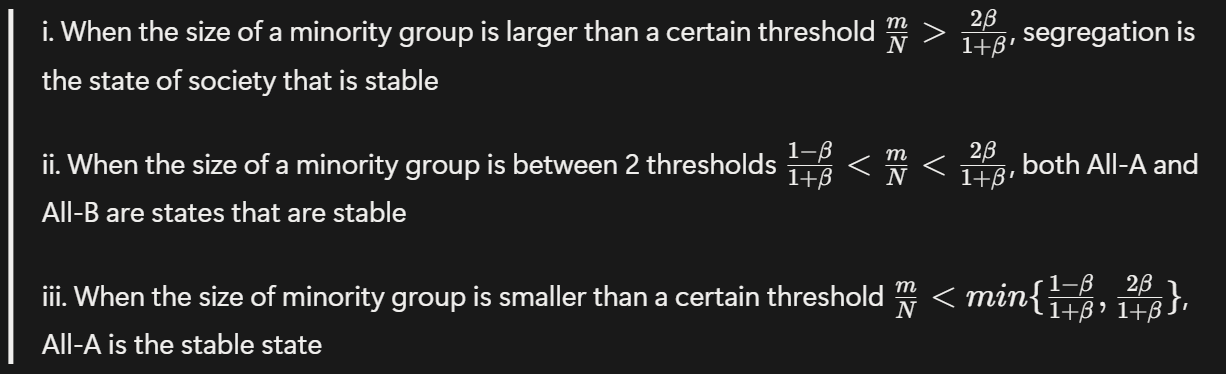
In human words: when the share of minority is small, the minority will choose to abandon its convention and adopt the majority convention. When the size of minority is intermediate, both outcomes are possible and we are not sure who will win. When the size of minority is large enough, there is enough people from the minority group to sustain its own conventions.
But minority cultures do spread
Yes, the results above almost mean that minority culture will never spread. But we do observe this in real life.
My brother was the only diver among my family, but managed to get everyone to spend our hard-earned money on diving gears.
You are in a WhatsApp group where 1 person started running and playing padel, but soon that becomes your go-to Sunday activities.
Sometimes bad practises can spread too. For instance you have a colleague who starts coming in slightly later to work. Slowly other people find it okay to come late too and soon people only start arriving at the office at 10/11am.
We think that this can be explained in two ways. First is minority premium. This means that the action of the minority is seen as superior, either because the action itself is superior, or because the minority group is seen as more elite that the rest of the people want to emulate.
The second way this can happen is if there is strong minority attachment. This happens when the minority is more attached to their own action and is more reluctant to change their action.
The result is a payoff matrix that looks slightly different.
Payoff matrices for minority premium case.

Payoff matrices for minority attachment case.

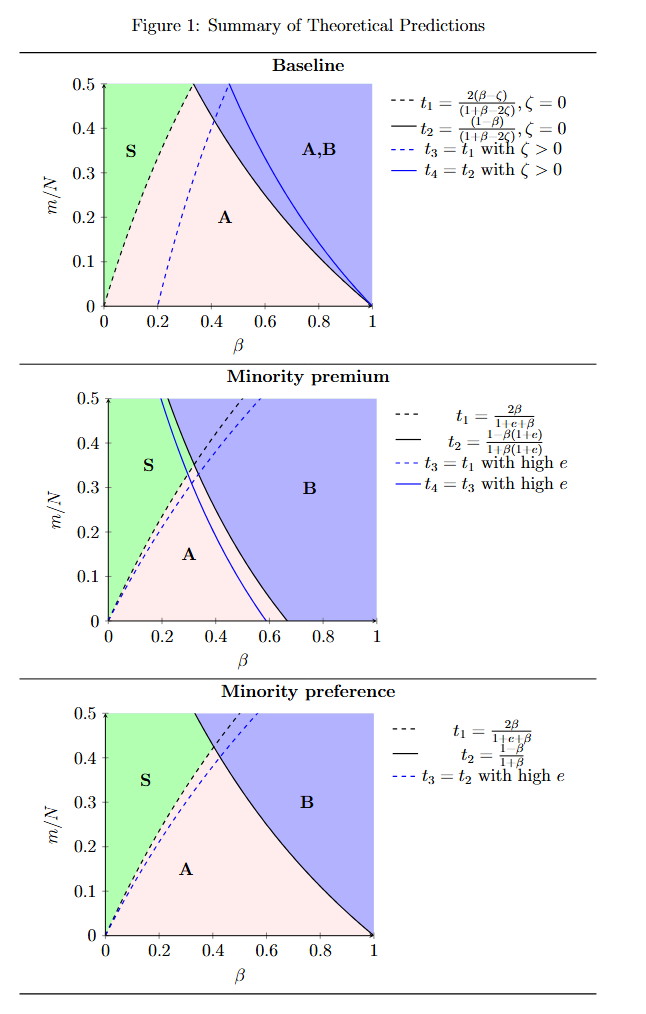
This leads to some changes to the resulting equilibrium. The results become:
When the size of a minority group is small, the minority will choose to abandon its convention and adopt the majority convention. When the size of minority is intermediate, segregation is the outcome (previously it could be A or B). When the size of minority is large enough, the majority will adopt the minority action (previously it was segregation).
The result seems to be in line with common sense. When the minority is very small, they may choose to adopt the majority action so that they can interact with more people. When the minority is mid-sized, each group is happy enough interacting within their own bubble. When the minority is large enough, the majority may want to emulate the minority because it elevates their own status, and this status elevation outweighs their discomfort in changing their behavior (in the case of minority premium). In the case of strong minority attachment, the majority may choose to compromise for the minority, since the latter is not willing to do so.
Below is a pictorial representation of the result.
The takeaway for you
We are always surrounded by people.
Sometimes we unknowingly get influenced by the people around us. If we are influenced positively, then that’s good for us. But if we get influenced negatively, then we want to be cognisant of that and think of how to change our environment to avoid being pulled down.
This also gets me thinking. Maybe the reason why influencers can be so powerful is because they are able to create a minority premium persona. We tend to admire those people because they have the physique that we want, they can go on business class flights, etc etc. We think of these attributes as enviable and therefore we adopt their behavior in hopes of becoming like them.
At the same time, this model may give you strategy to influence the people around you, in positive ways I hope. If you want to get your family to exercise, maybe show them examples of people they admire who also exercise. If you want your kids to sleep early, be headstrong enough to also sleep early (so that they don’t have anything fun to do in the evening) and do fun activities in the morning.
I hope you have fun reading this and do share with me your own experience navigating majority-minority conventions in the comment section!
P.S. If you are interested in reading the paper, with all the mathematical proofs, do leave a comment and I can share it with you when it is ready to be circulated :)

interesting, i wonder if we include another variable into the mix, that is historical value, to measure strong minority attachment