

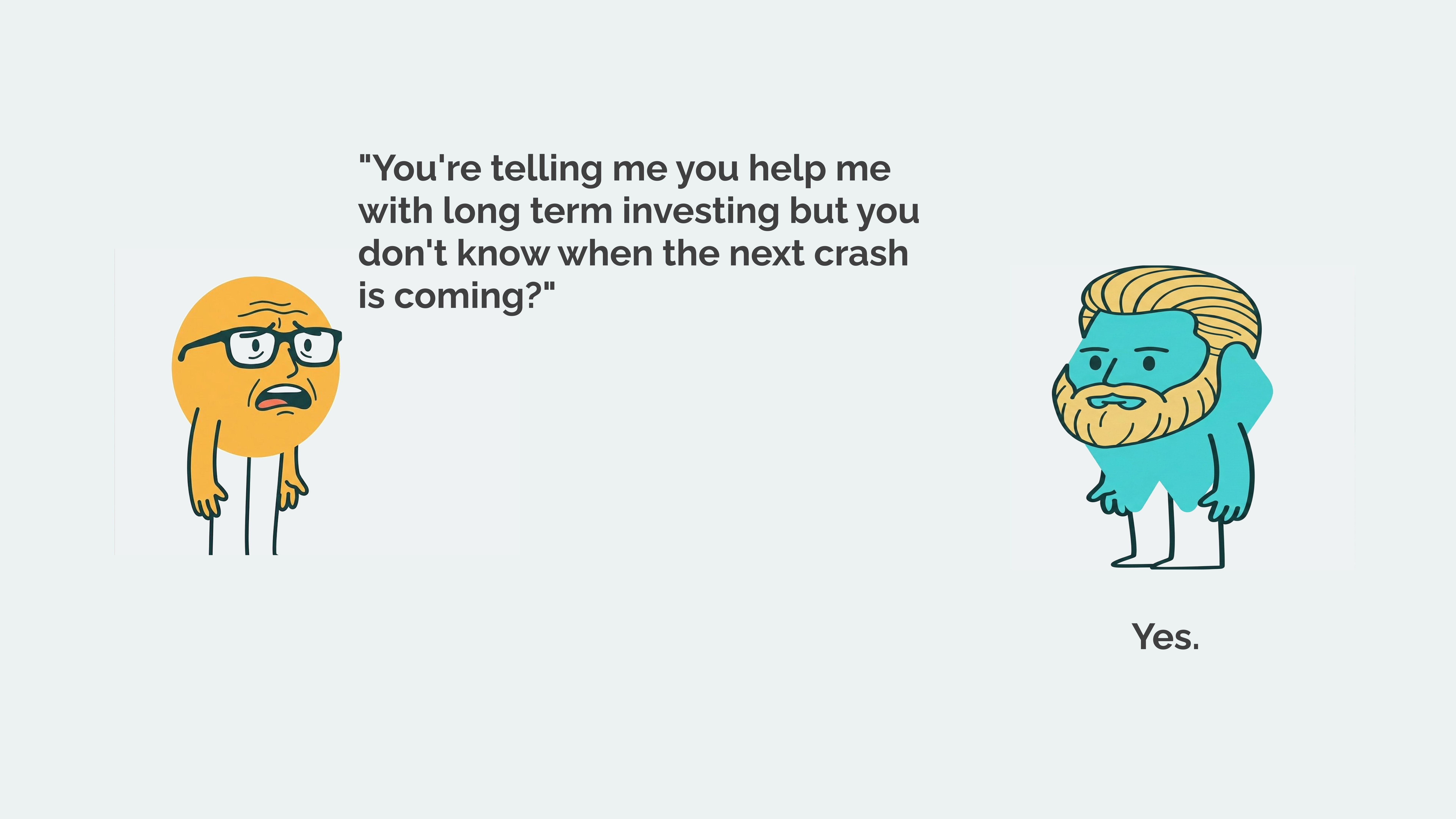
Last Thursday, Budi and I had an incredibly insightful conversation with Chris Angkasa. For those who missed it, I am very sorry. We are trying to push Substack to resolve a technical difficulty and get the live recording (for some reason it does not get saved in my draft). So if that gets recovered, we will publish it. But one key lesson that stood out, amongst many gems that were mentioned, was the emphasis to write down things that we do not know instead of things we know.
Let me repeat. One of the key lessons was to write down the things that we do not know (surrounding our investments) instead of the things we know.
This resonates deeply with Nassim Taleb’s concept of epistemocracy. In his book the Black Swan, Taleb discusses about an epistemocrat, a person who is well aware of the limitations of their knowledge. Instead of being overly confident towards exclaiming their knowledge prowess, they continue to question the truthfulness of their understanding. As a result, they will not be rushed to commit to a brash decision, they will make claims with adequate qualification and they will not be overzealous in their predictions of the uncertain future.
Taleb loves epistemocrats. He even goes to say that a utopia is a world that is ruled by epistemocrats. A society that gives their constant questioning of knowledge legitimacy. He calls that world an epistemocracy.
Well, it needs no convincing that such a world obviously does not exist today. A politician who claims that they don’t have a full picture about how the country would progress amidst global uncertainty will not gain votes. As the overconfident counterpart will make better promises and fare better in elections.
An entity who’s in the investment space (for e.g. Recompound) who does not know the 2nd order impact of a middle eastern conflict to an earnest public company selling ceramics to a domestic market in Indonesia will not gain as many followers as an investment guru who can “reverse engineer” and time when a market crash would occur.
But what’s the value of a person who admits the things they don’t know?
Understandably, you might be thinking:
“what’s so special about being an epistemocrat? All I am seeing is a timid mostly ignorant overthinker who is reluctant in making decisions with respect to their knowledge that they aren’t 100% sure about. How do they gain followers, influence, power and ultimately, money?”
Let me help you clear the confusion.
The value of an epistemocrat is not in the predictions they make. It’s in the predictions they refuse to make. They catalog their ignorance, writing down the things that is uncertain and unknowable. When they are tempted to want to know the unknowable, they avoid doing so.
Let me make this concrete. Picture a pool table.
It is a Friday night and you are playing billiard with your group of friends, a boys night out at a Jazz bar in Canggu. Now it is your turn to hit that 8 ball with the cue ball. Given the initial position of the cue ball, how hard you hit the 8 ball, you could mathematically compute the positions of the two balls after.

Guess what’s the endpoint? Well if you guess that the 8 ball will be in the top right corner as the cue ball remains in the same quadrant, then you are correct.

But, your friend, Bob, are given the position below as the end point after your turn.

Do you think Bob could guess where the 8 ball and the cue ball came from initially? I don’t think so. It is quite impossible because the cue ball and the 8 ball could start initially from anywhere! I hope you’d agree with me on this.
Therefore, it is borderline crazy to say with relative confidence where the ball come from, except Bob starts yapping:
Actually, look at the spin on the 8 ball — see how it’s slightly off-center? That tells you the cue ball struck it at roughly a 35-degree angle with a left English. The only position that produces that angle while leaving the cue ball where it is? Lower-left quadrant, two diamonds from the corner pocket. And your friend is right-handed, tends to favor an elevated bridge, which biases his break angle. Factor that in and honestly, there’s only one plausible starting configuration. Cue ball bottom-left, 8 ball dead center. I’d bet money on it.
Bob is so confident 😂
Well, here are more explanations that you might hear from time to time. They don’t confine themselves to you playing pool with your friends. The overconfidence extends to cover economy, politics, markets and so on.
Either in WhatsApp groups, family conversations or straight up “experts” fire chats. Below quotes might ring a bell. Although I have to give you fair warning that identifying causal errors in the made up sentences can feel unnatural*.*
On COVID-19: “If you were paying attention to the epidemiological data out of Wuhan in late December, the R0 alone told you everything. A novel respiratory virus with asymptomatic transmission in a hyper-connected global economy with daily international flights? There was only one outcome. I flagged this to my team on January 3rd and said — this goes global by March, lockdowns by April. The writing was on the wall. People just chose not to read it.”
On AI replacing jobs: “This was completely predictable. The job was 80% pattern recognition and template-based output — exactly the task profile that transformer models excel at. Once GPT-4 hit the market, anyone doing that kind of work had maybe 18 months. The companies that didn’t restructure were just in denial. I’ve been saying since 2022 — if your job can be described in a two-page SOP, it’s already gone.”
On climate change: “The science has been there since the 1800s — Arrhenius literally calculated CO2 warming in 1896. You had ice core data showing the correlation, satellite measurements confirming it since the 70s, and every single climate model trending in the same direction. When you combine that with post-industrial emission rates doubling every 40 years, there was only one trajectory. I’ve been saying since 2005 — we hit 1.5 degrees by 2030, extreme weather events triple by 2025. This wasn’t a prediction, it was arithmetic.”
You have got to love AI for saving me time digging through my WhatsApp and making me these texts. If needed, you can also use it as your thinking buddy by asking “where’s the causal error in the sentences that I am reading, what other range of possibilities that can occur”.
Value of not knowing things
Great, now that we have established the logical fallacies people are tempted to make in cocktail parties (and their corresponding mispredictions), we can move on to the central argument of this article:
which is being an epistemocrat maximises the chance of long term compounding.
Exponential Growth Bias
Now you have 5 seconds to think and guess. Promise? 5 seconds only. What is the answer to the below multiplication question?
Ok proceed once you have submitted your answer.
This is a math question that was asked in Kahneman and Tversky’s experiment. The median estimate of the group’s response was 512. When the question is flipped, starting from 8 times 7 and so on, the median estimate rises to 2,250. The correct mathematical answer is 40,320. If you guessed incorrectly, how surprised are you? Well certainly my guess was wrong when I first attempted the question.
This experiment tells us that we like to massively underestimate exponentially growing numerical series. We tend to fail to grasp the non-linear acceleration of growth, towards the end.
It is reported that the size of this underestimation is considerable: it is common for two-thirds of subjects to produce estimates that are at or below 10% of the actual (normative) value. For example in another test, many subjects expected a population growth target that would naturally be hit in 1979 to not be reached until the year 2000.
What else does research say about exponential growth bias? A number of things. But one thing that strikes the most to me is
people’s immunity to experience, education, and instruction when it comes to having this bias.
This bias occurs even if you have a strong mathematical background: A subject’s number of college credits in mathematics had no significant correlation with their ability to accurately predict the growth.
This bias occurs even if you have an extensive professional experience: An experiment testing professional decision-makers (members of a government Joint Conservation Committee) whose jobs require understanding growth processes showed they performed no better than naive undergraduate subjects. Daily experience with growing processes does not reduce the underestimation.
This bias even occurs after a direct instruction: When subjects were given a 75-minute lecture on exponential misperception, shown numerical examples, and given immediate feedback before being tested, their core perception of the mathematical exponent only improved slightly. Instead of truly understanding the non-linear curve, these “sophisticated” subjects simply attempted to evade the error by universally inflating all their guesses linearly across the board.
Wow, so compounding, being the 8th wonder of this world also happens to be something that is:
grossly underestimated
incomprehensible to our human brain
Now that we know that wrapping our mind into compounding is somewhat of a loss cause, let’s take another look at another property of compounding.
It cannot compound if it gets disrupted
Remember your overconfident friend, Bob, from a moment ago? Yes he’s the one who plays pool but he also likes to say things from time to time about the market.
“Look, it was obvious. The yield curve inverted in August, manufacturing PMI was contracting for three straight months, and the Fed was hiking into a slowing economy. Layer on the fact that insider selling hit a two-year high in Q3 and you had every textbook signal flashing red. Anyone who didn’t see this coming simply wasn’t reading the data. I told my subscribers in September — we’re six weeks from a correction. Sell everything.”
You listened to him as his prediction was correct. So a few months down the line, he muttered the exact same line of argument, this time about the geopolitical tension that is causing investors to be jittery. He decides to again, sell everything and you decide to follow suit.
Only to find out weeks later that geopolitical tension actually causes a steep rally to commodities and commodity producing stocks that you used to own. Because of Bob’s overconfident assertions, you missed 10 best days of your stock portfolio. Well not so much of a big deal right?
Wrong.
According to JP Morgan’s research, $10,000 invested in the S&P 500 from January 2005 to December 2024 would have grown to $71,750 if you stayed fully invested. Miss just the 10 best days — ten days out of roughly 5,000 trading days — and you’re left with $32,871. That’s more than half your wealth. Not because the market crashed. But because you weren’t there when it recovered.
And here’s what makes Bob especially dangerous: those 10 best days occurred within two weeks of the 10 worst days. The biggest rallies can happen right after the sharpest drops — exactly the moments when Bob has already convinced you to sell everything.
But being wrong is not the issue here, it is the act
I make wrong predictions all the time. I predicted that Manchester United would win the Premier League after Sir Alex Ferguson retired under David Moyes (you guys are probably thinking that I was hallucinating, I was not). When Cristiano signed for Man Utd again, I also thought that year was going to be the year. But nope. And you could probably see clearly that my wrong prediction of Man Utd’s glory is not a problem. Why? Because it costs me nothing except some dignity amongst my Liverpool “friends”.
Bob’s prediction cost you $38,879.
Bob’s overconfidence didn’t just make him wrong. It made him act. And the action — not the necessarily wrongness — is what killed the compounding.
So what would an Epistemocrat probably do?
They draw a sharp line between predictions they can enjoy (football, cocktail parties, WhatsApp group debates) and predictions they refuse to act on (portfolio decisions). I suppose like normal people, they still have opinions. But they stop letting opinions that fall on the “unknowable” list touch their money.
Overconfidence attacks compounding from the outside, through unnecessary action. Exponential growth bias attacks it from the inside, by making you feel like nothing is happening so why bother staying invested. The long-term investor is fighting on two fronts at the same time. The epistemocrat’s toolkit — writing down what you don’t know, resisting the urge to act on noise, accepting that years will feel flat — is a defense system against both attacks at once.
That is why being an epistemocrat can maximise your chance of long term compounding. Not because you know more than Bob. But because you know what not to act on.
All of this starts with one shameless/ful admission: we don’t know some things about macro and about our own investments. And yet we invest anyway.
Simple in theory. Counter intuitive to wrap our head around. Very hard to practice over and over again.
I sure hope Substack can find the Live recording with Chris Angkasa last Thursday. There were more gems covered in the talks. Or we can do another one 🙂
References
In case you’re interested in reading the materials consulted in writing this article, below are the entry points:
Taleb, N. N. (2007). The Black Swan: The Impact of the Highly Improbable. Random House. Chapter 12: “Epistemocracy, a Dream.”
Tversky, A. & Kahneman, D. (1974). “Judgment under Uncertainty: Heuristics and Biases.” Science, Vol. 185, No. 4157, pp. 1124–1131. [The 1 × 2 × 3 × ... × 8 anchoring experiment.]
Wagenaar, W. A. & Sagaria, S. D. (1975). “Misperception of Exponential Growth.” Perception & Psychophysics, 18, pp. 416–422. [The foundational paper on exponential growth bias: two-thirds of subjects estimating below 10% of the actual value, immunity to instruction and professional experience.]
Stango, V. & Zinman, J. (2009). “Exponential Growth Bias and Household Finance.” The Journal of Finance, 64(6), pp. 2807–2849. [More-biased households borrow more, save less, and favor shorter maturities.]
JP Morgan Asset Management (2025). Analysis of S&P 500 Total Return Index, January 2005 – December 2024. Cited in: Megan, L. “Selling Out During the Market’s Worst Days Can Hurt You, Research Shows.” CNBC, April 7, 2025. https://www.cnbc.com/2025/04/07/selling-out-during-the-markets-worst-days-can-hurt-you-research.html
Recompound Live with Chris Angkasa. [Recording pending recovery from Substack.]